Tel:
+86 13143444311
Email:sst@szsst88.com
Fax:+0086-755-27322278
Address:Building 9, First Industrial Zone, Tantou Industrial City, Songgang Street, Baoan District, Shenzhen 518105, Guangdong, China
Type:Metric Knurled Thumb Screws
Materials:Stainless Steel
Surface treatment:Plain
Head Type:Cap Head
Drive:Knurl only for hand drive; no slot, no cross recess, no socket
Thread:Metric machine thread, rolled 60 degrees, full to the head bearing face
Point:Blunt end with a small chamfer; no taper, no drill point
Forming:Single-die heading with knurl formed in the die, thread rolling, cleaning and passivation, sorting
Size:M1 M2 M3 M4 M5 M6 M7 M8 M9 M10 M14
Number:14-2
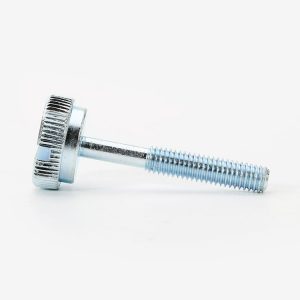
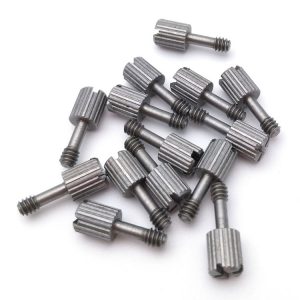
We manufacture metric knurled thumb screws with a knurled cup head and no slot or recess, so the fingers are the only drive, a rolled metric thread and a blunt end, in plain stainless steel. Head diameter, knurl, thread and length are taken from your drawing.
Watch the factory video·Email sst@szsst88.com
ISO 9001:2015 · Manufacturing since 1998 · 8,678+ customers · 89 countries and regions
Made to order – there is no stock catalogue. Each part is produced to your drawing, and production starts after drawing review and first-article approval.
Metric knurled thumb screws are machine screws with a knurled head that is turned between the fingers, and the recorded part on this page has no slot and no recess at all: the knurl is the only drive. It is stainless steel with a plain finish, a cup head and a metric machine thread, quoted from M1 to M14 with Number 14-2.
Knurled cup head. A short cylinder with a flat top and a knurl around the rim. The flat top gives the head a clean face, and the knurl is what the fingers grip — there is nothing else on the head to turn.
No drive. No slot, no cross, no socket. That is the defining feature: a metric knurled thumb screw of this type can only be tightened by hand, which limits the torque and also means no tool can be used later to add or remove torque without gripping the knurl itself.
Metric thread. Diameter and pitch in millimetres — M3 × 0.5, M4 × 0.7, M5 × 0.8 — for a tapped hole or a nut. The pitch is part of the size and does not interchange with a fine pitch of the same diameter.
Machine thread. A rolled thread for a tapped hole, with a blunt end. This is a machine screw, not a self-tapping one: the thread it engages already exists.
Plain stainless. The alloy protects the part, so the knurl and the thread are bare alloy at their formed size — which on a knurl is what keeps the grip the drawing intended.
The cup head and the knurl are formed in one heading route: the head is upset with its flat top and then the straight knurl is rolled or formed into the rim. Cutting a knurl would leave burrs at the flute ends and a surface that wears the fingers, which on a part with no other drive would matter at once.
The head diameter is the leverage. At roughly twice to two and a half times the thread, a metric knurled thumb screw gives a hand enough grip to seat a joint without a tool — and that ratio is the whole torque specification on this part, because the fingers are the only drive there is.
The thread is rolled from under the head to the end. Rolling work-hardens the flank and leaves a smooth surface, and it is what lets the screw run in and out by hand without galling the thread after a few cycles.
The end is blunt with a small chamfer, because the hole is tapped and there is nothing to start. The chamfer is what lets the first thread enter cleanly when the screw is offered up by hand and there is no tool to force it.
Cleaning and passivation follow, and the recorded finish is plain. Nothing is applied to the knurl, which matters: a coating on the flutes rounds them and a part with no other drive then becomes hard to turn at all.
The family is quoted from M1 to M14, with M1, M2, M3, M4, M5, M6, M7, M8, M9, M10 and M14 in the recorded range. Custom lengths up to 2,000 mm are subject to DFM review after drawing submission; metric knurled thumb screws are mostly used from M3 to M8, where the head is still comfortable between the fingers and the thread still carries a useful load.
| Item | How it is defined | What we control |
|---|---|---|
| Head diameter | About 2 to 2.5 times the thread | Checked on the projector |
| Head height | Short cylinder, flat top | Measured from the bearing face |
| Knurl | Straight flutes round the rim | Pitch and depth checked on the first article |
| Thread | Metric machine thread, rolled | Gauged per batch |
| End | Blunt with a small chamfer | Checked on the first article |
| Length | From under the head to the end | Measured on the shop plate |
The head diameter is the number to agree first, because it is the only way the joint can be tightened. A head that is too small cannot be turned hard enough by hand for the joint; one that is too large needs more room around the fixing than the panel has, which on a row of thumb screws is usually what decides the design.
The knurl pitch is the second number. A coarse knurl grips better in a glove and hurts a bare hand; a fine knurl is comfortable and slips sooner. Both are valid, and the drawing should say which — because on this part there is no fallback drive if the fingers cannot hold.
A thumb screw with no slot is a deliberate restriction, and it is worth being clear about what it buys and what it costs before the part is specified.
| Feature | What it gives | What it costs |
|---|---|---|
| No drive at all | Cannot be over-tightened, cannot be undone with a tool | Cannot be tightened past hand torque either |
| Knurled rim | Fingers get grip on a stainless head | Grip is limited by hand strength |
| Cup head | Flat top, clean face | Nothing to grip if the knurl is worn |
| Machine thread | Runs in and out freely | Backs out under vibration |
| Plain stainless | Knurl stays sharp; no coating to round it | Galls against stainless |
The value of having no drive is that the joint cannot be forced. A slot invites a technician to add torque with a driver, and that is how a thumb screw strips its thread or crushes a gasket; a knurled head with nothing else on it sets a natural limit at what a hand can do. On a joint designed around finger torque, that is a feature.
The cost is the same limit in the other direction. When a joint has been in place and needs to come out, there is no tool to add leverage: the head has to be gripped as it is, and if it is tight the only recourse is pliers on the knurl — which marks a stainless head permanently. Where a joint is likely to seize, the version with a recess is the practical choice.
The absence of a drive also means the thread has to do the locking. A plain machine thread will back out under vibration, and on a thumb screw the usual answers are a nylon patch or a thread insert. That is a decision for the drawing, not something the shop can add once the parts are made.
The recorded finish is plain stainless with no coating. On a knurled head that is not only a protection choice: a coating fills the flute roots and rounds the crests, and on a part with no other drive that changes how it feels in the hand.
| Option | What it does | Effect on knurl and thread | Typical use |
|---|---|---|---|
| Cleaned and passivated | Removes free iron after forming | Knurl as formed | General and wet service |
| Satin bead blast | Even matte face | Softens the flute crests slightly | Visible equipment |
| Bright passivated | Cleaner, brighter surface | No dimensional change | Instruments and appliances |
| Electropolished | Levels micro peaks | Rounds crests a little; grip re-checked | Hygienic service |
| Dry film on the thread | Reduces galling in stainless joints | Film checked in the knurl | Joints opened often |
Passivation is the one treatment that can be added without changing the grip. It removes the embedded iron from the knurl roots — where a stainless part starts to corrode first — and leaves the geometry alone, so the first article does not have to be re-judged by hand.
A dry film is the exception. It is applied to the thread to stop galling, and a little of it inevitably reaches the knurl; where it is specified, the first article is turned by hand after the film rather than before, because grip is the function here.
Three assemblies where a fixing has to be adjustable by hand and must not be over-tightened:
| Where it sits | The screw holds a module or a cover that is removed by hand during setup, where the head is the only thing that turns it. |
| When it goes wrong | A screw with a slot invites a driver and the panel boss strips, and a head that is too small cannot be turned with gloves. |
| Why it happens | The panel is dark or visible, the joint is opened often, and no tool is wanted near the electronics. |
| What we control | Head diameter and knurl checked by hand on the first article, thread gauged per batch. |
| Where it sits | The screw locks a plate, a rail block or an accessory where the fixing is adjusted between setups and has to stay finger-tight. |
| When it goes wrong | A tool drive on a small head marks the finish, and a thread that backs out loses the setting. |
| Why it happens | The equipment is small, it is adjusted often, and the surface is finished. |
| What we control | Knurl grip checked by hand, head height checked against the accessory, thread gauged. |
| Where it sits | The screw holds a small cover or a sensor mount that is removed for cleaning, on stainless equipment. |
| When it goes wrong | A slot or a socket traps residue that a knurl does not, and a plated head loses its coating in the wash. |
| Why it happens | The equipment is stainless, it is washed, and the cover comes off daily. |
| What we control | Grade and passivation recorded, knurl checked for burr, thread gauged per batch. |
Four reasons that matter on a hand-drive part, each tied to what the drawing has to prove:
|
Head and knurl reviewed together
The head diameter, the knurl pitch and the thread size are reviewed as one set, so a head that a hand cannot turn is raised before tooling. Basis: Head and knurl reviewed as one set. |
Head, knurl and thread in one route
The cup head is upset with its flat top, the knurl is formed into the rim, and the metric thread is rolled to a blunt chamfered end. Basis: One route from wire to passivated screw. |
|
Knurl and thread checked on the part
The knurl is checked by turning the first article by hand, and the thread is gauged per batch in the finished condition. Basis: First article turned by hand. |
First article to repeat production
The first article fixes the drawing revision, wire heat, knurl die, die set and thread roll; repeat orders are compared against that record. Basis: First article signed off before the batch is released. |
Shi Shi Tong forms these metric knurled thumb screws on a single-die header that upsets the cup head and forms the straight knurl into the rim, then rolls the metric thread to a blunt chamfered end. The parts are cleaned and passivated. The first part of every run is measured on the head, turned by hand and gauged on the thread, before the batch continues.


|

|
The knurl die is the tool that decides the part. A worn die leaves flutes that look correct and slip in the fingers, and on a screw with no slot there is no second way to turn it — the part simply fails to do its job. That is why the knurl is checked by hand rather than by gauge, and the die is changed on that judgement.
What decides whether metric knurled thumb screws pass is the head, the knurl, the thread and the surface. The inspection agreement covers those, and the criteria come from the drawing.

Head and knurl on the projector |

Thread gauged per batch |

Hardness testing of the wire |

Salt-spray testing where the service requires it |
The knurl is checked by hand and then by measurement. Diameter across the flutes is a dimension; whether a thumb can turn the screw with the joint at torque is a judgement, and on this part — with no slot to fall back on — it is the judgement that matters. The first article is turned by hand and the result is recorded.
The head is checked for height and for the flat top, because a cup head that is domed is a different head. The thread is gauged at the size the batch was run to, and the blunt end is checked so that a hand-started screw enters cleanly.
Every shipment of metric knurled thumb screws is traceable to the wire it was made from. The grade and heat number are recorded on the material certificate supplied with the parts, and the inspection records follow the criteria agreed on the drawing.

ISO 9001:2015 |

RoHS test report |

Registered trademark |

Patent: security screw and driver |
With each batch we supply the material certificate, the inspection record for the criteria on the drawing and, where it is listed, the third-party report for the material. The documents carry the drawing revision and the batch number, so the paperwork can be matched to the parts.
More than 8,678 customers in 89 countries and regions have ordered from Shi Shi Tong; 87% of orders come from repeat customers and 56% through referrals. Most projects follow the same route: drawing review, first-article approval, then batches checked against that sample. On a hand-drive part the first article is handled, not only measured, because the grip of the knurl is the specification. Buyers visit during the process to review samples and to see how the knurls are formed.
|
8,678+
customers served
|
87%
of orders from repeat customers
|
56%
of orders through referrals
|
89
countries and regions shipped to
|
Buyers and quality engineers visit for sample review, process discussion and supplier audits; the visit is arranged around production so the header and the knurling station can be seen on the day the parts run.

Customer group visit – sample review |

Customer group visit – process discussion |

Customer group visit – factory tour |

Customer visit – project kick-off |

Danish customer – drawing review |

Industry exhibition – meeting customers |
A machine screw with a knurled head turned between the fingers. The recorded part has no slot or recess, so the knurl is the only drive.
So the joint cannot be over-tightened. A slot invites a driver, and a thumb screw with a driver behind it strips its thread or crushes a gasket.
Only by gripping the knurl, which marks a stainless head. Where a joint is likely to seize, the version with a recess is the practical choice.
A plain machine thread can under vibration. A nylon patch or a thread insert is specified on the drawing where that matters.
M3 to M8 covers most hand-drive joints; the head diameter, not the thread, is what limits how hard the joint can be tightened.
Thread size and pitch, head diameter and height, knurl pitch and depth, length and datum, stainless grade and finish.
How a metric knurled thumb screw project runs from drawing to repeat delivery:
|
1
Send the drawing or sample
|
→ |
2
Head and knurl review
|
→ |
3
First article turned by hand
|
→ |
4
Batch production and repeat orders
|
Each step is confirmed with you before the next one starts; the drawing revision from the first article is what repeat orders are checked against.
For a quotation, send the drawing with the thread size and pitch, head diameter and height, knurl pitch and depth, length and datum, stainless grade and finish.
|
Thread and pitch
|
Head diameter and height
|
Knurl pitch
|
|
Length and datum
|
Grade
|
Finish
|
Sending a drawing? The form below does not take attachments. Email the PDF, DXF or STEP file to sst@szsst88.com with the part name and quantity in the subject line – the drawing is reviewed and a quotation follows.

 +86 13143444311
 sst@szsst88.com