Tel:
+86 13143444311
Email:sst@szsst88.com
Fax:+0086-755-27322278
Address:Building 9, First Industrial Zone, Tantou Industrial City, Songgang Street, Baoan District, Shenzhen 518105, Guangdong, China
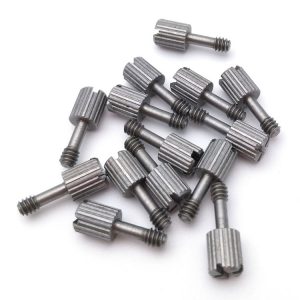
Type:Stainless Thumb Screw
Materials:Stainless Steel
Surface treatment:Plain
Head Type:Cap Head
Drive:No Drive (Knurled)
Thread:Machine Thread
Point:Blunt
Forming:Turned
Size:M1 M2 M3 M4 M5 M6 M7 M8 M9 M10 M14
Number:552
We make stainless thumb screws with a straight-knurled cap head, no drive recess and a machine thread, quoting them from M1 to M14 in passivated A2 or A4. Head diameter, knurl, thread and grade come from your drawing, and the first article is turned by hand in your insert.
Watch the factory video·Email sst@szsst88.com
ISO 9001:2015 · Manufacturing since 1998 · 8,678+ customers · 89 countries and regions
Made to order – there is no stock catalogue. Each part is produced to your drawing, and production starts after drawing review and first-article approval.
A stainless thumb screw is a screw with a knurled head large enough to be turned between finger and thumb, with no drive recess at all, made in stainless so that a part handled constantly does not corrode. The recorded item on this page is stainless with a plain finish, a knurled cap head and a machine thread, quoted from M1 to M14 with Number 552.
Knurled head. A straight knurl cut or rolled around a cylindrical head. The ridges give the fingers something to grip, and the diameter gives them the leverage to tighten the screw by hand alone.
No drive. There is no slot and no socket. The part is designed to be turned by hand, which limits the torque it can apply and is the whole point of the form.
Machine thread. A rolled thread with a blunt chamfered end, made for a tapped hole or a nut. It runs in and out without cutting, which suits a joint that is opened and closed by hand.
Stainless, plain. The alloy is the protection, and passivation restores the oxide film after the knurl is formed. There is no coating to wear through on the ridges, which on a knurled head would show within the first few uses.
A stainless thumb screw has no recess because the knurl is the drive. The head is made larger than the thread needs, with a straight knurl around the side, and the hand applies torque to the outside diameter rather than to a socket at the centre. Everything about the geometry follows from that: head diameter for leverage, knurl depth for grip, head height for the fingers.
The knurl itself is a set of ridges formed by a knurling tool that presses into the rotating head. On stainless the tool has to work harder than on brass or aluminium, because the material work-hardens under the roller; a knurl that is rolled with too little pressure comes out shallow and shiny, with ridges that look like decoration and grip like it too.
The relationship between head diameter and thread is what makes the part usable. Too small a head and the fingers cannot produce enough torque to seat the joint; too large and the head fouls adjacent parts or looks out of scale. On the recorded part the knurled head is a cap head form, so the bearing face is a full flat annulus and the head sits in a counterbore when one is provided.
On a stainless thumb screw the end of the thread is blunt and chamfered. A thumb screw is meant to be run in and out repeatedly, and a chamfer that is cut cleanly is what stops the first turn from picking up. On stainless, a picked thread will gall rather than yield, which ends with a screw that cannot be removed.
The finish is plain because nothing else is possible. Stainless cannot be anodised — anodising grows an oxide on aluminium and on titanium, not on steel — so a dark, hard finish on this material has to come from a coating rather than from the metal.
The family is quoted from M1 to M14, with M1, M2, M3, M4, M5, M6, M7, M8, M9, M10 and M14 in the recorded range. Custom lengths up to 2,000 mm are subject to DFM review after drawing submission; on stainless thumb screws the head diameter and the knurl are quoted with the thread, because they set the torque a hand can apply.
| Item | How it is defined | What we control |
|---|---|---|
| Head | Knurled cap head, straight knurl | Head diameter, height and knurl depth |
| Bearing face | Flat annulus | Face flatness and squareness |
| Thread | Machine thread | Pitch and length, gauged per batch |
| End | Blunt, chamfered | Chamfer cut, not deburred |
| Finish | Plain stainless, passivated | Surface condition and tone |
| Length | From under the head to the end | Measured on the shop plate |
Head diameter is the functional dimension on a thumb screw. It is the lever arm the hand works with, and it is chosen from the torque the joint needs and the space around it: a head that is comfortable in the fingers but fouls a neighbouring part is the wrong head, whatever the drawing says about the thread.
Length is measured from under the head, because that face bears. A thumb screw that is run in and out every day wears the bearing face and the first thread most, so the length is checked on that datum and the face is checked for flatness rather than assumed.
Three features define a stainless thumb screw: the knurled head, the absent drive and the machine thread. Together they describe a part whose torque is set by a hand rather than by a tool, and that has consequences for the joint.
| Feature | What it gives | What it costs |
|---|---|---|
| Knurled head | Turned by hand, no tool needed | Torque limited to what fingers produce |
| No drive | Nothing to strip; nothing to find in a toolbox | Cannot be tightened with a driver |
| Machine thread | Runs in and out repeatedly | Needs a tapped hole or a nut |
| Plain stainless | No coating to wear on the ridges | Cannot be anodised or blackened by anodising |
| Cap head form | Full bearing face in a counterbore | Needs the counterbore to be provided |
The torque a hand can apply through a knurled head is small: enough to seat a joint that is designed for finger-tight, and not enough to compress a gasket or to resist vibration on its own. That is why a thumb screw usually appears on a joint that is opened often and does not need to be tight, or alongside a locking feature when it does.
The second consequence is the assembly instruction. “Hand tight plus a quarter turn” is not a specification and cannot be inspected; what can be specified is a head diameter and a thread that make hand-tight sufficient, and a joint that does not rely on the screw for preload. Where a customer needs repeatable clamp load, the answer is a driven head, not a longer knurl.
Stainless thumb screws are finished plain and passivated. Nothing is added, so the knurl is exactly as formed and the ridges keep their edge, which is what the grip depends on.
| Material and finish | How it protects | Effect on knurl and thread | Typical use |
|---|---|---|---|
| Stainless, plain | Passive chromium oxide film | None; knurl as formed | Handled and washed parts |
| Aluminium, black anodised | Grown oxide layer, dyed | A few microns; knurl re-checked | Lightweight dark thumb screws |
| Steel, black oxide | Conversion film, oiled | No measurable build | Unseen instrument parts |
| Steel, nickel plated | Hard barrier deposit | Thicker; knurl softened by build | Bright visible thumb screws |
| Steel, zinc plated | Sacrificial zinc | A few microns; re-checked | Cost-driven indoor work |
The black anodised look that customers often ask for on a thumb screw belongs to aluminium, not to stainless. Anodising is a process for aluminium and titanium; on steel it does not exist. Where a dark stainless thumb screw is needed, the honest options are a coating on the stainless or a change of base metal to anodised aluminium, and the two have different strength and weight.
Stainless also has the galling behaviour to plan for. A stainless thumb screw run in and out of a stainless insert every day will eventually seize, and a seized thumb screw is worse than a seized machine screw because there is nothing to put a tool on. A dry-film lubricant on the thread, or a different grade for the insert, prevents it.
Three assemblies where a stainless thumb screw is the right fixing:
| Where it sits | The screw opens an access panel or holds a module where the joint is opened by an engineer without tools and the panel is handled daily. |
| When it goes wrong | A driven head needs a tool that is never where it should be, and a screw that is over-tightened strips the insert the first week. |
| Why it happens | The joint is serviced often, the parts are indoors, and no tool is available. |
| What we control | Knurl depth and head diameter checked, thread gauged, bearing face checked flat. |
| Where it sits | The screw holds a guard or a cover that is removed for cleaning or adjustment, where speed matters more than clamp load. |
| When it goes wrong | A tool-driven screw slows every changeover, and a plain head with no grip cannot be turned by hand. |
| Why it happens | The guard is removed daily, and the joint does not need preload. |
| What we control | Knurl checked for grip, thread checked for galling, length sized to the cover. |
| Where it sits | The screw fixes a cover or a bracket where the part is washed, the fixing is handled by hand and a plated screw would lose its coating. |
| When it goes wrong | A chipped coating traps residue, and a corroded thread seizes before it is a year old. |
| Why it happens | The joint is washed often, handled by hand, and visible. |
| What we control | Passivation checked, grade confirmed, knurl and thread measured. |
Four reasons that matter on stainless thumb screws, each tied to what the drawing has to prove:
|
Head and knurl reviewed with the joint
The head diameter, the knurl and the joint it tightens are reviewed as one set, so a head that gives too little leverage or fouls a neighbour is raised before the tool is set. Basis: Head and knurl reviewed with the joint. |
Heading, knurling and threading in one route
The cap head is formed, the straight knurl is rolled and the machine thread is produced in one route, so the head and the thread stay concentric. Basis: One route from bar to finished screw. |
|
Knurl and thread checked on the part
The knurl is checked for depth and pitch, the head for diameter and face flatness, and the thread is gauged per batch. Basis: First article checked by hand and by gauge. |
First article fixes the setting
The first article fixes the alloy, the knurling tool, the thread pass and the passivation; repeat orders are compared against that record. Basis: First article signed off before the batch is released. |
Shi Shi Tong makes these stainless thumb screws from stainless bar: the head is turned and faced, the straight knurl is rolled onto the head, the machine thread is cut or rolled to a blunt chamfered end, and the parts are passivated before packing. The first part of every run is measured on the head, checked for knurl depth and turned by hand in a sample insert before the batch continues.


|

|
Knurling stainless is where the process shows. The material work-hardens under the roller, so the tool has to be fed decisively; a hesitant pass leaves shallow ridges that look right under a light and slip under a thumb. The knurl is judged by hand on the first article, because that is the only test that matches how the part is used.
What decides whether stainless thumb screws pass is the knurl, the head, the bearing face, the thread and the alloy. The inspection agreement covers those, and the criteria come from the drawing.

Head and knurl on the projector |

Thread gauged per batch |

Hardness checked on the formed head |

Salt-spray testing of the stainless grade |
The knurl is checked for depth, pitch and the condition of the ridges, and the head for diameter and height. A knurl that is shallow is the defect that no dimensional check catches: it measures inside a tolerance on the outside diameter and still grips like a polished cylinder.
The bearing face of a stainless thumb screw is checked for flatness and squareness to the axis. A thumb screw that leans when it is seated is the failure a user notices first, because the head is what they are holding while it happens.
The thread is gauged and turned by hand in a sample insert. On stainless, a thread that is a shade tight will gall on the third or fourth cycle rather than the first, so the sample is run in and out several times rather than once.
Every shipment of stainless thumb screws is traceable to the bar they were made from and to the passivation batch. The grade and heat number are recorded on the material certificate supplied with the parts, and the inspection records follow the criteria agreed on the drawing.

ISO 9001:2015 |

RoHS test report |

Registered trademark |

Patent: security screw and driver |
With each batch we supply the material certificate, the inspection record for the criteria on the drawing and, where it is listed, the third-party report for the grade or the passivation. The documents carry the drawing revision and the batch number, so the paperwork can be matched to the parts.
More than 8,678 customers in 89 countries and regions have ordered from Shi Shi Tong; 87% of orders come from repeat customers and 56% through referrals. Most projects follow the same route: drawing review, first-article approval, then batches checked against that sample. On stainless thumb screws the first article is also turned by hand in the customer’s insert, because the grip is the function and only a hand can judge it. Buyers visit during the process to review samples and to see how the heads are knurled.
|
8,678+
customers served
|
87%
of orders from repeat customers
|
56%
of orders through referrals
|
89
countries and regions shipped to
|
Buyers and quality engineers visit for sample review, process discussion and supplier audits; the visit is arranged around production so the lathes and the knurling station can be seen on the day the parts run.

Customer group visit – sample review |

Customer group visit – process discussion |

Customer group visit – factory tour |

Customer visit – project kick-off |

Danish customer – drawing review |

Industry exhibition – meeting customers |
The knurled head is the drive. A recess would add a feature that a hand cannot use and that would collect dirt; the ridges are what the fingers work against.
Only as tight as a hand can manage through a knurled head. That is enough to seat a joint designed for finger-tight and not enough to preload a gasket.
Not by anodising. Anodising is an aluminium and titanium process; stainless needs a coating instead, or a change of base metal to anodised aluminium.
Stainless on stainless can gall, and a thumb screw that seizes has no head to put a tool on. A lubricant on the thread or a different grade for the insert prevents it.
In the weather, yes, subject to the grade. A2 is fine inland; a coastal or chlorinated joint needs A4.
Head diameter and height, knurl type and depth, thread size and length, length under the head, stainless grade and passivation.
How a stainless thumb screw project runs from drawing to repeat delivery:
|
1
Send the drawing and the joint it tightens
|
→ |
2
Head, knurl and thread review
|
→ |
3
First article turned by hand in your insert
|
→ |
4
Batch production and repeat orders
|
Each step is confirmed with you before the next one starts; the drawing revision from the first article is what repeat orders are checked against.
For a quotation, send the drawing with the head diameter and height, the knurl type and depth, the thread size and length, the length under the head, and the stainless grade and passivation.
|
Head diameter
|
Head height
|
Knurl type
|
|
Thread and length
|
Length under head
|
Grade
|
Sending a drawing? The form below does not take attachments. Email the PDF, DXF or STEP file to sst@szsst88.com with the part name and quantity in the subject line – the drawing is reviewed and a quotation follows.

 +86 13143444311
 sst@szsst88.com