Tel:
+86 13143444311
Email:sst@szsst88.com
Fax:+0086-755-27322278
Address:Building 9, First Industrial Zone, Tantou Industrial City, Songgang Street, Baoan District, Shenzhen 518105, Guangdong, China
Type:Stainless Steel Thumb Screws
Materials:Stainless Steel
Surface treatment:Plain
Head Type:Cap Head
Drive:Slotted
Thread:Machine Thread
Point:Chamfered
Forming:Turned From Bar
Size:M1 M2 M3 M4 M5 M6 M7 M8 M9 M10 M14
Number:188
We make stainless steel thumb screws from stainless bar, turned with a knurled cylindrical head, a driver slot and a machine thread, quoting them from M1 to M14. Head, knurl, slot, undercut and alloy come from your drawing, and the first article is turned by hand in your own joint.
Watch the factory video·Email sst@szsst88.com
ISO 9001:2015 · Manufacturing since 1998 · 8,678+ customers · 89 countries and regions
Made to order – there is no stock catalogue. Each part is produced to your drawing, and production starts after drawing review and first-article approval.
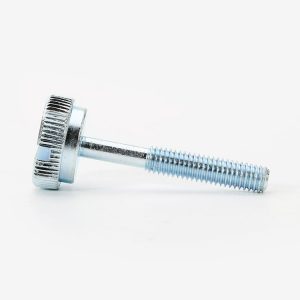
Stainless steel thumb screws are fasteners turned from stainless bar with a knurled cylindrical head, a slot across the top and a machine thread, made so that a joint can be opened by hand. On the recorded item the head is knurled for the fingers and slotted for a driver at the same time, and the Type field classes it as a knurled or captive screw. The family is quoted from M1 to M14 with Number 188.
Knurled cylindrical head. A straight knurl on the side of a plain cylinder, gripped by the fingers. It gives a second way to turn the part without a tool.
Slot. A single straight slot across the top of the head. It takes a flat screwdriver and gives the joint a torque the hand cannot reach.
Machine thread. A turned thread for a tapped hole or a nut, ending in a small chamfer.
Plain stainless. Passivated and uncoated, so the knurl and the slot are exactly as cut.
Captive option. An undercut behind the thread that lets the screw be held in the panel by a retaining ring, so it cannot be lost when the joint is opened.
Most fasteners give you one way to turn them. A knurled thumb screw gives two: the fingers on the knurl, and a screwdriver in the slot. That combination is not decoration — it is how a part can be adjusted by hand in service and still be tightened properly during assembly, without becoming two different parts in the store.
The two drives want different things from the head. The knurl wants a tall cylinder with enough surface for the fingers; the slot wants material across the whole top face, because a slot is a cut that removes the middle of the head. A tall knurled cylinder with a slot across it satisfies both, which is why the head of a stainless steel thumb screw looks the way it does and why a low head cannot carry the same combination.
The dividing line between the two drives is a design decision. In service, the joint is opened by hand and closed by hand, and the slot is not used; at assembly, the slot takes the torque that a hand cannot reach. If the joint needs that torque on every opening, a thumb screw is the wrong part and a socket head is the right one — the slot is for assembly, not for maintenance.
That is where the captive version comes in. On the recorded item the Type field is a knurled or captive screw, and a captive stainless steel thumb screw normally carries an undercut behind the thread where a retaining ring sits. The screw stays attached to the panel when the joint is opened, so nothing is dropped into the machine, and the part always goes back into the same hole.
The undercut is where the trade shows. It takes length that would otherwise carry thread, so a captive screw has less engaged thread than the same screw without one; and it makes the shank a turned feature with a stress concentration, which is fine in a hand-tightened part and is not what you want on a fastener tightened with a wrench. A captive screw is a design compromise in favour of not losing the part.
The recorded range is M1 to M14, covering M1, M2, M3, M4, M5, M6, M7, M8, M9, M10 and M14. Custom lengths up to 2,000 mm are subject to DFM review after drawing submission. For a stainless steel thumb screw the quotation carries head diameter, head height, knurl pitch, slot width and depth, and the undercut if it is captive.
| Item | How it is defined | What we control |
|---|---|---|
| Head | Cylindrical, knurled | Head diameter, height and knurl pitch |
| Slot | Single straight slot | Slot width, depth and burr |
| Thread | Machine thread, turned | Pitch and length, gauged per batch |
| Undercut | Captive groove (if specified) | Groove diameter and position |
| Finish | Plain stainless, passivated | Surface condition and film |
| Length | Under the head to the end | Measured on the shop plate |
Length is measured from under the head. On a captive screw the useful number is the length that passes through the panel plus the length that engages the thread, and the undercut sits between them; a drawing that specifies only an overall length leaves the split between those two to the maker.
Slot width is worth putting on the drawing even though a screwdriver will fit almost anything. A slot that is too narrow binds the blade and lifts a burr at the edge; one that is too wide lets the blade rock and chews the slot floor. On a stainless part both are permanent, because there is no coating to hide the damage.
Three features define this part: the knurled head, the slot and the stainless body. The first is for the hand, the second for the driver, and the third is what makes the part usable on a wet machine without rust at the knurl, which is the reason to buy stainless steel thumb screws instead of plated ones.
| Feature | What it gives | What it costs |
|---|---|---|
| Knurled cylinder | Finger grip, no tool | Torque limited by the hand |
| Slot | Driver torque when it is needed | A cut across the head; burr risk |
| Tall head | Room for both knurl and slot | Projects above the panel |
| Captive undercut | Screw stays with the panel | Less thread; a stress step |
| Plain stainless | No rust, no coating to wear | Galls against stainless |
The tall head is the visible cost. A part that has to be gripped by fingers and cut by a slot cannot be low, so it stands proud of the panel and everything in a workshop catches on it eventually. Where clearance matters more than hand access, a low head with a single drive is the honest alternative.
The stainless body is what makes the part last. A knurl is a surface that gets handled, and a plated knurl loses its plate in the hand; a stainless knurl only dulls. The one thing to watch is galling: stainless on stainless seizes, and a thumb screw is exactly the part that gets turned until it does.
The recorded finish is plain, passivated stainless. Nothing is added, so the knurl keeps its edges and the slot keeps its width after plating — which on a part this small is not a detail, because a few microns change both. The pitting resistance is therefore the alloy’s own, with nothing on top to help.
| Option | How it protects | Effect on knurl and slot | Typical use |
|---|---|---|---|
| Stainless 303, passivated | Passive film; free-machining alloy | Knurl and slot as turned | General indoor and dry |
| Stainless 304, passivated | Stronger passive film | Slightly harder to machine | Outdoor and food areas |
| Stainless 316, passivated | Molybdenum in the film | Machines less freely | Coastal, marine, chemical |
| Steel, nickel plated | Barrier deposit | Knurl rounds; plate wears in hand | Decorative indoor |
| Aluminium, anodised | Thick oxide layer | Sharp knurl dulled by the oxide | Lightweight panels |
The alloy choice is the one that matters here. A free-machining stainless such as 303 machines beautifully — which is why turned knurled parts are usually made from it — but the sulphur that makes it free-cutting also lowers its resistance to chlorides. In a coastal or washdown application the part should be made from 316, and the extra machining cost is the price of the alloy.
On a thumb screw, galling is the failure that is noticed. A stainless screw turned into a stainless nut or boss can seize on the first assembly, and a seized thumb screw has nothing to grip with a tool except a slot that was not designed for high torque. A dry-film lubricant on the thread, or a different alloy for one of the two parts, avoids it.
Three assemblies where stainless steel thumb screws are the fixing:
| Where it sits | The screw holds a cover or an adjustment on a machine that is cleaned with water, where the fixing is opened by hand and must not rust. |
| When it goes wrong | A plated screw rusts at the knurl where the plate wears, and a galled stainless joint cannot be opened by hand. |
| Why it happens | The joint is wet, it is opened by hand, and the part is handled. |
| What we control | Grade confirmed, knurl and slot checked, passivation inspected. |
| Where it sits | The screw fixes a guard, a sample holder or a plate where the part is adjusted by hand and has to stay clean. |
| When it goes wrong | Rough knurls and burred slots trap soil, and a low-alloy stainless pits in cleaning chemicals. |
| Why it happens | The surface must be cleanable, the joint is adjusted, and the part is stainless. |
| What we control | Knurl and slot condition checked, burrs removed, grade recorded. |
| Where it sits | The screw clamps a plate or a rail where the fixing is adjusted by hand and a driver is used only at set-up. |
| When it goes wrong | A soft or plated part marks, and a captive screw that is not undercut properly falls out anyway. |
| Why it happens | The joint is adjusted often, the torque is low, and the part is visible. |
| What we control | Knurl depth and slot checked, undercut verified where specified. |
Four reasons that matter on a hand-adjusted turned part, each tied to what the drawing has to prove:
|
Two drives and the alloy agreed
The knurl size, the slot and the alloy are confirmed against the joint, because a thumb screw is adjusted by hand in service and tightened with a driver at set-up, and both have to work. Basis: Knurl, slot and alloy agreed in writing. |
Turned, knurled, slotted in one route
The blank is turned, the knurl rolled, the slot milled and the thread cut in one route, so the head, the slot and the thread share a datum. Basis: One route from bar to finished part. |
|
Turned by hand and by driver
The first article is turned by hand and driven with the production blade, because a knurl that measures correctly can still be too slippery to grip. Basis: First article tried both ways. |
First article fixes the setting
The first article fixes the bar stock, the knurl and the slot; repeat orders are compared against that record. Basis: First article signed off before the batch is released. |
Shi Shi Tong machines these stainless steel thumb screws from stainless bar: the blank is turned, the knurl is rolled into the head, the slot is milled across the top, the undercut is cut where the part is captive and the machine thread is turned to a chamfered end. The first part of every run is measured on the head, tried by hand and with a blade, and entered into a thread gauge before the batch continues.


|

|
Stainless is a different working material from carbon steel, and the knurl shows it. It work-hardens as it is rolled and cut, so a light pass leaves a knurl that grips and a heavy one leaves a hard, polished surface that slips; the setting is found once per material lot and then held.
What decides whether stainless steel thumb screws pass is the head, the knurl, the slot and the thread. The inspection agreement covers those, and the criteria come from the drawing.

Head and slot on the projector |

Thread gauged per batch |

Hardness checked on the bar |

Salt-spray testing of the grade |
On stainless steel thumb screws the knurl is checked for pitch and depth and judged by hand on every first article, because grip is the function and no dimension describes it fully. The slot is checked for width, depth and burr; a burr at the slot edge is scrap on a part that is handled, since it cuts the operator and traps soil.
The thread is gauged per batch and the undercut is checked where the part is captive, because a groove in the wrong place means the screw either cannot be retained or cannot be inserted. The alloy is confirmed from the mill certificate, and the salt-spray sample is run where the customer’s environment asks for it.
Every shipment of stainless steel thumb screws is traceable to the stainless bar it was turned from. The grade and heat number are recorded on the mill certificate supplied with the parts, and the inspection records follow the criteria agreed on the drawing.

ISO 9001:2015 |

RoHS test report |

Registered trademark |

Patent: security screw and driver |
With each batch we supply the mill certificate for the bar, the inspection record for the criteria on the drawing and, where it is listed, the third-party report for the grade or the passivation. The documents carry the drawing revision and the batch number, so the paperwork can be matched to the parts.
More than 8,678 customers in 89 countries and regions have ordered from Shi Shi Tong; 87% of orders come from repeat customers and 56% through referrals. Most projects follow the same route: drawing review, first-article approval, then batches checked against that sample. On a thumb screw the first article is turned by hand in the customer’s joint, because the grip is the function. Buyers visit during the process to review samples and to see how the parts are turned and knurled.
|
8,678+
customers served
|
87%
of orders from repeat customers
|
56%
of orders through referrals
|
89
countries and regions shipped to
|
Buyers and quality engineers visit for sample review, process discussion and supplier audits; the visit is arranged around production so the turning cells can be seen on the day the parts run.

Customer group visit – sample review |

Customer group visit – process discussion |

Customer group visit – factory tour |

Customer visit – project kick-off |

Danish customer – drawing review |

Industry exhibition – meeting customers |
The knurl is for hand adjustment in service and the slot is for driver torque at set-up. A tall head can carry both; a low head cannot.
An undercut behind the thread takes a retaining ring, so the screw stays with the panel when the joint is opened and cannot be lost.
303 for general indoor use and free machining; 316 for coastal, marine or chemical exposure. The sulphur in 303 makes it easier to cut and less resistant to chlorides.
Stainless on stainless galls. A dry-film lubricant on the thread, or a different alloy for one of the two parts, prevents it.
Yes, by the slot — but treat that as an assembly torque, not a service one. In service the joint is closed by hand, and the knurl is the limit.
Thread size and length, head diameter and height, knurl pitch, slot width and depth, the undercut if captive, and the alloy.
How a stainless steel thumb screw project runs from drawing to repeat delivery:
|
1
Send the drawing and the joint it goes into
|
→ |
2
Head, knurl, slot and alloy agreed
|
→ |
3
First article turned by hand in your joint
|
→ |
4
Batch production and repeat orders
|
Each step is confirmed with you before the next one starts; the drawing revision from the first article is what repeat orders are checked against.
For a quotation, send the drawing with the thread size and length, the head diameter and height, the knurl pitch, the slot width, the undercut if captive, and the alloy.
|
Thread size
|
Length
|
Head diameter
|
|
Knurl pitch
|
Slot width
|
Alloy
|
Sending a drawing? The form below does not take attachments. Email the PDF, DXF or STEP file to sst@szsst88.com with the part name and quantity in the subject line – the drawing is reviewed and a quotation follows.

 +86 13143444311
 sst@szsst88.com