Tel:
+86 13143444311
Email:sst@szsst88.com
Fax:+0086-755-27322278
Address:Building 9, First Industrial Zone, Tantou Industrial City, Songgang Street, Baoan District, Shenzhen 518105, Guangdong, China
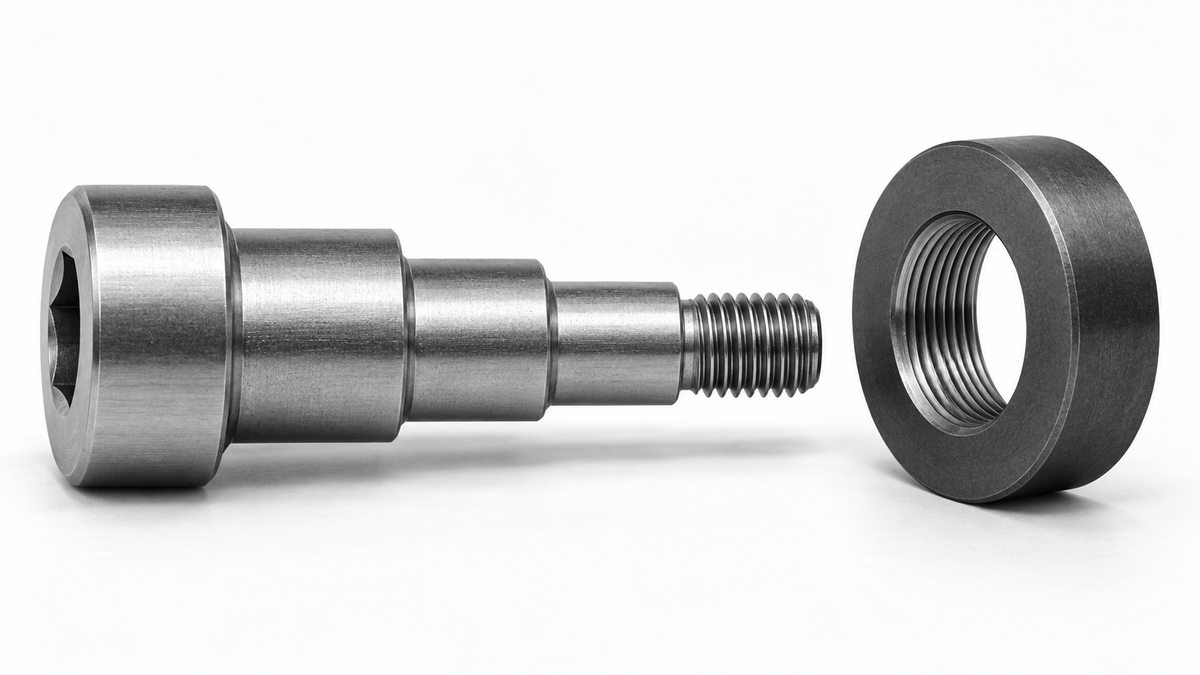
Type:Shoulder Head Cap Screw
Materials:Stainless Steel 304
Surface treatment:Cleaning
Head Type:Cylindrical knurled head
Drive:Knurled rim, hand driven
Thread:Machine thread, partial
Point:Plain, chamfered
Forming:CNC turning and grinding; knurl rolled
Size:M1 M2 M3 M4 M5 M6 M7 M8 M9 M10
We make knurled shoulder screws in stainless 304, with a hand-gripped knurled head, no recess and a ground shoulder, quoted to the drawing. The knurl is the drive, so head size and knurl pattern are agreed together, and the shoulder stops the screw at the depth the joint needs.
Watch the factory video·Email sst@szsst88.com
ISO 9001:2015 · Manufacturing since 1998 · 8,678+ customers · 89 countries and regions
Made to order – there is no stock catalogue. Each part is produced to your drawing, and production starts after drawing review and first-article approval.
A shoulder head cap screw has a cylindrical head with a knurled band on its side, a ground shoulder below the head, and a smaller machine thread behind the shoulder. The part recorded here is stainless steel 304 cleaned and passivated, quoted with the shoulder made to the drawing.
Knurled head. A cylindrical head with a straight knurl around its rim, gripped between thumb and forefinger.
No recess. The head carries no slot or socket, so the screw is turned by hand rather than with a driver.
Ground shoulder. A precision diameter that locates the part and sets how deep the head can go.
They are used where a part is adjusted by hand, where no tool is allowed at the point of use, or where a fixing has to be removable without equipment. Knurled shoulder screws are also the form chosen when the fixing itself has to be the adjustment, because the head can be turned at any time without a driver.
On this screw the knurled head is the drive. There is no recess on top, no hex inside, and no flats on the rim; the only place torque can be applied is the knurl, and it is applied by a hand. That sets the whole design envelope of the part, because a hand is not a torque wrench.
The torque a person can apply to a head of this size is small. A thumb and forefinger on a knurled rim of a few millimetres radius can produce a fraction of what a screwdriver produces on the same screw, and the figure varies from one person to the next. The joint therefore has to be designed so that it seals and seats at hand torque, and the shoulder is what makes that possible: the screw stops when the shoulder meets the part, so the depth no longer depends on how hard it was turned.
The knurl has a second job. Its ridges are what the fingers grip, and their direction decides how the grip feels: a straight knurl resists turning but lets the fingers slide along the axis, while a diamond knurl resists both. On a part that is turned by hand and also pulled, that difference is felt immediately, and it is a drawing decision rather than a finish detail.
The knurl also has to be safe to touch. A rolled knurl leaves a clean ridge, but a cut knurl can leave a burr at the shoulder end where the tool runs out. On a part that is handled, that burr is the first thing the user meets, so deburring the knurl edge is a functional operation and not a cosmetic one.
The last consequence is wear. The knurl is the part that is gripped every time the screw is adjusted, and a stainless knurl under repeated handling wears smooth at the ridges. That is why the head material and the knurl depth both matter on an adjustable part.
The part is quoted to the drawing with the head, the knurl, the shoulder and the thread stated separately. Custom lengths up to 2,000 mm, subject to DFM review after drawing submission. The quotation for knurled shoulder screws carries the head diameter and height, the knurl pattern, the shoulder diameter and length, and the thread.
| Item | How it is defined | What we control |
|---|---|---|
| Head | Cylindrical, knurled rim | Diameter, height and edge finish |
| Knurl | Straight or diamond | Pattern, depth and deburring |
| Shoulder | Ground locating diameter | Diameter, length and roundness |
| Thread | Machine thread behind the shoulder | Size, length and start |
| Surface | Cleaned and passivated | Free of oil, scale and iron |
| Bore | In the customer part | Agreed with the shoulder |
The head diameter is what sets the grip, and grip is what sets the torque. A head that is a little smaller feels the same on the drawing but cannot be turned as firmly, so on an adjustable part the diameter is a functional dimension rather than a size for appearance.
On knurled shoulder screws the knurl pattern is written on the drawing by type and by pitch, because two knurls of the same depth but different pitch grip differently and wear differently.
The shoulder is agreed against the bore. On a hand-driven part the shoulder also limits the force a user can apply, because the screw stops as soon as it seats; that is what protects a soft or thin part from being crushed by a strong grip.
Four properties decide knurled shoulder screws, and each one carries a cost:
| Property | What it gives | What it costs |
|---|---|---|
| Knurled head | Tool-free adjustment | Torque limited by hand |
| Shoulder stop | Depth set by the part | Shoulder must match the bore |
| Stainless 304 | Corrosion resistance without a coating | Softer knurl wear than 316 |
| Cleaned surface | No oil or iron residue | Handled parts show marks sooner |
The value is adjustment without a tool. The knurl gives a grip, the shoulder gives a repeatable depth, and the thread holds the setting; a user can take the part off and put it back without a driver and without changing where it sits.
The cost is that the joint cannot be tightened hard, and the knurl is a surface that is touched. Both are acceptable on an adjustable part and neither is acceptable on a structural one, which is why this head form belongs to adjustment rather than to load.
The recorded finish is cleaning and passivation on stainless steel 304. That is not a coating: it removes oil, scale and free iron from the surface and lets the passive layer form, which is what a part that is handled by hand actually needs.
| Option | How it protects | Effect on knurl and shoulder | Typical use |
|---|---|---|---|
| Cleaned, passivated | Passive film, no coating | Knurl and shoulder as formed | Handled and adjustable parts |
| Passivated 316 | Higher alloy passive layer | No build; better in chlorides | Marine and medical |
| Nickel plated | Hard bright barrier | Thin build in the knurl valleys | Visible decorative parts |
| Black oxide | Conversion film, oiled | No measurable build | Dark mechanisms |
| Bead blasted | Matte, uniform surface | Can round knurl ridges | Optical and instrument trim |
On knurled shoulder screws where the part is handled, the surface is also a hygiene question. Passivated 304 leaves no oil film to collect dust, and it removes the free iron that would otherwise show as rust spots on a part that never sees water.
Bead blasting is the treatment to avoid on a knurled head. It makes the part look uniform, but it rounds the ridges that give the grip, and a knurled head with rounded ridges is a head that cannot be turned by hand.
Three assemblies where a part has to be adjusted or removed by hand, and where knurled shoulder screws are the usual choice:
| Where it sits | The screw locates an arm or a stop where the setting is changed by the user or by a technician. |
| When it goes wrong | The screw cannot be turned by hand, or the setting drifts after adjustment. |
| Why it happens | The grip is too small, or the depth is set by torque rather than by the shoulder. |
| What we control | Head diameter and knurl checked; first article adjusted by hand. |
| Where it sits | The screw holds a panel that has to come off without tools at the point of use. |
| When it goes wrong | The panel is hard to remove, or the screw loosens in service. |
| Why it happens | The knurl is too fine to grip, or there is no feature to stop the joint at depth. |
| What we control | Knurl pattern checked; shoulder length set to the panel stack. |
| Where it sits | The screw is a small pivot or a stop that is adjusted to set an optical position. |
| When it goes wrong | The adjustment is not repeatable, and the position drifts. |
| Why it happens | The joint is small, the position is fine, and adjustment is by hand. |
| What we control | Shoulder fit and seat checked; first article adjusted in the assembly. |
Four reasons that matter on a part whose drive is a hand, each tied to something the drawing or the first article proves. All four show in the sample.
|
Knurl and head stated together
The drawing states head diameter, knurl pattern and knurl depth together, because together they decide how firmly a hand can turn the screw. Basis: Knurl and head dimensioned. |
Rolled knurl, deburred edge
The knurl is rolled and the shoulder end of the head is deburred, because that edge is what the user meets when taking the part off. Basis: Knurl edge deburred. |
|
Turned by hand in the check
The first article is fitted into the customer bore and turned by hand, so the grip and the seat are proved the way the part is used. Basis: Grip proved by hand. |
Same grip on repeat runs
Head size, knurl pattern and shoulder limits are recorded with the drawing revision, so a repeat batch feels the same in the hand. Basis: Same grip across orders. |
These screws are turned from stainless 304 bar in a single setup, with the knurl formed on the head, the shoulder turned and then ground, and the thread cut behind it; the parts are cleaned, passivated and inspected. The first piece of every run is measured on head diameter, knurl depth, shoulder diameter and length, and thread.


|

|
Rolling the knurl is the operation that decides how the part feels. A rolled knurl displaces material into ridges and leaves a clean crest; a cut knurl removes material and can leave a burr where the tool runs out at the shoulder end of the head. On a part that is handled every time it is adjusted, that burr is a defect even when the knurl measures correct.
The head is knurled before the shoulder is ground, so the grinding operation can clean up the face and the edge without disturbing the knurl. Grinding after knurling also means the shoulder is finished on a part that is not handled again.
Cleaning and passivation come last and are done as a process rather than a dip: the parts are degreased, pickled where scale is present, and passivated. On a part that is gripped by hand, a residue from any of those steps is something the user will touch.
What decides whether knurled shoulder screws pass is the knurl, the shoulder and the head edge. The inspection agreement covers those, and the criteria come from the drawing.

Knurl and shoulder on the projector |

Thread and start checked |

Material checked |

Salt-spray testing where plated |
The knurl is checked for pattern and depth on the projector, and for grip by turning a sample by hand. A knurl that looks right but slips is usually too shallow, and a knurl that cuts the fingers is usually a burr rather than a depth problem.
On knurled shoulder screws the shoulder is measured for diameter, roundness and length, and the step for squareness. On a hand-driven part the shoulder also stops the user, so its length is a protection dimension for the part it holds.
The head edge is checked visually and by touch on a sample from each batch. Passivated parts are checked for residue and for free iron, since a part that is handled should not leave a mark on a hand or on a white cloth.
Every batch of knurled shoulder screws is traceable to the bar it was made from and to the passivation lot that finished it. The grade and heat number appear on the material certificate supplied with the parts, and the passivation record is kept with the batch.

ISO 9001:2015 |

RoHS test report |

Registered trademark |

Patent: security screw and driver |
With each shipment we supply the material certificate, the inspection record for the dimensions on the drawing, including the knurl and shoulder, and the passivation record. The records carry the drawing revision and the batch number, so a repeat order of knurled shoulder screws feels and seats the same.
More than 8,678 customers in 89 countries and regions have ordered from Shi Shi Tong; 87% of orders come from repeat customers and 56% through referrals. Most projects follow the same route: drawing review, first-article approval, then batches checked against that sample. On a hand-driven part the first article is fitted into the customer bore and adjusted the way the end user will adjust it. Buyers visit during the process to review samples.
|
8,678+
customers served
|
87%
of orders from repeat customers
|
56%
of orders through referrals
|
89
countries and regions shipped to
|
For knurled shoulder screws the sample review includes turning the part by hand, because grip is part of the specification. Buyers and quality engineers visit for sample review, process discussion and supplier audits; the visit is arranged around production so the knurling setup and the passivation line can be seen on the day the parts run.

Customer group visit – sample review |

Customer group visit – process discussion |

Customer group visit – factory tour |

Customer visit – project kick-off |

Danish customer – drawing review |

Industry exhibition – meeting customers |
By hand, on the knurled rim. The head is the drive, and the shoulder is what stops the screw at the right depth.
Only what a hand can apply to the rim, which is much less than a driver. The joint is designed to seat at that level.
Straight resists turning, diamond resists turning and pulling. The choice depends on how the part is handled.
Yes. The edge at the shoulder end is touched every time the part is adjusted, so a burr there is a functional defect.
Because the part is handled. Passivation removes iron and oil without adding a layer that could chip or fill the knurl.
Head diameter and height, knurl pattern and depth, shoulder diameter and length, thread size and length, and the bore.
How a knurled shoulder screw project runs from drawing to repeat delivery:
|
1
Send the drawing and the bore
|
→ |
2
Knurl, head and shoulder agreed
|
→ |
3
First article adjusted by hand
|
→ |
4
Batch production and repeat orders
|
Each step is confirmed with you before the next one starts; the drawing revision from the first article is what repeat orders are checked against.
For a quotation, send the drawing with the head diameter and height, knurl pattern and depth, shoulder diameter and length, thread size and length, and the bore.
|
Head size
|
Knurl pattern
|
Knurl depth
|
|
Shoulder diameter
|
Shoulder length
|
Thread
|
Sending a drawing? The form below does not take attachments. Email the PDF, DXF or STEP file to sst@szsst88.com with the part name and quantity in the subject line – the drawing is reviewed and a quotation follows.

 +86 13143444311
 sst@szsst88.com