Tel:
+86 13143444311
Email:sst@szsst88.com
Fax:+0086-755-27322278
Address:Building 9, First Industrial Zone, Tantou Industrial City, Songgang Street, Baoan District, Shenzhen 518105, Guangdong, China
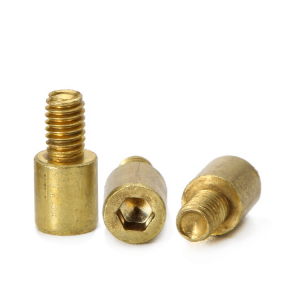
Type:Brass Hex Socket Cup Head Machine Screw, Allen Drive, Full Thread (Non-Standard)
Materials:Brass; alloy and temper per drawing
Surface treatment:Plain, cleaned; no plating, no passivation, no oil film specified
Head Type:Cup Head (plain cylinder, flat top with a chamfered edge, flat annular bearing face, no flange, no washer face)
Drive:Internal hexagon (Allen); one drive interface, no slot, no cross recess
Step:Thread major diameter steps down below the head bearing annulus; short chamfered step at the thread start
Thread:Machine thread, rolled 60 degree, full thread from the step to the blunt end; no plain shank
Point:Blunt end with a small chamfer; no taper, no drill point, no cutting slot
Forming:Single-die heading, thread rolling, cleaning and dry sorting
Size:M1 M2 M3 M4 M5 M6 M7 M8 M9 M10 M14
Number:170
We manufacture brass hex socket cap head screws with a cup head, a stepped neck under the head and a rolled machine thread running full from the step to a blunt end. Socket size and depth, step, head dimensions and length are taken from your drawing.
Watch the factory video·Email sst@szsst88.com
ISO 9001:2015 · Manufacturing since 1998 · 8,678+ customers · 89 countries and regions
Made to order – there is no stock catalogue. Each part is produced to your drawing, and production starts after drawing review and first-article approval.
Brass hex socket cap head screws are machine screws with a plain cylindrical head, a hexagon socket sunk into the top face and a machine thread for a tapped hole. The recorded item on this page has a stepped neck under the head and a rolled thread running from the step to a blunt end, in plain cleaned brass, quoted from M1 to M14 with Number 170.
Allen drive. One internal hexagon, no slot and no cross. The key sits on six flats and turns the screw without the wedging action of a cross, so the drive transmits more torque before anything deforms. On brass that matters, because the socket is the softest part of the part.
Cup head. A plain cylinder with a flat top and a chamfered edge. There is no flange and no washer face, so the head bears on its own flat underside and reads as a plain disc on a visible panel.
Stepped neck. Just below the head the diameter steps down, and the thread starts from that step. The step gives the thread a clean place to begin and keeps the roll from crowding the bearing face, which on a small brass head is only a few tenths of a millimetre thick.
Rolled thread. Formed by rolling rather than cut, which work-hardens the brass flank and leaves a clean, uniform thread for its whole length. There is no plain shank: the engaged length is the whole length.
Together these decide the joint: the hexagon socket takes the key, the cup head sits flat, the stepped neck keeps the thread clean under the head, and the brass body gives conductivity and a colour that no plated steel part matches.
The body is brass wire, with alloy and temper recorded on the batch. The head is upset in a single heading stroke that forms the cylinder, the chamfered edge and the flat underside, and the hexagon socket is punched in the same stroke so it stays concentric with the shank.
The socket depth is the critical dimension on this part. A hexagon socket that is too shallow bottoms out on the key and the key corners round off; one that is too deep cuts into the material that carries the head load. On brass the socket wall is softer than a steel equivalent, so both the depth and the across-flats are checked on the first article rather than one of them.
The stepped neck is formed by the die at the same time as the head. Its diameter is smaller than the thread major diameter, so the thread roll has a defined start below the bearing face and the roll does not push a burr up into the annular face. A brass hex socket cap head screws part with a burred bearing face will sit on the burr instead of on the panel, and the joint reads as loose although the screw is tight.
The thread is rolled from the step to the blunt end. Rolling displaces material rather than cutting it, so the blank diameter under the thread is set smaller than the finished major diameter, and the brass work-hardens as it forms. That is why the rolled thread on these parts holds up better than a cut one of the same alloy, and why the thread is gauged after rolling rather than before.
Cleaning is the last step: the parts are degreased and dried, with no plating, no passivation and no oil film on the recorded configuration. They arrive dry, which matters if the next operation is soldering or plating.
The family is quoted from M1 to M14, with M1, M2, M3, M4, M5, M6, M7, M8, M9, M10 and M14 in the recorded range. Custom lengths up to 2,000 mm are subject to DFM review after drawing submission; on brass hex socket cap head screws the length is quoted from under the head, and with a stepped neck the position of the step belongs on the drawing with it.
| Item | How it is defined | What we control |
|---|---|---|
| Thread | Metric machine thread, rolled, full from the step | Gauged per batch after rolling |
| Head diameter | Cup head, plain cylinder | Checked on the projector |
| Head height | Flat top with a chamfered edge | Measured from the bearing face |
| Socket across flats | Sized to the thread | Checked with the key on the first article |
| Socket depth | Leaves material under the socket | Checked on the section |
| Step | Smaller diameter than the thread, below the head | Diameter and length measured |
| Length | From under the head to the tip | Measured on the shop plate |
The socket across flats has to match the key the customer uses, and on brass there is no second chance. A key that is slightly undersize will spin in the socket and turn the hexagon into a circle, and because brass does not spring back the damage is permanent. Where a key size is fixed by the assembly, it is stated on the drawing and checked with that key.
The step diameter decides how much of the thread is available in a shallow joint. If the step is longer than the customer expects, the thread starts lower and there is less engagement in a thin panel; if it is shorter, the roll crowds the bearing face. Both numbers are quoted on the drawing rather than left to the standard.
A hexagon socket on a brass screw is a different proposition from one on steel, and the difference is worth stating plainly. Brass is soft, so the socket is both the strongest drive available and the feature that limits the torque.
| Feature | What it gives | What it costs |
|---|---|---|
| Hexagon socket | High torque with no cam-out | Socket rounds if the key is worn |
| Cup head | Flat top, plain disc on a panel | Needs a counterbore to sit flush |
| Stepped neck | Clean thread start below the bearing face | Reduces usable thread in a shallow joint |
| Rolled thread | Work-hardened flank, clean full thread | Needs a blank size set for each thread |
| Brass body | Conductivity, colour, non-magnetic | Soft; tarnishes; not for high load |
The socket wins on torque but loses on tools. A slot or a cross will cam out when it is overloaded, which is a warning; a hexagon socket will not cam out, so an over-tightened brass screw tears the socket instead. That is why the joint torque belongs on the drawing for these parts, and why the first article is driven with the production key at that torque.
The cup head and the step together make the part usable in a shallow recess. The flat top gives a clean face, the chamfered edge keeps a burr off the panel, and the step keeps the thread away from the annular bearing face. On a brass hex socket cap head screws part that is used in a row on a plate, those three details are what make the row look even.
Brass is also chosen for what it does not do. It does not attract a magnet, it conducts, and it does not rust the way steel does. In an instrument or a terminal those are functional requirements, not preferences, and they are the reason a brass part is specified where a stainless one would be stronger.
The recorded finish is plain cleaned brass, with no coating. That keeps the socket and the thread at their cut and rolled dimensions, and it means the part can be soldered or plated later without stripping anything first.
| Option | What it does | Effect on socket and thread | Typical use |
|---|---|---|---|
| Plain cleaned | Degreased and dried; no film | No change | Electrical and instrument parts |
| Clear lacquer | Slows tarnish, keeps the colour | Can narrow a small socket | Visible decorative brass |
| Nickel plated | Silver tone, harder bearing face | A few microns; socket re-checked | Mixed hardware assemblies |
| Chrome plated | Bright and hard | Thicker; thread and socket re-checked | Sanitary and decorative fittings |
| Antique finish | Deliberate dark patina | Surface only; socket re-checked | Reproduction hardware |
Tarnish is the visible issue and the socket is the functional one. Brass darkens in air as the copper reacts, and the film is thin and self-limiting; a lacquer slows it if the colour has to hold. But any film that reaches the socket, even a thin one, reduces the depth the key can reach, and on a small brass hexagon that is enough to start rounding the corners.
Where the joint is wet or salty, plain brass is the wrong choice and plating it is not always the answer, because a plated brass socket is still soft underneath. Bronze, or a stainless part with an insulating washer, is usually what the application actually wants, and the drawing should say which environment it is for.
Three applications where a brass socket head and an Allen key are chosen together:
| Where it sits | The screw clamps a lug or a busbar in a terminal where the brass body carries current as well as load, and the socket lets it be tightened in a confined space. |
| When it goes wrong | A slotted head cannot be tightened hard enough with a screwdriver, and a plated steel screw adds a dissimilar metal junction. |
| Why it happens | The joint carries current, the space is tight, and the torque matters more than the look. |
| What we control | Socket depth and across-flats checked with the production key, alloy confirmed on the certificate. |
| Where it sits | The screw holds a mount, a bezel or a bracket where a magnet must not disturb the assembly and the head sits in a counterbore. |
| When it goes wrong | A steel screw attracts debris and disturbs magnetic sensors, and a slot head is easily damaged during adjustment. |
| Why it happens | The assembly is non-magnetic, the recess is machined, and the screw is adjusted during setup. |
| What we control | Head height and socket checked against the counterbore, thread gauged per batch. |
| Where it sits | The screw fixes a knob, a rosette or a trim plate where the fastener has to match the brass of the fitting and be driven with a key that does not slip on a polished face. |
| When it goes wrong | A slot or a cross slips and marks a polished brass face, and a plated steel screw reads as a different metal. |
| Why it happens | The face is polished, the fixing is visible, and the part is handled daily. |
| What we control | Colour and tarnish behaviour agreed, socket checked with the key after any coating. |
Four reasons that matter on a brass socket screw, each tied to what the drawing has to prove:
|
Socket and step reviewed together
The socket size and depth, the head height and the step position are reviewed as one set, so a socket that would thin the head is raised before the die is cut. Basis: Socket and step reviewed as one set. |
Head, socket and thread in one route
The cup head, the chamfered edge, the step and the socket are formed in one heading stroke, and the thread is rolled from the step to the end. Basis: One route from wire to dry brass screw. |
|
Socket and thread checked on the part
The socket is checked with the production key, the step is measured, and the thread is gauged per batch after rolling. Basis: First article driven with the production key. |
First article to repeat production
The drawing revision, wire heat, die set and thread roll are set at the first article and kept as the reference for later batches. Basis: First article signed off before the batch is released. |
Shi Shi Tong forms these brass hex socket cap head screws on a single-die header that upsets the cup head, the chamfered edge, the stepped neck and the hexagon socket in one stroke, then rolls the machine thread from the step to the blunt end. The parts are cleaned and dry-sorted. The first part of every run is measured on the head, the step and the socket, and driven with the production key, before the batch continues.


|

|
Brass takes a heading die well, which is why the same single-die route that makes a steel screw also makes this part, and why the socket can be formed rather than milled. What changes is the setting: the blank is sized for the rolled thread, and the socket punch is kept sharp, because a dull punch tears the hexagon corners in soft brass and no amount of gauging afterwards will put them back.
What decides whether brass hex socket cap head screws pass is the head, the socket, the step, the thread and the surface. The inspection agreement covers those, and the criteria come from the drawing.

Head and socket on the projector |

Thread gauged per batch |

Hardness testing of the brass wire |

Salt-spray testing where a coating is specified |
The socket is inspected by driving, not by measuring alone. The first article is turned with the production key at the joint torque and the hexagon corners are then checked for deformation, because a socket can measure correct and still tear on the first tightening if the punch left a rough bottom.
The step is measured from the bearing face down to the first full thread. That dimension is what keeps the thread out of the head and the head square on the panel, and on a brass hex socket cap head screws part it is also what tells the customer how much thread is available in a shallow joint.
Every shipment of brass hex socket cap head screws is traceable to the wire it was made from. The alloy and heat number are recorded on the material certificate supplied with the parts, and the inspection records follow the criteria agreed on the drawing.

ISO 9001:2015 |

RoHS test report |

Registered trademark |

Patent: security screw and driver |
With each batch we supply the material certificate, the inspection record for the criteria on the drawing and, where it is listed, the third-party report for the alloy. The documents carry the drawing revision and the batch number, so the paperwork can be matched to the parts.
More than 8,678 customers in 89 countries and regions have ordered from Shi Shi Tong; 87% of orders come from repeat customers and 56% through referrals. Most projects follow the same route: drawing review, first-article approval, then batches checked against that sample. On a brass socket screw the first article is driven with the key and torque the customer will use, because the socket is where a brass part fails first. Buyers visit during the process to review samples and to see how the sockets are formed.
|
8,678+
customers served
|
87%
of orders from repeat customers
|
56%
of orders through referrals
|
89
countries and regions shipped to
|
Buyers and quality engineers visit for sample review, process discussion and supplier audits; the visit is arranged around production so the header and the sorting line can be seen on the day the parts run.

Customer group visit – sample review |

Customer group visit – process discussion |

Customer group visit – factory tour |

Customer visit – project kick-off |

Danish customer – drawing review |

Industry exhibition – meeting customers |
A brass machine screw with a plain cylindrical head and a hexagon socket for an Allen key. This version has a stepped neck under the head and a rolled thread to a blunt end.
A socket drives on six flats and does not cam out, so it takes more torque without marking the head. On a soft brass part the socket is the strongest drive available.
It gives the thread roll a defined start below the bearing face, so no burr is pushed into the face. It also sets how much thread is available in a shallow joint.
Yes. A hexagon socket does not cam out, so excess torque tears the hexagon corners in brass. The joint torque belongs on the drawing.
Yes. Plain brass darkens in air, and the film is thin and stops at the surface. A clear lacquer slows it, but a heavy film can reduce the socket depth.
Thread size and pitch, head diameter and height, socket across flats and depth, step diameter and length, length and datum, brass alloy and finish.
How a brass hex socket cap head screw project runs from drawing to repeat delivery:
|
1
Send the drawing or sample
|
→ |
2
Socket and step review
|
→ |
3
First article driven with your key
|
→ |
4
Batch production and repeat orders
|
Each step is confirmed with you before the next one starts; the drawing revision from the first article is what repeat orders are checked against.
For a quotation, send the drawing with the thread size and pitch, head diameter and height, socket across flats and depth, step diameter and length, length and datum, brass alloy and finish.
|
Thread and pitch
|
Head diameter and height
|
Socket across flats
|
|
Socket depth
|
Step dimensions
|
Alloy and finish
|
Sending a drawing? The form below does not take attachments. Email the PDF, DXF or STEP file to sst@szsst88.com with the part name and quantity in the subject line – the drawing is reviewed and a quotation follows.

 +86 13143444311
 sst@szsst88.com