Tel:
+86 13143444311
Email:sst@szsst88.com
Fax:+0086-755-27322278
Address:Building 9, First Industrial Zone, Tantou Industrial City, Songgang Street, Baoan District, Shenzhen 518105, Guangdong, China
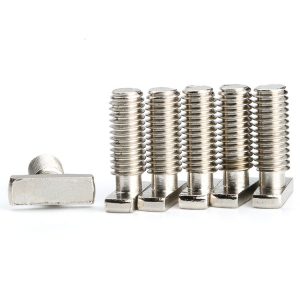
Type:T head screw (hammer head) for aluminium extrusion slots, flat bar head, half machine thread (Non-Standard)
Materials:Stainless Steel; grade per drawing
Surface treatment:Plain, cleaned and passivated (no plating, no applied coating)
Head Type:T head: flat rectangular bar, two long flats, no recess, no hexagon
Drive:None on the head; the nut is turned across flats and the head reacts on the channel walls
Neck:Plain unthreaded neck between head and first thread; height set to lip plus plate stack
Thread:Machine thread, rolled 60 degrees, half thread; run-out above the lip
Point:Blunt end with a small chamfer; no taper, no drill point
Forming:Single-die heading, thread rolling, cleaning and passivation, sorting
Size:M1 M2 M3 M4 M5 M6 M7 M8 M9 M10 M14
Number:600
We manufacture T head screws in stainless steel for aluminium extrusion slots, with a flat bar head, two long flats, a plain neck sized to the lip and a half machine thread ending above it. Head width and thickness, neck height, thread and length are taken from your drawing.
Watch the factory video·Email sst@szsst88.com
ISO 9001:2015 · Manufacturing since 1998 · 8,678+ customers · 89 countries and regions
Made to order – there is no stock catalogue. Each part is produced to your drawing, and production starts after drawing review and first-article approval.
A T head screw is a bolt with a flat rectangular head that drops into the open channel of an aluminium extrusion and locks when it is turned a quarter turn. The recorded item on this page is a stainless steel version, with a plain neck above a half machine thread, blunt end and no drive on the head, quoted from M1 to M14 with Number 600.
The head is a bar, not a disc. It is flat on both faces with two long parallel flats, and its width fits through the slot opening. That shape is what lets a T head screw be inserted from the face of the profile instead of from the end, which is how a frame gets assembled without taking it apart.
No drive. There is no recess, no hexagon and no slot on the head. The T head screw is held by its head while the nut is turned, and the flats react against the inside of the channel. That is the whole driving method, and it is why the head has to fit the slot closely.
Plain neck. Between the head and the first thread there is an unthreaded neck. Its height is set by the lip of the profile plus the thickness of whatever is clamped on top, so it is a joint dimension rather than a detail of the screw.
Half thread. The thread starts above the neck and ends before the head, so the neck stays clear of the lip and the plate sits flat against the head. A thread that runs up into the neck will not close the joint, however hard the nut is turned.
Together these decide the assembly: the head enters the slot, turns and locks, the neck clears the lip, the thread engages the nut, and the stainless body lets the joint sit outdoors or in wash-down equipment.
The body is stainless wire, with grade on the batch record. The head is upset in a single heading stroke into a flat bar and then trimmed or formed to width, because a T head screw has to be both flat and parallel: a head that is thicker at one end will wedge in the slot and stop the assembly from sliding.
The two long flats are the surfaces that carry the reaction. When the nut is turned, the T head screw tries to rotate and the flats press against the inside walls of the channel. That is why the head width is a fit rather than a clearance: too narrow and the head turns and scrubs the slot, too wide and it will not drop in.
The neck is formed with the head and left unthreaded. Its diameter is a clearance diameter, and its height is the joint dimension described above. On a T head screw the neck is also the part that takes the bending when the clamped plate is offset from the channel, so it is checked for diameter and for a smooth surface rather than only for length.
The thread is rolled on the section above the neck. Rolling keeps the grain continuous and work-hardens the stainless, and the thread ends where the neck begins so that nothing stands between the plate and the head. The point is blunt with a small chamfer, because a T head screw goes into a nut or a threaded plate and has no reason to be pointed.
Cleaning and passivation come last. On a T head screw the slot-facing surfaces are the ones that rub, and passivation is what keeps the rubbed areas from rusting where the passive layer has been disturbed in handling.
The family is quoted from M1 to M14, with M1, M2, M3, M4, M5, M6, M7, M8, M9, M10 and M14 in the recorded range. Custom lengths up to 2,000 mm are subject to DFM review after drawing submission; on a T head screw the length is measured from the underside of the head, and the neck and thread lengths are quoted separately because they set the fit.
| Item | How it is defined | What we control |
|---|---|---|
| Head length and width | Flat bar, sized to the slot | Checked on the projector |
| Head thickness | Flat both faces, parallel | Checked on the section |
| Flats | Two long parallel surfaces | Checked against the slot on the first article |
| Neck diameter | Clearance diameter, unthreaded | Measured with a micrometer |
| Neck height | Lip plus plate stack | Measured from the head underside |
| Thread length | From above the neck to the point | Measured on the first article |
| Length | From under the head to the tip | Measured on the shop plate |
The neck height is the dimension that decides whether a T head screw works in a given profile. If it is too short, the plate bottoms on the lip before the head seats and the joint is soft; if it is too long, the plate stands off and the joint rocks. It is measured from the head underside and quoted against the profile lip and the plate thickness together.
Head width follows the slot, and the slot is not the same in every profile series. A T head screw that is right for one series will not enter another, so the profile series belongs on the drawing next to the head dimensions rather than being assumed from the thread size.
The T head screw is a connection that exists because aluminium extrusions have a slot. Its behaviour is set by the slot as much as by the screw, and the specification should say which of the two is doing the work.
| Feature | What it gives | What it costs |
|---|---|---|
| Bar head in the slot | Assembly from the face, no end loading | Head width is tied to one profile series |
| No drive | Nothing to strip; the nut does the driving | The nut and the access to it decide the joint |
| Plain neck | Plate seats on the head, lip cleared | Neck height must match lip plus plate |
| Half thread | Thread only where the nut runs | Less engagement than a full thread |
| Stainless in aluminium | No plating to chip at the slot | Galvanic pair; aluminium corrodes first |
The load path is worth knowing. The head bears on the inside faces of the slot, the flats stop it turning, and the nut pulls the plate down onto the lip. That means the pull-out load is limited by the lip thickness of the profile, not by the thread: over-tightening a T head screw deforms the extrusion before it breaks the screw.
The half thread is a consequence of the neck. Because the thread starts above the lip, the engaged length is shorter than the overall length, and on short screws that can leave only a few threads in the nut. Where the joint needs more engagement, a longer T head screw is used rather than a deeper nut.
Stainless in aluminium is the one combination worth flagging. The stainless screw is cathodic to the aluminium profile, so in the presence of moisture the aluminium around the slot becomes the anode and corrodes. Dry indoor framing is fine; wash-down, coastal or outdoor use needs an isolating washer or a different pairing, and that belongs on the drawing.
The recorded finish is plain cleaned and passivated stainless, with no plating and no applied coating. That keeps the head, the neck and the thread at their formed dimensions, which matters on a T head screw because the head is a fit in the slot.
| Option | What it does | Effect on the part | Typical use |
|---|---|---|---|
| 304, passivated | General corrosion resistance | No dimensional change | Indoor and general outdoor framing |
| 316, passivated | Molybdenum for chloride exposure | No dimensional change | Coastal, marine and wash-down |
| Satin bead blast | Even matte face on the head | Softens edges slightly | Visible framing and displays |
| Dry film on the neck | Reduces galling and galvanic contact | Thin film; head re-checked | Stainless in aluminium joints |
| Zinc plated steel (equivalent part) | Cheaper, but a coating in a fit | Coating adds thickness to the head | Dry indoor framing |
Grade selection is the decision that matters most here. 304 covers indoor framing; 316 is used where chlorides are present, and on a stainless T head screw in an aluminium profile the grade is only half the answer, because the aluminium side of the pair still corrodes if water sits in the slot.
A coating on the head is a mixed benefit. Plating a steel T head screw adds thickness to a part that has to drop into a slot, so a plated version is usually specified with a slightly smaller head rather than the same one. On the stainless version there is no coating to add thickness, which is one reason it is chosen for slots that are tight.
Three assemblies where the slot of an aluminium profile is the starting point:
| Where it sits | The screw drops into the T-slot of a profile and clamps a bracket, a linear rail or a guard plate, so the frame can be built and changed from the face. |
| When it goes wrong | A head that is too narrow turns in the slot and scrubs it, and a neck that is too short stops the plate from seating. |
| Why it happens | The frame is extruded aluminium, the joint is adjustable, and the assembly is built on site. |
| What we control | Head width checked against the profile series, neck height against the lip and plate, thread gauged per batch. |
| Where it sits | The screw fixes a panel or a guard to an aluminium frame where the joint is washed down and has to come apart for cleaning. |
| When it goes wrong | A plated head sheds coating into a slot that cannot be cleaned, and a stainless screw in a wet aluminium slot corrodes the profile. |
| Why it happens | The equipment is washed, the joint is opened regularly, and the slot traps whatever gets into it. |
| What we control | Grade confirmed, passivation recorded, and galvanic isolation agreed where the joint stays wet. |
| Where it sits | The screw holds a panel, a shelf or a graphic frame to an aluminium profile, often assembled and taken down many times. |
| When it goes wrong | A head that is a loose fit in the slot turns under the nut and marks the anodised face, and a thread that runs into the neck stops the panel closing up. |
| Why it happens | The structure is reused, the faces are visible, and the assembly is done by hand. |
| What we control | Head thickness and flats checked, neck height confirmed, and the first article assembled in the profile. |
Four reasons that matter on a slot-fit part, each tied to what the drawing has to prove:
|
Head and neck reviewed against the slot
The head width, head thickness and neck height are reviewed together against the profile series and the plate stack, so a head that will not drop in is raised before tooling. Basis: Head and neck reviewed against the slot. |
Head, neck and thread in one route
The bar head is headed and trimmed flat, the neck is left unthreaded and the thread is rolled above it, so the neck height stays fixed. Basis: One route from wire to passivated screw. |
|
Head and neck checked on the part
The head is checked for width, thickness and parallel faces, the neck height is measured, and the first article is assembled in the profile. Basis: First article assembled in the profile. |
First article to repeat production
A repeat order is measured against the first article, where drawing revision, wire heat, die set and thread roll were fixed. Basis: First article signed off before the batch is released. |
Shi Shi Tong forms these T head screws on a single-die header that upsets the flat bar head, trims it to width and leaves the neck unthreaded, then rolls the machine thread above the neck to a blunt point. The parts are cleaned and passivated. The first part of every run is measured on the head, the neck and the thread, and assembled in a sample profile, before the batch continues.


|

|
The head is where a T head screw is won or lost. It has to come out of the die flat and parallel, because there is no machining step afterwards to correct it: a head that is thicker at one end will wedge, and a head that is not parallel will rock in the slot and mark it. The trimming station is therefore set from the profile sample rather than from the drawing alone.
What decides whether a T head screw passes is the head, the neck, the thread and the surface. The inspection agreement covers those, and the criteria come from the drawing.

Head profile on the projector |

Thread gauged per batch |

Hardness testing against the property class |

Salt-spray testing of the passivated part |
The head is checked by assembling the first article in a sample of the customer’s profile. Dimensions on a projector prove the head is the size on the drawing; only the assembly proves it turns and locks without scrubbing, and on a T head screw that is the test that matters.
The neck is measured for diameter and height, and the thread for length above the neck. A thread that has crept into the neck shows as a short neck and a plate that will not seat, and because it is a forming operation rather than a cutting one, the check is on the first article and then sampled through the run.
Every shipment of T head screws is traceable to the wire it was made from. The grade and heat number are recorded on the material certificate supplied with the parts, and the inspection records follow the criteria agreed on the drawing.

ISO 9001:2015 |

RoHS test report |

Registered trademark |

Patent: security screw and driver |
With each batch we supply the material certificate, the inspection record for the criteria on the drawing and, where it is listed, the third-party report for the material or the surface condition. The documents carry the drawing revision and the batch number, so the paperwork can be matched to the parts.
More than 8,678 customers in 89 countries and regions have ordered from Shi Shi Tong; 87% of orders come from repeat customers and 56% through referrals. Most projects follow the same route: drawing review, first-article approval, then batches checked against that sample. On a slot-fit part the first article is assembled in the customer’s own profile, because the fit is decided by the extrusion and not by the screw. Buyers visit during the process to review samples and to see how the heads are formed.
|
8,678+
customers served
|
87%
of orders from repeat customers
|
56%
of orders through referrals
|
89
countries and regions shipped to
|
Buyers and quality engineers visit for sample review, process discussion and supplier audits; the visit is arranged around production so the header and the finishing line can be seen on the day the parts run.

Customer group visit – sample review |

Customer group visit – process discussion |

Customer group visit – factory tour |

Customer visit – project kick-off |

Danish customer – drawing review |

Industry exhibition – meeting customers |
A bolt with a flat rectangular head that fits into the slot of an aluminium extrusion and locks when turned a quarter turn. This one is stainless with a half thread.
The nut is turned. The head is held by the slot, and the two long flats react against the inside walls of the channel while the nut pulls the joint closed.
So the plate seats against the head and the lip of the profile is cleared. The neck height is the lip plus the plate stack, and it is a joint dimension.
The lip of the aluminium profile rather than the screw. Over-tightening deforms the extrusion before the thread fails, so the joint torque follows the profile.
Only with care. Stainless and aluminium form a galvanic pair, and in wet conditions the aluminium corrodes. An isolating washer or a different pairing is used.
Thread size and pitch, head length, width and thickness, head flats, neck diameter and height, thread length, overall length, profile series, grade and finish.
How a T head screw project runs from drawing to repeat delivery:
|
1
Send the drawing or sample
|
→ |
2
Head and profile review
|
→ |
3
First article assembled in the profile
|
→ |
4
Batch production and repeat orders
|
Each step is confirmed with you before the next one starts; the drawing revision from the first article is what repeat orders are checked against.
For a quotation, send the drawing with the thread size and pitch, head length, width and thickness, neck diameter and height, thread length, overall length, the profile series and the finish.
|
Thread and pitch
|
Head width and thickness
|
Head length
|
|
Neck height
|
Thread length
|
Profile series
|
Sending a drawing? The form below does not take attachments. Email the PDF, DXF or STEP file to sst@szsst88.com with the part name and quantity in the subject line – the drawing is reviewed and a quotation follows.

 +86 13143444311
 sst@szsst88.com