Tel:
+86 13143444311
Email:sst@szsst88.com
Fax:+0086-755-27322278
Address:Building 9, First Industrial Zone, Tantou Industrial City, Songgang Street, Baoan District, Shenzhen 518105, Guangdong, China
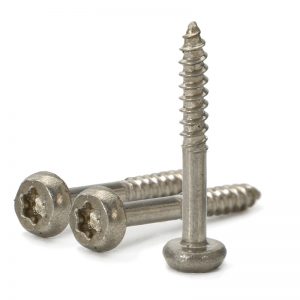
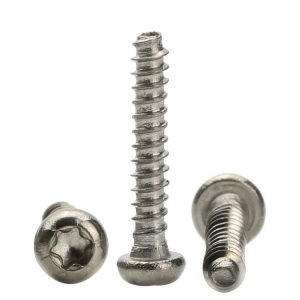
Type:Stainless Steel Self Tapping Screws Torx
Materials:SUS
Surface treatment:Plain
Head Type:Low Cap Head
Drive:Torx six-lobe recess (T-size matched to the thread)
Thread:Coarse single-lead self-tapping thread, rolled, full to the head
Point:Flat end with a small chamfer; no drill point, no sharp taper
Forming:Single-die heading, thread rolling, end trimmed flat, cleaning and passivation, sorting
Size:M1 M2 M3 M4 M5 M6 M7 M8 M9 M10 M14
Number:254
We manufacture stainless steel self tapping screws with a Torx drive and a low cap head, a coarse thread over the full length and a flat end, in plain passivated stainless. Head height, star size, hole size and length are taken from your drawing.
Watch the factory video·Email sst@szsst88.com
ISO 9001:2015 · Manufacturing since 1998 · 8,678+ customers · 89 countries and regions
Made to order – there is no stock catalogue. Each part is produced to your drawing, and production starts after drawing review and first-article approval.
Stainless steel self tapping screws torx are screws with a coarse thread that forms its own mating thread, driven with a six-lobe star bit instead of a cross. The recorded item on this page has a low cap head and a flat end, in SUS with a plain passivated finish, quoted from M1 to M14 with Number 254.
Low cap head. A plain short cylinder, lower than a standard cap head, with a flat top and no flange. It sits down in a recess and leaves very little above the surface, which is what a low-profile joint needs.
Torx drive. Six lobes with straight walls. A self-tapping screw is cutting for its whole travel, and the torque peaks during the cut — which is exactly where a cross recess cams out and a star bit does not.
Self-tapping thread. A coarse single-lead thread rolled from under the head to the end. It cuts or forms its own thread in a prepared hole, so no nut and no tapped hole are needed.
Flat end. The point is blunt, so the screw cannot drill and stops when the hole ends. On thin sheet that is what keeps the fixing from breaking out of a visible face.
Plain stainless. The alloy provides the protection, so nothing is added to the thread crests. On a self-tapping screw the crest is the cutting edge, which is why a bare finish is a functional choice here.
The low cap head and the star recess are formed in one heading stroke, so the recess stays concentric with the shank. On a low head that matters more than on a tall one: the crown is shallower, the wall around the recess is thinner, and a recess formed off centre breaks through on one side.
The head height is kept low deliberately. The socket depth is set against that height, so a low head carries a shallow socket and the bit has less to seat in — which is why the star size is checked with the production bit rather than guessed from the thread.
The thread is rolled over the full length with a sharp crest, because the crest is what forms the thread in the hole. Rolling work-hardens the stainless flank, and that work-hardening is what keeps the crest from folding on the first turn.
The end is trimmed flat after rolling, with a small chamfer. A flat end cannot start a hole and cannot skate, so the position is exactly the one drilled — and it stops at the far face instead of breaking through.
The parts are cleaned and passivated. The recorded finish is plain, so the thread and the socket are gauged in exactly the condition that ships, with no coating to blunt the crests or narrow the lobes.
The family is quoted from M1 to M14, with M1, M2, M3, M4, M5, M6, M7, M8, M9, M10 and M14 in the recorded range. Custom lengths up to 2,000 mm are subject to DFM review after drawing submission; stainless steel self tapping screws torx of this form are normally short, because the thread works through a panel rather than through a stack.
| Item | How it is defined | What we control |
|---|---|---|
| Thread | Coarse single-lead self-tapping, full length | Gauged per batch |
| Head | Low cap head, flat top, chamfered edge | Diameter and height on the projector |
| Recess | Torx six-lobe, sized to the thread | Checked with the production bit |
| End | Flat with a small chamfer | Checked on the projector |
| Length | From under the head to the flat end | Measured on the shop plate |
| Hole | Set by the thread and the sheet | Confirmed in the customer’s material |
The head height is the number that decides whether the screw fits. A low cap head is shorter than a standard cap head, so it can go into a counterbore that a standard one would not — but if the counterbore is too shallow even for this head, the top stands proud and the fixing shows on a face that was meant to be flat.
The hole size is the customer’s number. A self-tapping screw needs a hole sized for the thread and the material, and stainless is less forgiving of a wrong hole than plated steel: too small and the thread binds, too large and it strips.
The combination answers a specific problem: a fixing that has to sit almost flush, be tightened hard enough to hold, and cut its own thread in stainless sheet.
| Feature | What it gives | What it costs |
|---|---|---|
| Low cap head | Minimal height above the panel | Shallow socket limits the bit depth |
| Torx recess | Drive holds through the cut | Needs the matching star bit |
| Self-tapping thread | No nut, no tapped hole | Hole size is critical on stainless |
| Flat end | No breakthrough, no skating | Cannot start its own hole |
| Plain stainless | Crests stay sharp | Galls against stainless |
The low head is chosen for clearance, not for looks. In a counterbore it lets the panel sit flat over the fixing; on a chassis it keeps the head out of the way of the next component. What it does not give is a deep socket, so the drive is the part of the design that has to be checked.
The star drive is what makes a shallow head workable. A cross recess in a low head needs depth it does not have, and the bit lifts and marks the crown; a star socket engages on six straight flanks and pushes down the axis, so the bit stays seated even with less depth.
Neither feature suits every joint. Where the joint has to be tightened with a wrench, an external hexagon is the answer; where the head can stand proud, a normal cap head gives a deeper socket and more torque. On stainless steel self tapping screws torx the drawing should say which of those applies.
The recorded finish is plain stainless, cleaned and passivated, with no coating. On a self-tapping screw that is not a cost decision: any coating on the thread crests blunts the edge that forms the thread, and any coating in the recess narrows the socket.
| Option | What it does | Effect on recess and thread | Typical use |
|---|---|---|---|
| Cleaned and passivated | Removes free iron after forming | No dimensional change | General and wet service |
| Satin bead blast | Even matte face on the head | Edges softened slightly | Visible panels |
| Bright passivated | Cleaner, brighter surface | No dimensional change | Instruments and appliances |
| Electropolished | Levels micro peaks | Crests rounded a little; bite checked | Hygienic service |
| Dry film | Reduces galling in stainless joints | Film checked in the recess | Joints opened occasionally |
Passivation is the one treatment that can be added without changing the bite. It removes the embedded iron from the thread roots and leaves the geometry alone, so the first article does not have to be re-driven — which matters on a screw whose function is to cut.
A dry film is the exception, and it is worth specifying where the joint is stainless to stainless. It reduces galling, but a little reaches the recess, so the first article is checked with the bit after the film rather than before.
Three assemblies where a low head and a self-cut thread in stainless are both wanted:
| Where it sits | The screw fixes a trim panel, a bracket or a cover where the head sits in a shallow recess and the joint is exposed to weather. |
| When it goes wrong | A standard head stands above the recess, and a cross recess marks a painted panel while the thread is cutting. |
| Why it happens | The panel is exposed, the recess is shallow, and the fixing is seen. |
| What we control | Head height and recess checked with the production bit, thread gauged per batch. |
| Where it sits | The screw closes a cover or fixes a bracket on stainless equipment where the joint is washed between runs. |
| When it goes wrong | A plated screw rusts at the recess in a wash area, and a head that traps a crevice holds residue. |
| Why it happens | The equipment is stainless, it is cleaned daily, and the fixing is visible. |
| What we control | Grade and passivation recorded, recess driven with the bit after passivation. |
| Where it sits | The screw fixes a board, a bracket or a cover where the head has to sit in a counterbore and the panel above it has to close flat. |
| When it goes wrong | A head that is too tall fouls the cover, and a drive that slips marks a finished face. |
| Why it happens | The space is tight, the panel is thin, and the fixing repeats. |
| What we control | Head height checked against the counterbore, socket driven with the production bit. |
Four reasons that matter on a low-head star-drive tapping screw, each tied to what the drawing has to prove:
|
Head height and socket reviewed together
The head height, the socket depth and the star size are reviewed as one set, so a low head that cannot take a usable socket is raised first. Basis: Head height and socket reviewed as one set. |
Head, socket and thread in one route
The low cap head and the star socket are formed in one stroke, and the coarse thread is rolled to a flat chamfered end. Basis: One route from wire to passivated screw. |
|
Socket and thread checked on the part
The socket is driven with the production bit, the head height is measured on the projector, and the thread is gauged per batch. Basis: First article driven with the production bit. |
First article to repeat production
Repeat orders are compared with the first article, which holds the drawing revision, wire heat, die set and thread roll. Basis: First article signed off before the batch is released. |
Shi Shi Tong forms these stainless steel self tapping screws torx on a single-die header that upsets the low cap head and punches the star recess in one stroke, then rolls the coarse thread over the full length and trims the end flat. The parts are cleaned and passivated. The first part of every run is measured on the head, driven with the production bit and driven into a sample of the sheet, before the batch continues.


|

|
The shallow head is the hard part of the die. The socket has to be deep enough for the bit to seat and shallow enough not to thin the crown, and on a low head those two limits are close together. The punch is made for the head rather than scaled from a taller one, and the socket is checked by driving on every first article.
What decides whether stainless steel self tapping screws torx pass is the head, the socket, the thread, the end and the surface. The inspection agreement covers those, and the criteria come from the drawing.

Head height on the projector |

Thread gauged per batch |

Hardness testing of the wire |

Salt-spray testing where the service requires it |
The socket is checked by driving, not by gauging. On a low head the bit has less depth to work with, so a socket that measures correct can still let the bit rock; the first article is driven at the joint torque and the lobe flanks are inspected for a polished line.
The end is checked on a sample of the actual sheet. A flat end that is not square drags on one side of the hole and tilts the screw before the thread engages, and that shows as a torn hole rather than as a dimension.
Every shipment of stainless steel self tapping screws torx is traceable to the wire it was made from. The grade and heat number are recorded on the material certificate supplied with the parts, and the inspection records follow the criteria agreed on the drawing.

ISO 9001:2015 |

RoHS test report |

Registered trademark |

Patent: security screw and driver |
With each batch we supply the material certificate, the inspection record for the criteria on the drawing and, where it is listed, the third-party report for the material. The documents carry the drawing revision and the batch number, so the paperwork can be matched to the parts.
More than 8,678 customers in 89 countries and regions have ordered from Shi Shi Tong; 87% of orders come from repeat customers and 56% through referrals. Most projects follow the same route: drawing review, first-article approval, then batches checked against that sample. On a low head the first article is fitted in the real counterbore, because the clearance only proves itself against the panel. Buyers visit during the process to review samples and to see how the heads are formed.
|
8,678+
customers served
|
87%
of orders from repeat customers
|
56%
of orders through referrals
|
89
countries and regions shipped to
|
Buyers and quality engineers visit for sample review, process discussion and supplier audits; the visit is arranged around production so the header and the passivation line can be seen on the day the parts run.

Customer group visit – sample review |

Customer group visit – process discussion |

Customer group visit – factory tour |

Customer visit – project kick-off |

Danish customer – drawing review |

Industry exhibition – meeting customers |
Self-tapping joints where the head has to sit low in a recess and the joint is exposed to weather, such as trim and brackets on powersports equipment or wash-down enclosures.
It keeps the fixing almost flush in a shallow counterbore. The trade is a shallow socket, so the drive has to be checked rather than assumed.
A tapping screw cuts for its whole travel and the torque peaks during the cut. A star bit stays seated; a cross recess cams out at that point.
A flat end with a small chamfer. It cannot drill or break through, and it stops when the hole ends, so the hole has to be drilled or punched first.
They can, especially into stainless sheet. A dry film on the thread or a different alloy pairing are the usual answers.
Thread size, head diameter and height, star recess size, length and datum, hole size, stainless grade and finish.
How a stainless steel self tapping screw torx project runs from drawing to repeat delivery:
|
1
Send the drawing and a sheet sample
|
→ |
2
Head height and socket review
|
→ |
3
First article fitted and driven
|
→ |
4
Batch production and repeat orders
|
Each step is confirmed with you before the next one starts; the drawing revision from the first article is what repeat orders are checked against.
For a quotation, send the drawing with the thread size, head diameter and height, star recess size, length and datum, hole size, stainless grade and finish.
|
Thread size
|
Head diameter and height
|
Star recess size
|
|
Length and datum
|
Hole size
|
Grade and finish
|
Sending a drawing? The form below does not take attachments. Email the PDF, DXF or STEP file to sst@szsst88.com with the part name and quantity in the subject line – the drawing is reviewed and a quotation follows.

 +86 13143444311
 sst@szsst88.com