Tel:
+86 13143444311
Email:sst@szsst88.com
Fax:+0086-755-27322278
Address:Building 9, First Industrial Zone, Tantou Industrial City, Songgang Street, Baoan District, Shenzhen 518105, Guangdong, China
Place of Rorigin:Guangdong, China (Mainland)
Brand name:OEM
Model number:sst 237-1
Materials:Stainless steel
Surface treatment:Cleaned and passivated
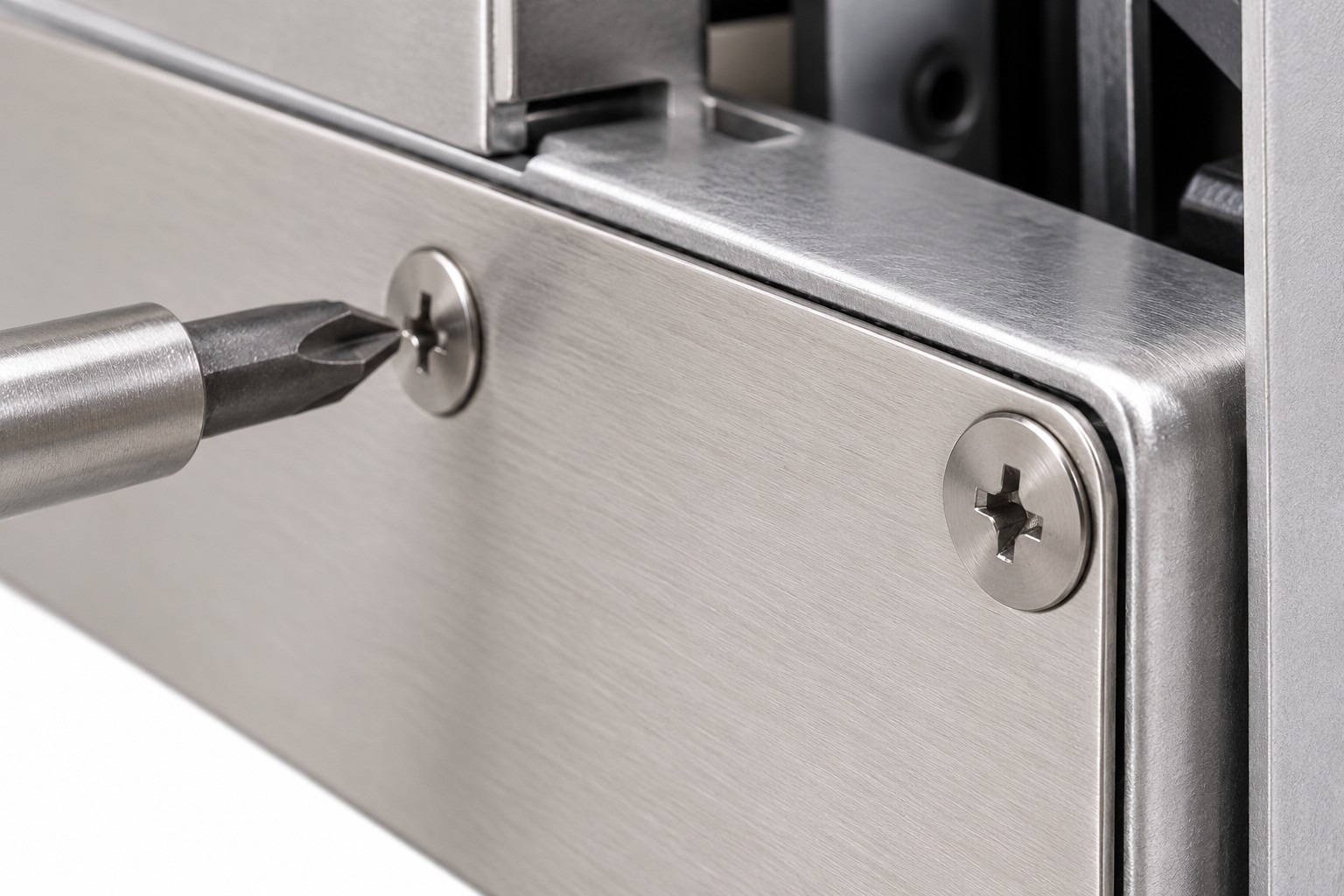
Head Type:Flat head with concentric pattern
Drive:Torx (six-lobe)
Pattern:Concentric grooves, concentric to the recess
Thread:Machine thread
Point:Plain, chamfered
Forming:CNC turning from bar; pattern turned last; recess cut
Size:M2.4*6
Available materials:titanium, aluminum, copper, stainless steel, carbon steel
We turn CD pattern screws in stainless steel, with concentric grooves cut into a flat head and a Torx recess in the centre, quoted to the pattern on the drawing. The pattern is judged by whether the rings look concentric to the recess, so it is cut last and never polished across afterwards.
Watch the factory video·Email sst@szsst88.com
ISO 9001:2015 · Manufacturing since 1998 · 8,678+ customers · 89 countries and regions
Made to order – there is no stock catalogue. Each part is produced to your drawing, and production starts after drawing review and first-article approval.
A CD pattern screw has concentric grooves machined into a flat head, the way a disc reflects light, with a Torx recess in the centre. This part is stainless steel, cleaned, M2.4 by 6 in the smaller end of the range, and is quoted with the pattern and the recess made to the drawing so that the two share one axis.
CD pattern. Concentric circular grooves cut into the head face, which catch light in rings.
Torx recess. A six-lobe star in the centre of the pattern, driven with the matching bit.
Stainless body. No coating, so the pattern is the finished surface rather than a layer over it.
Machine thread. A fine thread for a tapped hole or a nut, with a plain chamfered point.
CD pattern screws are used on camera hardware, audio equipment, instruments and consumer products where the fastener is a design detail and the head is seen at close range under product lighting.
The grooves on a CD pattern head do nothing mechanically. They are there to catch light, and what the eye reads when it sees one is concentricity: rings that share a centre look deliberate, and rings that are slightly off look like a mistake. That is why the pattern is specified as concentric to the recess and to the thread, not just as a groove pitch.
The reference for the pattern is the recess in the middle of it. If the star is cut first and the grooves turned second, the grooves follow the lathe axis and the star can end up off-centre within them; if the pattern is turned first and the recess cut second, the same error appears the other way round. Only one sequence keeps both on the same axis, and the drawing has to make the relationship explicit.
The grooves are shallow and narrow, which makes them fragile in the last steps. Polishing across them smears the edges and the rings lose their crispness; a part that is polished after the pattern reads as faded rather than turned. That is why the pattern is usually the last cut, with only a clean and a passivation after it.
The pattern also changes how the head wears. Dirt and polish residue collect in the grooves, and the crests between them take the handling marks first, so the appearance of the part is decided by how it is packed as much as by how it is cut.
The Torx recess and the pattern compete for the same face. The pattern has to stop short of the recess, with a clean ring around it, or the groove walls run into the star and the head looks unfinished. That ring is a dimension, not an afterthought.
So the part is specified as an appearance item: pattern pitch and depth, the concentricity of the pattern to the recess, the clear ring, and the finishing sequence after the cut. Written that way the head reads correctly under light; left to a general note, it reads as a part that was turned without care.
CD pattern screws are quoted by thread size and pitch, length, head diameter and height, pattern pitch and depth, the clear ring around the recess, recess size and depth, and finish. Custom lengths up to 2,000 mm, subject to DFM review after drawing submission. The quotation carries the material, the head, the pattern, the recess and the thread.
| Item | How it is defined | What we control |
|---|---|---|
| Body | Stainless steel | Grade and condition |
| Head | Flat head with pattern | Diameter, height and face |
| Pattern | Concentric grooves | Pitch, depth and concentricity |
| Clear ring | Plain band around the recess | Width and finish |
| Recess | Torx | Size, depth and concentricity |
| Thread | Machine thread | Size, pitch and length |
The pattern pitch is chosen with the head diameter. Too few grooves and the rings read as a rough turned face; too many and the crests are so fine that handling flattens them.
The clear ring is written as a width. It separates the pattern from the recess and gives the eye an edge to compare against, which is what makes the rings look concentric.
The concentricity of the pattern to the recess is a tolerance, not a note. On a visible head it is the first thing that reads as wrong, and it is the first thing an inspector with a loupe will find.
Four properties decide this part, and each carries a cost:
| Property | What it gives | What it costs |
|---|---|---|
| CD pattern | A head that catches light as a detail | Shallow grooves that show handling |
| Torx recess | A clean drive in a small head | The recess must stay concentric with the pattern |
| Stainless body | No coating over the pattern | Softer than a hardened screw |
| Cleaned finish | Pattern as cut, nothing added | Marks cannot be polished out afterwards |
The value of a CD pattern screw is a fastener that reads as a designed detail rather than a fixing, on hardware where the head is part of the appearance and the fixing is meant to be noticed.
The cost is that the finish cannot be corrected afterwards: an off-centre pattern or a smeared groove is scrap rather than rework, and it is decided by the last cut on the machine.
The recorded finish is cleaned stainless, usually passivated. There is no plating to soften the grooves or to fill the clear ring, so the pattern stays crisp and the rings read the way they were cut.
| Option | How it protects | Effect on the pattern | Typical use |
|---|---|---|---|
| Cleaned stainless | Natural oxide | Grooves as cut; crisp rings | Camera and audio hardware |
| Passivated | Clean, thickened oxide | No build; free of free iron | Laboratory and medical |
| Polished then patterned | Removes tool marks first | Cleaner crests, but no further polishing | Premium visible parts |
| Anodised titanium | Grown oxide, coloured | No build; colour in the pattern | Coloured premium hardware |
| Black oxide | Conversion layer | Dark and matte; pattern softens | Dark camera bodies |
A polished part is polished before the pattern is cut, never after. Polishing across the grooves blurs the crests and the pattern loses the sharp rings that the design was for.
Where the product is dark, a black oxide version carries the pattern at lower contrast; it reads as a soft ring rather than a bright one, which suits a matte body.
Three products where the head is a visible detail:
| Where it sits | The screw holds a plate or a knob where the head is seen at close range under product lighting. |
| When it goes wrong | The rings read off-centre, or a groove has been flattened in packing. |
| Why it happens | The pattern and the recess were cut on different axes, or the part was polished after patterning. |
| What we control | Concentricity toleranced; sample read under angled light before approval. |
| Where it sits | The screw fixes a face plate or a knob on a product sold on its finish. |
| When it goes wrong | The head marks, or the pattern loses contrast against the panel. |
| Why it happens | Handling without protection, and a finish that is too matte to read the rings. |
| What we control | Finish and packing agreed; sample handled and re-checked. |
| Where it sits | The screw secures a bezel where the fixing is part of the interface. |
| When it goes wrong | The Torx is off-centre in the pattern, or the clear ring is uneven. |
| Why it happens | The clear ring was not dimensioned, so the grooves run into the recess. |
| What we control | Clear ring width specified; sample inspected at the recess edge. |
Four points that decide whether a pattern head reads as designed or as damaged:
|
Concentricity written as a tolerance
The drawing states that the pattern is concentric to the recess, because that relationship is what the eye judges. Basis: Pattern tied to the recess. |
Pattern cut last
The pattern is the final cut before cleaning, so nothing polishes across the grooves afterwards. Basis: Rings left crisp. |
|
Read under light
The first article is inspected under the lighting the product is sold in, not on a bench under a lamp. Basis: Judged as it is seen. |
Same pitch every lot
Pattern pitch, depth and clear ring are recorded with the drawing revision, so a repeat lot reads the same. Basis: Same pattern across lots. |
A decorative pattern is bought for how it looks and rejected for how it looks. These four points turn that judgement into something that can be measured on a sample.
These screws are turned from stainless bar: the head is faced, the pattern is turned in concentric passes, the Torx recess is cut in the centre, and the thread is cut or rolled before cleaning and passivation. The first piece of every run is measured on head, pattern, recess and thread.


|

|
The pattern is turned in one continuous pass with a single-form tool, which is what keeps the grooves even. A tool that is fed in two passes leaves a step between them, and the step is visible under light as a band across the rings.
The recess is cut after the pattern and centred on it. On a head this small a few hundredths of eccentricity shows at once, because the eye has the rings as a reference circle to compare against.
Nothing abrasive follows the pattern. The part is cleaned and passivated, packed so the heads do not touch, and inspected under angled light, which is the condition in which the customer will see it.
What decides whether a batch of CD pattern screws passes is the pattern that reads concentric, the clear ring that frames it and the recess that drives it. The inspection agreement covers all three.

Pattern and recess on the projector |

Thread checked with gauges |

Material checked |

Salt-spray testing where required |
The pattern is measured for pitch and depth on the projector, and its concentricity to the recess is checked as a number. Then the sample is looked at under angled light, because that is where an off-centre pattern becomes obvious even when the numbers are close.
The clear ring is measured for width and checked for a continuous edge. A ring that varies in width reads as an off-centre recess, whatever the recess actually measures.
The recess is measured for depth and lobe form and driven with the bit, and the head face is inspected for marks between the grooves. A scratch across the rings cannot be blended out, so it is a reject rather than a rework.
Every batch of CD pattern screws is traceable to the bar it was made from. The material certificate states the grade, the heat number, the chemistry and the mechanical properties, and the inspection record carries the head, pattern, recess and thread against the drawing.

ISO 9001:2015 |

RoHS test report |

Registered trademark |

Patent: security screw and driver |
With each shipment we supply the material certificate and the inspection record for the head, pattern, recess and thread. The records carry the batch number, so a repeat order can be compared with the first on the pattern pitch and the clear ring that decide how the head reads.
More than 8,678 customers in 89 countries and regions have ordered from Shi Shi Tong; 87% of orders come from repeat customers and 56% through referrals. Most projects follow the same route: drawing review, first-article approval, then batches checked against that sample. On a decorative head the first article is looked at under the product lighting before it is approved, because that is the condition the customer’s customer will judge it in. Buyers visit during the process to review samples.
|
8,678+
customers served
|
87%
of orders from repeat customers
|
56%
of orders through referrals
|
89
countries and regions shipped to
|
Buyers and quality engineers visit for sample review, process discussion and supplier audits; the visit is arranged around production so the turning cells can be seen on the day the parts run.

Customer group visit – sample review |

Customer group visit – process discussion |

Customer group visit – factory tour |

Customer visit – project kick-off |

Danish customer – drawing review |

Industry exhibition – meeting customers |
Concentric grooves turned into a flat head, so the face reflects light in rings. It is cosmetic, not functional.
The pattern and the recess were cut on different axes, or the clear ring around the recess varies in width.
No. Polishing across the grooves blurs the crests and the pattern reads as faded. Polish first, pattern last.
No. The drive is the Torx recess; the pattern is on the face around it.
The crests between the grooves take handling marks first, and dirt collects in the grooves.
Head size, pattern pitch and depth, concentricity to the recess, the clear ring width, the recess, the thread and the finish order.
How a CD pattern screw project runs from drawing to repeat delivery:
|
1
Send the drawing and the look you need
|
→ |
2
Pattern, ring and recess agreed
|
→ |
3
First article read under product light
|
→ |
4
Batch production and repeat orders
|
Each step is confirmed with you before the next one starts; the drawing revision used for the first article is what repeat orders are checked against.
For a quotation, send the drawing with the head size, pattern pitch and depth, the clear ring width, Torx size and depth, thread and length, and the finish.
|
Head
|
Pattern
|
Clear ring
|
|
Torx
|
Thread
|
Finish
|
Sending a drawing? The form below does not take attachments. Email the PDF, DXF or STEP file to sst@szsst88.com with the part name and quantity in the subject line – the drawing is reviewed and a quotation follows.

 +86 13143444311
 sst@szsst88.com