Tel:
+86 13143444311
Email:sst@szsst88.com
Fax:+0086-755-27322278
Address:Building 9, First Industrial Zone, Tantou Industrial City, Songgang Street, Baoan District, Shenzhen 518105, Guangdong, China
Type:Aluminum Screw Posts
Materials:Aluminum
Surface treatment:Cleaned
Head Type:Small hexagon head
Drive:Hexagon, driven on the head
Thread:Machine thread, internal in the barrel
Grip range:Set by the barrel depth and stud length
Forming:CNC turning from bar; barrel drilled and tapped
Size:M3 M4 M5
We turn aluminum screw posts as a matched male stud and female barrel with small hex heads, quoted with the grip range and thread to the binding they hold. Aluminium is light and bright but its thread wears by the opening, so the part belongs on a binding assembled once rather than on one taken apart weekly.
Watch the factory video·Email sst@szsst88.com
ISO 9001:2015 · Manufacturing since 1998 · 8,678+ customers · 89 countries and regions
Made to order – there is no stock catalogue. Each part is produced to your drawing, and production starts after drawing review and first-article approval.
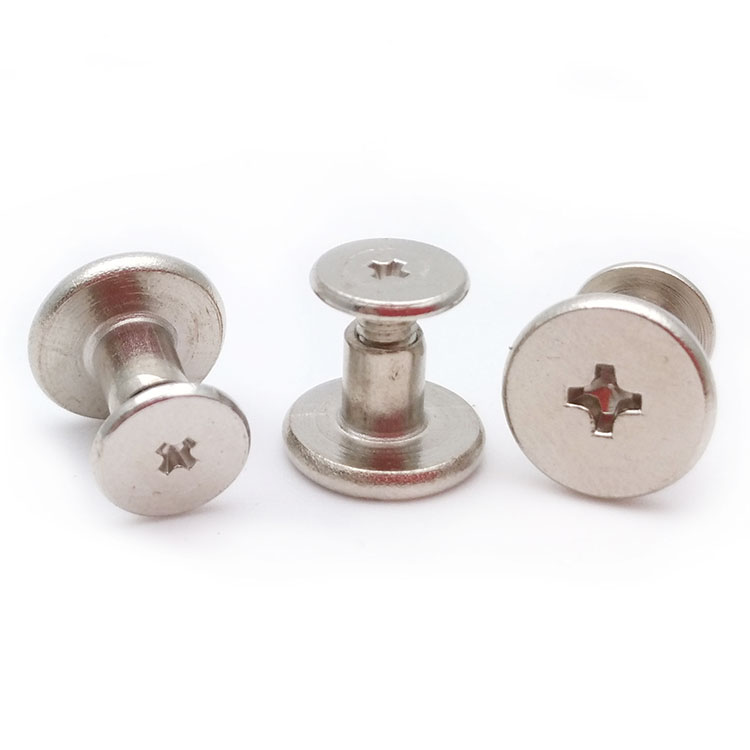
Aluminum screw posts are two-piece binding posts: a male stud with a thread and a female barrel, made in aluminium and used to bind sheets, boards and samples. This pair has a small hex head on each half, is supplied cleaned, and is quoted in M3 to M5 with the lengths made to the drawing.
Two pieces. A male and a female, so the binding can be closed and, if needed, opened.
Aluminium body. About a third of the weight of steel and no rust, with a bright natural finish.
Hex head. A small hexagon on each half, so the pair can be turned with a spanner or held with fingers.
Cleaned finish. No plating, so the thread and the head are exactly as machined.
These aluminum screw posts are used for sample books, swatch sets, catalogue boards and display bindings, where the part is light, discreet and often permanent once the binding is closed.
A binding post is opened and closed more often than most fasteners. Each cycle the male thread runs through the female thread, and each pass takes a little material off the flanks. In steel that loss is negligible over the life of the product; in aluminium it is not, because the material is softer and the thread is small. After a handful of cycles the pair that was snug begins to feel loose, and after a dozen the thread engagement is visibly worn.
That is the honest limit of an aluminum screw post, and it is not a defect: it is the reason the part is chosen for bindings that are assembled once. A sample book that is opened at a trade show every day is better served by brass or stainless; a swatch deck that is fanned but not taken apart is exactly what aluminium is for.
The second wear point is the head. A small hexagon gives a limited grip, so the pair is turned with light torque or by hand, and that is deliberate: the binding material is usually paper, board or plastic, and a strong torque would crush it rather than tighten the joint.
Aluminium brings one advantage that matters on a visible binding: it can be anodised to almost any colour, and the colour sits on the same part that binds. In this cleaned finish the natural metal is left bright, which suits a product where the posts are meant to read as hardware rather than as decoration.
The barrel is the fixed half and the stud is the one that moves. Because the barrel holds the thread depth, the grip is set once by the pair; the stud only decides how far it can reach. On a thick sample book the stud has to be long enough to cross the stack before it engages, and on a thin one the same stud bottoms in the barrel.
So the part is specified by the binding it holds and the number of times that binding is opened: grip, thread, head size, and a material that suits the service. Written that way, an aluminium post does its job without apology.
Aluminum screw posts are quoted by barrel diameter and length, stud diameter and length, thread size and pitch, head across-flats and height, and finish. Custom lengths up to 2,000 mm, subject to DFM review after drawing submission. The quotation carries the material, the barrel, the stud, the heads and the finish.
| Item | How it is defined | What we control |
|---|---|---|
| Barrel | Diameter and thread depth | Engagement inside the barrel |
| Stud | Diameter and thread length | Thread length and run |
| Heads | Hexagon across-flats | Size, height and squareness |
| Grip | Material thickness the pair holds | Set by the two lengths |
| Thread | Size and pitch | Size, pitch and class |
| Finish | Cleaned aluminium | Surface condition and burrs |
The grip is given as a range, because paper and board compress and a binding is rarely one exact thickness. The barrel depth sets the upper end and the stud length sets how the pair enters, and both are needed.
The head across-flats is written as a dimension rather than a tool size, since the small hexagon is turned by hand as often as by a spanner. A head that is too small for the fingers makes the pair awkward to open.
The thread is written with its pitch, because at M3 the pitch is a large fraction of the diameter and two posts of the same size can be incompatible.
Four properties decide this part, and each carries a cost:
| Property | What it gives | What it costs |
|---|---|---|
| Aluminium body | Light, rust free, bright | Thread wears faster than steel |
| Two-piece post | A binding that can be opened | Two parts to match and stock |
| Hex head | A spanner or fingers will fit | Small grip, so low torque |
| Cleaned finish | Thread and head as machined | Soft surface marks easily |
The value of aluminum screw posts is a light, clean binding that leaves the visible face of a sample book or a swatch deck flat and neat, with no rust and no coating to chip at the edge.
The cost of aluminum screw posts is a thread life measured in openings, so the part belongs on a binding that is assembled once and fanned in use rather than on one that is taken apart and rebuilt regularly through the season.
The recorded finish is cleaned aluminium. There is no plating and no anodising, so the threads and the hexagons are exactly as machined and the metal is left bright; burrs are removed by hand rather than by tumbling, because tumbling would round the hexagon that does the gripping.
| Option | How it protects | Effect on the thread | Typical use |
|---|---|---|---|
| Cleaned aluminium | Natural oxide | No build; gauge as cut | Bright hardware |
| Anodised | Grown oxide, coloured | No build; colour on the head | Coloured bindings |
| Black anodised | Grown oxide, dark | No build | Dark covers and cases |
| Clear anodised | Thicker natural oxide | Slight growth; checked | Handled parts |
| Brass body | No coating needed | No build; longer thread life | Bindings opened often |
Anodising is the finish that keeps the weight and adds colour, and because the oxide grows into the metal the thread stays as cut. It is the usual choice on a visible binding that has to match a cover.
Where the binding is opened often, the answer is not a finish but a different body: brass or stainless has a much longer thread life, at the cost of weight and price.
Three bindings where a light post leaves the face clean:
| Where it sits | The pair binds boards and swatches that are fanned and handled but rarely taken apart. |
| When it goes wrong | The pair loosens, or the head marks the cover. |
| Why it happens | The thread has worn from repeated opening, or the head is small for the cover. |
| What we control | Grip and head size set from the stock; first article fanned and re-closed. |
| Where it sits | The pair holds a display panel where the fixing should disappear into the design. |
| When it goes wrong | The heads stand proud, or the panel cracks at the hole. |
| Why it happens | The barrel is longer than the panel is thick, so the heads never meet it. |
| What we control | Panel thickness measured; barrel and stud lengths set from it. |
| Where it sits | The pair joins two panels of a carry case where weight and appearance both count. |
| When it goes wrong | The thread galls, or the aluminium marks the panel. |
| Why it happens | The mating material is wrong, and there is no washer between the head and the panel. |
| What we control | Interface agreed; sample assembled and inspected at the head. |
Four points that decide whether a pair fits its binding and survives the openings it will see:
|
Grip given as a range
The drawing gives the material thickness range, because paper and board compress and a binding is rarely one thickness. Basis: Grip matched to the stock. |
Barrel and stud made as a pair
The internal and external threads are cut to work together, so the pair that runs in the sample runs in the batch. Basis: Pair proved together. |
|
Assembled by hand
The first article is assembled through the customer stock and turned by hand, the way the binding will be used. Basis: Feel proved by hand. |
Same alloy every lot
Alloy and finish are recorded with the drawing revision, so a repeat lot has the same weight and the same wear. Basis: Same material across lots. |
An aluminium binding post is judged by how it feels after a hundred openings, which is something a sample can only suggest. These four points are what makes the suggestion reliable.
The stud and the barrel are turned in aluminium: the hexagon is formed on the head, the stud threaded, the barrel drilled and tapped to the depth on the drawing, and both halves cleaned. The first piece of every run is measured on head, thread, barrel depth and length, and assembled by hand.


|

|
Aluminium cuts quickly, which makes the barrel the part that needs attention: the internal thread has to be cut cleanly to a defined depth, and a tap that is run too fast leaves a torn thread that will wear out in a handful of openings.
The hexagon is formed before the thread so the two are concentric. A head that is off-centre turns the pair at an angle, and on a binding that shows as posts that do not line up along the edge.
The cleaned finish is the final surface, so handling marks show. The parts are packed so the heads do not rub, and inspected for burrs at the hexagon, which is the feature the fingers feel first.
What decides whether a batch of aluminum screw posts passes is the thread that engages, the barrel depth that sets the grip and the hexagon that turns. The inspection agreement covers all three.

Heads and barrel on the projector |

Threads gauged as a pair |

Alloy checked |

Salt-spray testing where required |
The stud and the barrel are gauged together. A pair that passes separately can still bind when they are run together, and on a part that is turned by hand that bind is felt immediately.
The barrel depth is checked with a depth gauge and confirmed by assembling over spacers at both ends of the grip range. On a binding that is the test that matches the way the part is used.
The hexagon is measured across-flats and checked with the spanner, and the corners are inspected for burrs. A rounded hexagon on an aluminium post is the first sign that the pair will be hard to open.
Every batch of aluminum screw posts is traceable to the bar, with the stud and the barrel recorded as a matched pair. The material certificate states the alloy, the temper and the mechanical properties, and the inspection record carries the heads, threads and barrel depth.

ISO 9001:2015 |

RoHS test report |

Registered trademark |

Patent: security screw and driver |
With each shipment we supply the material certificate and the inspection record for both halves. The records carry the batch number, so a repeat order can be compared with the first on the alloy and the barrel depth that decide the fit and the wear.
More than 8,678 customers in 89 countries and regions have ordered from Shi Shi Tong; 87% of orders come from repeat customers and 56% through referrals. Most projects follow the same route: drawing review, first-article approval, then batches checked against that sample. On a binding post the first article is assembled through the customer stock, because the grip is a property of the pair and the material together. Buyers visit during the process to review samples.
|
8,678+
customers served
|
87%
of orders from repeat customers
|
56%
of orders through referrals
|
89
countries and regions shipped to
|
Buyers and quality engineers visit for sample review, process discussion and supplier audits; the visit is arranged around production so the turning cells can be seen on the day the parts run.

Customer group visit – sample review |

Customer group visit – process discussion |

Customer group visit – factory tour |

Customer visit – project kick-off |

Danish customer – drawing review |

Industry exhibition – meeting customers |
A handful of cycles before the thread feels loose. Aluminium wears faster than brass or steel at the same size.
The thread has worn, or the binding material has compressed. Both are normal on a soft binding.
Yes, and because the oxide grows into the metal the thread stays as cut. It is the usual finish on a coloured binding.
No. Aluminium forms its own oxide and does not rust, though it can stain against steel in a damp joint.
Better to choose brass or stainless. Aluminium suits a binding assembled once and fanned in use.
Barrel diameter and depth, stud length, thread and pitch, head across-flats, the compressed grip range, and how often the binding is opened.
How an aluminum screw post project runs from drawing to repeat delivery:
|
1
Send the drawing and the stock sample
|
→ |
2
Grip and head size agreed
|
→ |
3
First article assembled by hand
|
→ |
4
Batch production and repeat orders
|
Each step is confirmed with you before the next one starts; the drawing revision used for the first article is what repeat orders are checked against.
For a quotation, send the drawing with the barrel diameter and depth, stud length, thread and pitch, head across-flats, and the stock thickness the pair has to hold.
|
Barrel
|
Stud
|
Thread
|
|
Heads
|
Grip
|
Finish
|
Sending a drawing? The form below does not take attachments. Email the PDF, DXF or STEP file to sst@szsst88.com with the part name and quantity in the subject line – the drawing is reviewed and a quotation follows.

 +86 13143444311
 sst@szsst88.com