Tel:
+86 13143444311
Email:sst@szsst88.com
Fax:+0086-755-27322278
Address:Building 9, First Industrial Zone, Tantou Industrial City, Songgang Street, Baoan District, Shenzhen 518105, Guangdong, China
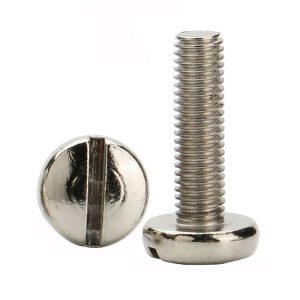
Type:Slotted Cheese Head Screw
Materials:Stainless Steel
Surface treatment:Plain
Head Type:Cheese Head
Drive:Slotted
Thread:Machine Thread
Point:Blunt
Forming:Single Die Heading
Size:M1 M2 M3 M4 M5 M6 M7 M8 M9 M10 M14
Number:108
We make slotted cheese head screws in passivated stainless to the DIN cheese head proportions, a single slot and a machine thread, quoting them from M1 to M14. Designation, size, grade and finish are agreed up front, and the first article is checked against the standard and driven with a standard blade.
Watch the factory video·Email sst@szsst88.com
ISO 9001:2015 · Manufacturing since 1998 · 8,678+ customers · 89 countries and regions
Made to order – there is no stock catalogue. Each part is produced to your drawing, and production starts after drawing review and first-article approval.
A slotted cheese head screw is a machine screw with a cylindrical head, a slightly domed top and a single slot, made to the proportions of the DIN cheese head standard. It is the interchangeable version of the form: thread size and length are the only variables, and everything else is fixed by the standard. This family is made in passivated stainless, quoted from M1 to M14 with Number 108.
Cheese head. A straight-walled cylinder with a domed top and a flat bearing face, fixed in height and diameter by the standard.
Single slot. One straight slot across the head, sized by the standard for its thread.
Machine thread. A rolled thread for a tapped hole or a nut, ending in a blunt chamfer.
Passivated stainless. Uncoated, so the slot and head are as made and the alloy carries the protection.
In practice a slotted cheese head screw is ordered by its code, so the drawing that matters is the material and finish specification that travels with the designation.
The interesting thing about a slotted cheese head screw is not the head. It is that the part can be specified by a code instead of a drawing: thread, length and standard, and every other dimension is already decided. For a maintenance spare, a catalogue item or a second source, that is worth a great deal, because two makers producing to the same standard produce parts that fit the same hole.
The standard fixes what matters to a joint: head diameter, head height, slot width and the bearing face. It does not fix what matters to a process — the exact surface finish, the steel grade, the plating, the batch traceability — so a standard part still needs a material and finish specification alongside it. That is the line an engineer has to draw: the shape comes from the standard, the metal comes from the drawing.
A cheese head is one of the older head forms and it shows. The tall cylinder with a domed top exists to give a slot depth, to allow a blade to be seen from the side while driving, and to give the fingers something to hold if the blade is missing. Those are all characteristics of a hand-assembled, hand-serviced design, which is exactly where the part is still used.
The slot itself is the same trade as on any slotted screw. It carries more torque than a cross of the same head size, because the blade contacts a long straight wall, and it gives no warning before it slips sideways. Operated with the right blade, held down while turning, it is a reliable drive; operated with a power tool and a worn blade, it marks the head immediately.
Stainless is the material specification that turns this standard part into one that survives outdoors. The head geometry does not change between a plated steel and a stainless version; what changes is that the stainless one can be left on a panel for years, be washed, and still be driven out with a flat blade when it has to come apart.
The recorded range is M1 to M14, covering M1, M2, M3, M4, M5, M6, M7, M8, M9, M10 and M14. Custom lengths up to 2,000 mm are subject to DFM review after drawing submission. For a slotted cheese head screw the quotation is the standard designation plus the material and finish, because the head dimensions come from the standard rather than from a drawing.
| Item | How it is defined | What we control |
|---|---|---|
| Head | Cheese head per standard | Head diameter and height to the standard |
| Slot | Single slot per thread size | Slot width and depth |
| Thread | Machine thread | Pitch and length, gauged per batch |
| End | Blunt, chamfered | Chamfer cut, not deburred |
| Finish | Passivated stainless | Surface condition and film |
| Length | Under the head | Measured on the shop plate |
Length is part of the designation, and it is measured under the head — so the same code number gives the same physical screw from any maker working to the standard. That is the practical value of buying to a standard, and it is also the trap: a customer who needs a shorter or longer version of the same screw is moving away from the standard and back to a drawing.
Where a joint needs a head that is not the standard height, or a slot that is wider than the standard for the thread, the part becomes a special. That is not a problem, but it should be a deliberate decision recorded on a drawing rather than an assumption that the standard covers it.
Three features define this part: the standard head proportions, the slot and the stainless body. The first makes it replaceable, the second makes it drivable with the simplest tool, and the third makes it survive where a plated part would not.
| Feature | What it gives | What it costs |
|---|---|---|
| Standard head | Interchangeable between makers | No freedom to adjust the head |
| Single slot | High torque from a flat blade | Blade can slide sideways |
| Tall head | Slot depth and something to grip | Stands proud of the panel |
| Machine thread | Repeatable clamp in a tapped hole | Needs a tapped hole or nut |
| Passivated stainless | No coating to chip | Galls against stainless |
The interchangeability is the reason to buy it and the reason to be careful with it. A standard part from two sources fits the same hole, but the two parts can still differ in grade, hardness and finish, and a joint that depends on one of those will notice. The material specification is what makes the standard part predictable.
The tall head is a small functional advantage that is easy to overlook. On a joint that is serviced by hand in the field, a cheese head can be turned with a blade, gripped between the fingers if the blade is lost, and seen from the side while the blade is engaged. None of those is a feature of modern drives, and all of them matter on equipment that is repaired rather than replaced.
The recorded finish is passivated stainless, with nothing added. On a standard part that is the right combination: the head and slot follow the standard, and the surface follows the alloy. Passivation removes free iron from cutting and lets the passive film rebuild, so the slot stays as cut and the part resists corrosion without a coating that could alter the fit.
| Option | How it protects | Effect on slot and head | Typical use |
|---|---|---|---|
| A2 stainless, passivated | Passive chromium oxide film | Slot as cut | General outdoor and indoor |
| A4 stainless, passivated | Passive film with molybdenum | Slot as cut | Coastal and chemical |
| Steel, white zinc | Sacrificial zinc | A few microns; slot re-checked | Indoor general work |
| Brass, plain | Alloy resists corrosion | Clean slot; softer metal | Electrical and instruments |
| Steel, black oxide | Conversion film, oiled | No measurable build | Internal mechanisms |
On a standard part the finish is often the only place where a customer can choose, so it is worth choosing deliberately. A zinc-plated steel version is the cheapest and is fine indoors; a stainless version is the one that survives washing and weather; a brass version is the one that carries current and looks right on an instrument.
Whichever is chosen, the slot has to be checked on the finished part, because a coating changes it. On a standard screw the slot width comes from the standard, and a deposit that narrows it turns a standard part into one that a standard blade will not fit.
Three assemblies where slotted cheese head screws are the fixing:
| Where it sits | The screw replaces a fastener on installed equipment where the part has to be available from a catalogue and fit without a drawing. |
| When it goes wrong | A special in place of a standard part makes the next service harder, and a slot that is damaged in place cannot be re-cut. |
| Why it happens | The part is a spare, the machine is in service, and the tool is a flat blade. |
| What we control | Standard designation and material confirmed, slot checked and plated fit verified. |
| Where it sits | The screw clamps a terminal or fixes a cover where the head is visible and the joint is adjusted with a blade. |
| When it goes wrong | A plated steel screw rusts in a damp cabinet, and a soft head deforms at the slot. |
| Why it happens | The joint is electrical or visible, it is serviced, and the part is stainless. |
| What we control | Grade confirmed, slot driven with the production blade. |
| Where it sits | The screw is called out by standard designation on an assembly drawing where the designer wants a known, replaceable part. |
| When it goes wrong | The standard fixes the head but not the material, and a mismatch shows up as corrosion rather than as a fit problem. |
| Why it happens | The design references a standard, the joint is serviced, and the environment is known. |
| What we control | Designation, grade and finish all confirmed against the drawing. |
Four reasons that matter on a standard part, each tied to what the drawing or designation has to prove:
|
Designation and material both confirmed
The standard designation and the material and finish are confirmed together, because a standard shape in the wrong grade is still the wrong part. Basis: Designation, grade and finish agreed. |
Head, slot and thread in one route
The standard head and the slot are formed in the heading stroke, the thread is rolled and the parts are passivated in the same route. Basis: One route from wire to passivated screw. |
|
Slot checked on the finished part
The slot is measured and driven with a standard blade on the finished screw, because a coating that narrows it turns a standard part into a special. Basis: First article driven with a standard blade. |
First article fixes the setting
The first article fixes the wire, the head die and the slot cutter; repeat orders are compared against that record. Basis: First article signed off before the batch is released. |
Shi Shi Tong forms these slotted cheese head screws from stainless wire on single-die headers that form the standard head and cut the slot in one stroke, rolls the machine thread to a blunt chamfered end and passivates the finished parts. The first part of every run is measured on the head and slot, driven with a standard blade and entered into a thread gauge before the batch continues.


|

|
Making a standard head is a different discipline from making a special one. There is no drawing to interpret, so the acceptance is entirely against the standard: diameter, height and slot width have to be inside the published limits, or the part stops being interchangeable — which is the only thing it was bought for.
What decides whether slotted cheese head screws pass is the head, the slot, the thread and the alloy. The inspection agreement covers those, and the criteria come from the standard and the material specification.

Head and slot on the projector |

Thread gauged per batch |

Hardness checked on the wire |

Salt-spray testing of the grade |
The head and slot are checked against the standard dimensions on the projector, and the slot is driven with a standard blade on the finished part. The thread is gauged per batch, and the alloy is confirmed on the mill certificate rather than assumed.
On a standard part the inspection record is the only thing that proves the part is still standard after a batch of production. It carries the designation, the dimensions checked, the grade and the batch number, so a repeat order can be compared with the one that was accepted.
Every shipment of slotted cheese head screws is traceable to the wire it was made from and to the passivation batch. The grade and heat number are recorded on the material certificate supplied with the parts, and the inspection records follow the standard and the material specification.

ISO 9001:2015 |

RoHS test report |

Registered trademark |

Patent: security screw and driver |
With each batch we supply the material certificate, the inspection record for the criteria on the drawing and, where it is listed, the third-party report for the grade or the passivation. The standard designation appears on the documents, so a spare can be ordered and checked against the same reference as the original.
More than 8,678 customers in 89 countries and regions have ordered from Shi Shi Tong; 87% of orders come from repeat customers and 56% through referrals. Most projects follow the same route: drawing review, first-article approval, then batches checked against that sample. On a standard part the first article is checked against the standard dimensions and tried with a standard blade. Buyers visit during the process to review samples and to see how the heads and slots are formed.
|
8,678+
customers served
|
87%
of orders from repeat customers
|
56%
of orders through referrals
|
89
countries and regions shipped to
|
Buyers and quality engineers visit for sample review, process discussion and supplier audits; the visit is arranged around production so the headers and the passivation line can be seen on the day the parts run.

Customer group visit – sample review |

Customer group visit – process discussion |

Customer group visit – factory tour |

Customer visit – project kick-off |

Danish customer – drawing review |

Industry exhibition – meeting customers |
The head diameter, head height, slot width and bearing face for each thread size. The grade and finish are separate, which is why they still have to be specified.
Because it is replaceable. Any maker working to the same standard produces a screw that fits the same hole, which is what a spare part needs.
Under the head. The length is part of the designation, so the same code gives the same screw from any source.
It takes more than a cross of the same head, but it slips sideways rather than camming out. A blade that fills the slot and is held down while turning is what keeps the head intact.
Where the joint is outdoors, washed or in a food area, yes. Indoors, a zinc-plated steel version is cheaper and behaves the same in the joint.
The standard designation, thread size and length, the grade and the finish, and the blade that will be used if the driving torque matters.
How a slotted cheese head screw order runs from specification to repeat delivery:
|
1
Send the designation, size and grade
|
→ |
2
Head, slot and thread confirmed to the standard
|
→ |
3
First article checked against the standard
|
→ |
4
Batch production and repeat orders
|
Each step is confirmed with you before the next one starts; the designation, grade and finish from the first article are what repeat orders are checked against.
For a quotation, send the standard designation with the thread size and length, the grade, the finish and the batch documentation you need.
|
Designation
|
Thread size
|
Length
|
|
Grade
|
Finish
|
Documentation
|
Sending a drawing? The form below does not take attachments. Email the PDF, DXF or STEP file to sst@szsst88.com with the part name and quantity in the subject line – the drawing is reviewed and a quotation follows.

 +86 13143444311
 sst@szsst88.com