Tel:
+86 13143444311
Email:sst@szsst88.com
Fax:+0086-755-27322278
Address:Building 9, First Industrial Zone, Tantou Industrial City, Songgang Street, Baoan District, Shenzhen 518105, Guangdong, China
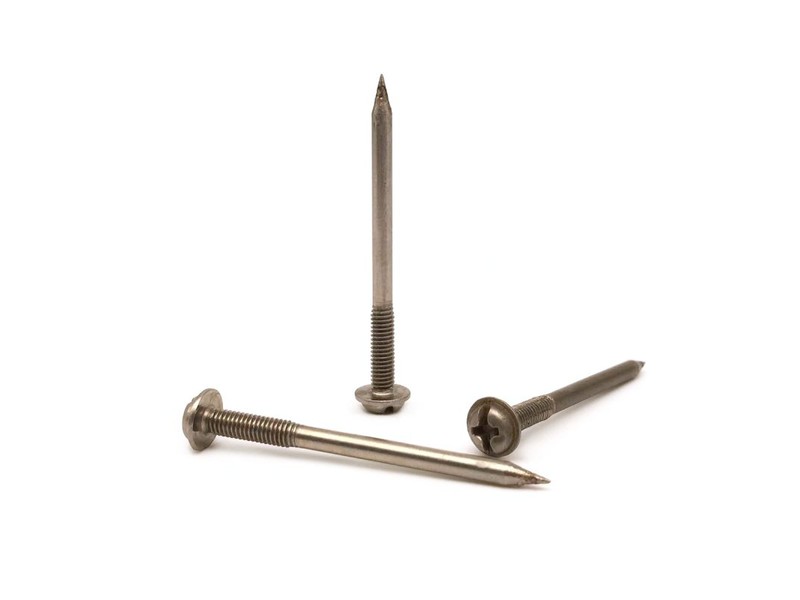
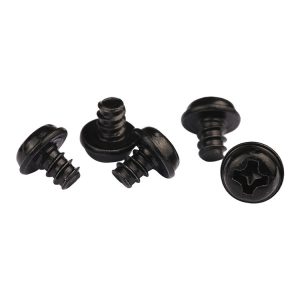
Type:Black Oxide Self Tapping Screws
Materials:Carbon Steel
Surface treatment:Black Oxide
Head Type:Pan Washer Head
Drive:Phillips cross recess (PH2 on M4 to M6 sizes)
Thread:Coarse single-lead self-tapping thread, rolled, full to the flange bearing face
Point:Gimlet point for wood, board and plastics; drill point for sheet metal on request
Forming:Single-die heading, thread rolling, black oxide, oiling and sorting
Size:M1 M2 M3 M4 M5 M6 M7 M8 M9 M10 M14
Number:775
We manufacture black oxide self tapping screws with a pan washer head and a Phillips recess, in carbon steel with a black oxide finish, quoted from M1 to M14. Head and flange, point form, thread and length are taken from your drawing.
Watch the factory video·Email sst@szsst88.com
ISO 9001:2015 · Manufacturing since 1998 · 8,678+ customers · 89 countries and regions
Made to order – there is no stock catalogue. Each part is produced to your drawing, and production starts after drawing review and first-article approval.
Black oxide self tapping screws are self-tapping screws with a thin black conversion finish, used where a dark fixing has to disappear into the assembly. The recorded item on this page has a pan washer head — a low domed head with an integral washer flange — a Phillips recess and a coarse self-tapping thread, in carbon steel, quoted from M1 to M14 with Number 775.
Self tapping. The screw forms or cuts its own mating thread in a prepared hole, so it needs no nut and no tapped hole. That is what makes it a fixing for sheet, timber, board and plastics rather than for machined parts.
Pan washer head. A low dome on a flat bearing ring, with the washer flange formed into the head. The flange widens the bearing area without adding a separate washer, which keeps the part count at one and the load spread over a proper ring on a thin panel.
Phillips recess. A cross recess that centres the bit and cams out before the head is destroyed. On a black part the recess is the first place wear shows, because a worn bit exposes bright steel against the oxide.
Black oxide. A conversion finish that darkens the steel without adding a measurable layer. It gives the dark tone that these screws are chosen for, and it leaves the thread and the recess at their formed dimensions.
Together these decide the joint: the self-tapping thread holds without a nut, the washer head spreads the load, the Phillips recess takes a standard bit, and the black finish lets the fixing sit quietly in a dark assembly.
The head and the washer flange are upset in a single heading stroke, and the Phillips recess is formed in the same stroke so that it stays concentric with the shank. A flange that is formed separately and pressed on would move under load; an integral one cannot.
The bearing ring under the flange is left flat. That ring is the working surface of a black oxide self tapping screws part: it has to sit on the panel and carry the clamp load, and if it is dished the head rocks and the joint loosens without the screw ever being loose in its hole.
The thread is rolled after heading and runs up to the flange. Rolling work-hardens the steel and gives a clean flank, which is what allows a self-tapping thread to cut or form its way into the hole without tearing the material around it. The point is formed after rolling, so the entry is clean and the first thread starts where it should.
Black oxide is applied last and the parts are lightly oiled. Because the finish is a conversion layer, the thread is gauged in its finished condition, and the recess is checked with the driver after treatment rather than before.
The family is quoted from M1 to M14, with M1, M2, M3, M4, M5, M6, M7, M8, M9, M10 and M14 in the recorded range. Custom lengths up to 2,000 mm are subject to DFM review after drawing submission; black oxide self tapping screws are normally short, because the thread is doing the work over the thickness of the material being fixed.
| Item | How it is defined | What we control |
|---|---|---|
| Thread | Coarse self-tapping thread, rolled | Gauged per batch |
| Head | Pan head, low dome | Checked on the projector |
| Washer flange | Integral, wider than the head crown | Measured on the first article |
| Bearing ring | Flat under the flange | Flatness checked on the first article |
| Recess | Phillips cross | Driven with the production bit |
| Point | Gimlet for wood and board; drill point for sheet on request | Checked on the first article |
| Length | From under the flange to the point | Measured on the shop plate |
Length is measured from under the flange, because that is the face that bears on the panel. On a washer head the flange adds thickness, so a drawing quoted from the top of the dome will produce a screw that stands off the panel by the flange thickness, and on a thin assembly that is enough to leave the joint loose.
The washer flange diameter is the number to agree when the panel is soft or thin. A flange that is too small dishes the material; one that is too large bridges a boss or fouls a neighbouring part. It belongs on the drawing next to the head diameter rather than being left to the standard.
Three features define this part, and each of them decides something the others cannot.
| Feature | What it gives | What it costs |
|---|---|---|
| Self-tapping thread | Holds without a nut or tapped hole | Needs the right pilot hole for the material |
| Pan washer head | Bearing area without a loose washer | Wider footprint than a plain pan head |
| Phillips recess | Standard bit, cams out before damage | Recess wears first on a dark finish |
| Black oxide | Dark tone, no dimensional change | Thin protection; not for wet service |
| Coarse thread | Grip in soft materials | Low pull-out in hard thin sheet |
The thread is the feature that sets the pilot hole. In timber and board the hole is small and the thread compresses the material as it enters; in sheet metal the hole is close to the thread diameter and the point has to start without wandering. The same black oxide self tapping screws part is not right for both, which is why the material being fixed belongs on the drawing.
The washer head is the feature that sets the bearing area. On a thin panel it spreads the load and covers a clearance hole that has opened up; on a soft panel it lowers the contact pressure enough that the material does not dish. The trade is a wider footprint, which matters where fixings sit close together.
The black finish is chosen for the assembly, not for the joint. It does not change the strength, the thread or the bearing area; it changes whether the fixing reads as part of a dark product or as a bright dot on it. That is a legitimate reason to specify it, provided the environment stays dry.
The recorded finish is black oxide with a light oil film. It is a conversion coating: the surface is chemically darkened, and there is no measurable thickness to change the thread or the recess.
| Finish | How it protects | Effect on thread and recess | Typical use |
|---|---|---|---|
| Black oxide, oiled | Thin conversion film plus oil | Almost no change | Dry indoor assemblies |
| Black zinc | Zinc layer with black passivation | A few microns; gauged after | Dark parts exposed to moisture |
| Black phosphate, oiled | Conversion coat, oil retention | Thin; thread unchanged | Machine tools and fasteners |
| Black Dacromet | Zinc-aluminium flake layer, cured | Thin film; thread re-checked | Outdoor and wet assemblies |
| Stainless, black passivated | Alloy protection with a dark tone | No coating | Wash-down and coastal work |
The distinction between black oxide and black zinc is worth stating plainly: both look black, and only one is a corrosion barrier. Black oxide relies on the oil film and the dryness of the service; black zinc sacrifices itself. On black oxide self tapping screws used in a damp workshop the first rust appears at the point and at the recess edges, where the film is thinnest.
Where a black part has to survive moisture, black zinc or black Dacromet is the step up. Both add a thin layer, so the thread is gauged after coating and the recess is checked with the bit, because a dark finish that fills the recess is no better than a bright one that rounds it.
Three assemblies where a dark self-tapping screw with a washer head is the right fixing:
| Where it sits | The screw fixes a panel, a speaker baffle or a module to a black housing where no nut is available on the far side. |
| When it goes wrong | A bright screw breaks a black face, and a head without a flange dishes a thin panel around the fixing. |
| Why it happens | The housing is thin and dark, the joint is made from one side, and the fixing is visible. |
| What we control | Flange diameter and flatness checked, thread and point matched to the material. |
| Where it sits | The screw joins board, MDF or a composite panel where the thread forms its own grip and the head has to spread load on a soft face. |
| When it goes wrong | A plain head pulls into the board, and a point that is wrong for the material splits it or wanders. |
| Why it happens | The material is soft, the fixing is seen, and the assembly is made on a line. |
| What we control | Point form and thread checked on the first article, flange diameter against the board. |
| Where it sits | The screw fixes a cover or a bracket to a black painted or powder-coated sheet panel with a prepared hole. |
| When it goes wrong | A coating that is chipped at the fixing rusts from the edge, and a flange that is too small deforms the sheet around the hole. |
| Why it happens | The panel is thin and coated, the fixing is on a visible face, and the joint is opened occasionally. |
| What we control | Flange and bearing ring checked, black finish matched so touch-up is not needed. |
Four reasons that matter on a black self-tapping screw, each tied to what the drawing has to prove:
|
Pilot hole and flange reviewed together
The thread, the point form and the washer flange diameter are reviewed against the material and the panel thickness, so a fixing that will not hold is raised before tooling. Basis: Thread, point and flange reviewed against the panel. |
Head, flange and thread in one route
The pan head and the washer flange are upset in one stroke with the recess, and the self-tapping thread is rolled to the flange before the black oxide. Basis: One route from wire to black screw. |
|
Recess and thread checked on the part
The recess is driven with the production bit, the flange is checked for flatness, and the thread is gauged per batch in the finished condition. Basis: First article driven with the production bit. |
First article to repeat production
The first article sets the drawing revision, wire heat, die set and thread roll; later batches are checked against the same record. Basis: First article signed off before the batch is released. |
Shi Shi Tong forms these black oxide self tapping screws on a single-die header that upsets the pan washer head and forms the Phillips recess in one stroke, rolls the coarse self-tapping thread up to the flange and forms the point, then applies the black oxide and oils the parts. The first part of every run is measured on the head and the flange, and driven into a sample of the material it is made for, before the batch continues.


|

|
The point is the operation that decides whether the screw works in the customer’s material. A gimlet point that suits board will skate on thin sheet, and a drill point that suits sheet will split a board. The point is therefore checked against a sample of the actual material rather than only against the drawing, and the sample is kept with the first-article record.
What decides whether black oxide self tapping screws pass is the head, the flange, the point, the thread, the recess and the finish. The inspection agreement covers those, and the criteria come from the drawing.

Head and flange on the projector |

Thread gauged per batch |

Hardness testing against the property class |

Salt-spray testing where a coating is specified |
The flange is checked for flatness on the first article and then sampled. A flange that is dished by a hundredth of a millimetre looks correct on a bench and rocks on a panel, and because a washer head carries the load on that ring, the joint it makes reads as loose long before anything fails.
The recess is checked after the black oxide, with the production bit at the joint torque. On a black part any brightening of the recess wings is visible straight away, which makes this check quicker than on a bright finish and also more important, because customers judge a black fixing by how the recess looks.
Every shipment of black oxide self tapping screws is traceable to the wire it was made from. The grade and heat number are recorded on the material certificate supplied with the parts, and the inspection records follow the criteria agreed on the drawing.

ISO 9001:2015 |

RoHS test report |

Registered trademark |

Patent: security screw and driver |
With each batch we supply the material certificate, the inspection record for the criteria on the drawing and, where it is listed, the third-party report for the material or the finish. The documents carry the drawing revision and the batch number, so the paperwork can be matched to the parts.
More than 8,678 customers in 89 countries and regions have ordered from Shi Shi Tong; 87% of orders come from repeat customers and 56% through referrals. Most projects follow the same route: drawing review, first-article approval, then batches checked against that sample. On a self-tapping screw the first article is driven into a sample of the customer’s material, because the point and the thread only prove themselves in the material they were specified for. Buyers visit during the process to review samples and to see how the heads are formed.
|
8,678+
customers served
|
87%
of orders from repeat customers
|
56%
of orders through referrals
|
89
countries and regions shipped to
|
Buyers and quality engineers visit for sample review, process discussion and supplier audits; the visit is arranged around production so the header and the finishing line can be seen on the day the parts run.

Customer group visit – sample review |

Customer group visit – process discussion |

Customer group visit – factory tour |

Customer visit – project kick-off |

Danish customer – drawing review |

Industry exhibition – meeting customers |
Fixing into sheet, board, timber and plastics where a dark, low-profile fixing is wanted and no nut is available on the far side.
Only in dry conditions, and only while the oil film lasts. It is a conversion finish, not a barrier. For damp or outdoor joints a black zinc or black Dacromet version is used.
A low domed pan head with the washer flange formed into it, so the bearing area of a washer comes with the screw and there is no separate part.
A gimlet point for timber, board and plastics; a drill point for sheet metal. The two are different parts and the material being fixed decides which.
Yes, from under the flange to the point, because the flange is the face that bears on the panel. Measuring from the dome gives a screw that stands off by the flange thickness.
Thread size and pitch, head and flange diameter, flange thickness, recess size, point form, length and datum, material, finish, and the pilot hole.
How a black oxide self tapping screw project runs from drawing to repeat delivery:
|
1
Send the drawing and a material sample
|
→ |
2
Point and flange review
|
→ |
3
First article driven in the sample
|
→ |
4
Batch production and repeat orders
|
Each step is confirmed with you before the next one starts; the drawing revision from the first article is what repeat orders are checked against.
For a quotation, send the drawing with the thread size and pitch, head and flange diameter, flange thickness, recess size, point form, length and datum, material, finish and the pilot hole.
|
Thread and pitch
|
Head and flange
|
Flange thickness
|
|
Point form
|
Length and datum
|
Material of the joint
|
Sending a drawing? The form below does not take attachments. Email the PDF, DXF or STEP file to sst@szsst88.com with the part name and quantity in the subject line – the drawing is reviewed and a quotation follows.

 +86 13143444311
 sst@szsst88.com