Tel:
+86 13143444311
Email:sst@szsst88.com
Fax:+0086-755-27322278
Address:Building 9, First Industrial Zone, Tantou Industrial City, Songgang Street, Baoan District, Shenzhen 518105, Guangdong, China
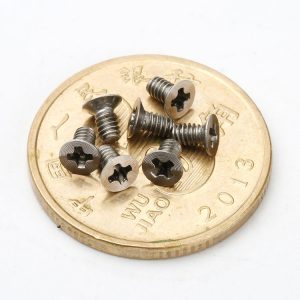
Type:Tiny Screws For Electronics, Small Screws
Materials:Stainless Steel
Surface treatment:Plain + Nylok Patch
Head Type:Ultra Low Profile Head
Drive:Phillips (cross)
Thread:Machine thread, nylon patch
Point:Blunt
Forming:Single Die Heading
Size:M1 M2 M3 M4 M5 M6 M7 M8 M9 M10 M14
Number:871
We make tiny screws for electronics in passivated stainless with a low profile Phillips head and a nylon locking patch, quoting them from M1 to M14. Head height, recess depth, patch position and prevailing torque come from your drawing, and the first article is driven at your service torque.
Watch the factory video·Email sst@szsst88.com
ISO 9001:2015 · Manufacturing since 1998 · 8,678+ customers · 89 countries and regions
Made to order – there is no stock catalogue. Each part is produced to your drawing, and production starts after drawing review and first-article approval.
Tiny screws for electronics are miniature stainless machine screws used inside handheld devices, instruments and control boards, where the head has to sit low and the screw has to stay put once it is driven. This one carries a pre-applied nylon locking patch on a low profile Phillips head, quoted from M1 to M14 with Number 871.
Low profile head. A flat-topped head with a small bearing face, low enough to sit under a cover or inside a moulded pocket.
Phillips cross recess. A PH000 or PH00 recess cut into the low head, driven with the matching bit.
Nylon locking patch. A nylon patch bonded onto part of the thread, which the mating thread compresses so the screw resists backing out.
Stainless, plain. Passivated and uncoated, so the recess and the thread are as made and the patch is the only addition.
Tiny screws for electronics are specified by the joint they hold rather than by the catalogue size: a head that fits under a cover, a thread that engages the tapped part, and a lock that survives the vibration the device sees. The patch is what supplies the third on a part too small for any other locking element.
A nylon patch is a spot of nylon bonded onto the thread of the screw before it is packed. When the screw goes into a tapped hole, the mating thread cuts into the patch, and the compressed nylon pushes back on both flanks. The result is a prevailing torque that holds the screw where it was left, even under vibration, without a washer, a second nut or a thread-locking fluid applied at the bench.
On tiny screws for electronics that is the whole reason the part exists. At M1.2 to M2 there is no room for a lock washer, a nylon insert nut would be larger than the screw head, and a liquid thread locker is applied by hand at an assembly station that may be automated. The patch moves the locking to the screw supplier, and every screw arrives with the same amount of it.
The patch also costs torque, and that cost is what has to be designed around. The prevailing torque sits between the drive and the seat: the bit has to overcome it before any clamp load is developed, and at M1.2 that can be a real fraction of what a Phillips recess in a low head will take. A patch that is too large or too far up the thread makes the screw hard to start; one that is too small does nothing.
Placement is as important as size. The patch belongs on the third to fifth thread from the tip, clear of the lead-in so the screw starts freely, and clear of the shank so it engages the full thickness of the tapped hole. On a screw only a few millimetres long, that window is narrow, and it is the placement that a customer notices first when they drive the first screw.
The material has limits. Nylon softens with heat and swells with some solvents, so a patched screw is not the answer for a joint that runs hot or is cleaned with aggressive chemistry. Where both are needed, a metal locking element or a different design carries the job and the patch does not.
The recorded range is M1 to M14 covering M1, M2, M3, M4, M5, M6, M7, M8, M9, M10 and M14, with M1 to M3 being where these screws are used. Custom lengths up to 2,000 mm are subject to DFM review after drawing submission. For tiny screws for electronics the quotation carries the head height, the recess depth, the patch position and the prevailing torque, because those four decide whether the screw starts, drives and stays.
| Item | How it is defined | What we control |
|---|---|---|
| Head | Low profile, flat top | Head diameter and head height |
| Recess | Phillips cross | Recess size and depth |
| Thread | Machine thread with nylon patch | Pitch, patch position and patch size |
| Patch | Nylon band on the thread | Band width, location and adhesion |
| End | Blunt, chamfered | Chamfer cut and lead-in clearance |
| Material | A2 stainless | Grade and heat number on the certificate |
| Finish | Passivated | Surface condition and patch bond |
Patch position on tiny screws for electronics should be given as a distance from the tip, not as a count of threads. Different pitches make a thread count ambiguous, and a patch that starts one thread late in a short hole may never engage.
Prevailing torque belongs on the drawing as a range. It is measurable, it is what the assembly station feels, and a supplier who is not given it will apply whatever patch looks reasonable.
Three features define tiny screws for electronics: the low head, the nylon patch and the stainless body. The first is what makes the screw fit inside a device, the second is what keeps it from backing out, and the third removes plating from the thread so the patch is the only variable at the joint.
| Feature | What it gives | What it costs |
|---|---|---|
| Nylon patch | Prevailing torque without extra parts | Adds drive torque; limited by heat |
| Low profile head | Fits under a cover | Shallow recess, limited torque |
| Passivated stainless | No plating in the recess or thread | Softer thread; galls dry |
| Patch as dry lubricant | Eases stainless-on-stainless contact | Not a substitute for anti-seize |
| Pre-applied at supply | Same locking on every screw | Not adjustable at the bench |
The locking is the reason tiny screws for electronics are bought with a patch rather than plain. In a handheld device the failure that matters is not the joint coming loose under load, it is a screw that backs out over months of vibration and ends up against a board or in the battery bay.
The restriction is temperature. A patch is nylon, and a joint that runs above the softening range of the material will lose the prevailing torque it was bought for. That limit belongs in the joint specification, not in the screw drawing alone.
The recorded finish on tiny screws for electronics is passivation with no coating, and the patch is applied directly to the passivated thread. That order matters: a coating applied after the patch would sit on top of the nylon, and a patch applied to an oily or contaminated thread will not bond and will come off during the first engagement.
| Option | How it locks or protects | Effect on the thread and recess | Typical use |
|---|---|---|---|
| Passivated A2, nylon patch | Prevailing torque plus passive film | Patch band on clean threads | Handheld electronics |
| Passivated A4, nylon patch | Prevailing torque plus passive film | Patch band on clean threads | Medical and marine devices |
| Passivated A2, plain | Passive film only | No patch; free-running | Joints with a separate lock |
| Steel, black oxide, patch | Conversion film plus prevailing torque | Patch on an oiled thread; bond checked | Internal mechanisms |
| Steel, zinc plated, patch | Sacrificial zinc plus prevailing torque | Build under the patch; gauged | Consumer hardware |
A2 and A4 are the usual choices, and the grade follows the cleaning regime rather than the size. A device that is wiped with a solvent does not need A4; an instrument that is disinfected repeatedly usually does.
Where the joint must also resist a hot environment, the patch is the wrong locking element and a metal insert or a thread-forming design carries the job. Changing the patch for a different nylon does not change the mechanism.
Three assemblies where tiny screws for electronics are the fixing:
| Where it sits | The screw retains a housing, a bracket or a screen frame where the head must sit under a cover and the joint sees constant vibration in use. |
| When it goes wrong | A screw with no locking backs out over months and ends up against a board or a battery. |
| Why it happens | The joint is small, it vibrates, and it is never serviced. |
| What we control | Patch position and prevailing torque checked on the first article. |
| Where it sits | The screw fixes a board stand-off or a shield where a low head clears the next assembly and the patch keeps the joint tight through thermal cycling. |
| When it goes wrong | Thermal cycling loosens a plain screw, and a loose screw changes a ground or a clearance. |
| Why it happens | The joint is inside an enclosure, it is assembled in volume, and it is not reopened. |
| What we control | Patch band clear of the lead-in; prevailing torque measured per batch. |
| Where it sits | The screw closes a small housing that is cleaned and handled, where the parts must be stainless and the joint must not loosen between services. |
| When it goes wrong | A patch that sheds nylon into a cleaned device, or a screw that backs out under handling. |
| Why it happens | The joint is cleaned, inspected and lightly loaded. |
| What we control | Patch adhesion and grade checked; first article driven at the service torque. |
Four reasons that matter on a patched mini screw, each tied to what the drawing has to prove:
|
Patch position and torque agreed
The patch band and the prevailing torque are agreed before the first part, because on tiny screws for electronics the lock has to work without adding parts. Basis: Patch band and torque agreed. |
Headed, patched, cured in one route
The low head and recess are formed, the thread is rolled, the parts are passivated and the patch is applied and cured in the same route. Basis: One route from wire to patched screw. |
|
Prevailing torque measured
The first article is driven into a gauge nut and the prevailing torque measured, because a patch that looks right can be in the wrong place. Basis: Prevailing torque measured on the part. |
Patch batch recorded
The patch material and cure are recorded with the batch, so a repeat order locks the same way as the sample. Basis: Patch batch recorded per delivery. |
Shi Shi Tong forms tiny screws for electronics from stainless wire on single-die headers that form the low head and cut the Phillips recess in one stroke, rolls the machine thread, passivates the parts and applies the nylon patch to the thread before packing. The first part of every run is measured on head height, recess depth, patch position and prevailing torque before the batch continues.


|

|
Tiny screws for electronics are patched after passivation and before packing, never before plating or cleaning. Applying a patch to a screw this small is the delicate step. The nylon has to be deposited in a band of a known width at a known distance from the tip, then cured without running; a patch that creeps toward the tip blocks the start, and one that cures in the wrong place locks nothing.
What decides whether tiny screws for electronics pass is the patch, the recess, the head height and the thread. The inspection agreement covers those, and the criteria come from the drawing.

Head and recess on the projector |

Thread gauged per batch |

Hardness checked on the wire |

Salt-spray testing of the grade |
The patch is checked for position, width and adhesion, and the prevailing torque is measured by driving a sample into a gauge nut on a torque instrument. The recess is checked for depth, the head for height, and the thread is gauged before the patch is applied, because a patch hides the thread it sits on.
The first article is driven three times into the same gauge nut to see how the prevailing torque falls off. A patch that locks on the first engagement and releases on the second is a patch that will not hold through the service the customer plans.
Every shipment of tiny screws for electronics is traceable to the wire it was made from, the passivation batch and the patch batch. The grade and heat number are recorded on the material certificate supplied with the parts, and the inspection records follow the criteria agreed on the drawing.

ISO 9001:2015 |

RoHS test report |

Registered trademark |

Patent: security screw and driver |
With each batch we supply the material certificate, the inspection record for the criteria on the drawing and, where it is listed, the third-party report for the grade or the passivation. The documents carry the drawing revision and the batch number, so a repeat order is patched in the same place to the same torque.
More than 8,678 customers in 89 countries and regions have ordered from Shi Shi Tong; 87% of orders come from repeat customers and 56% through referrals. Most projects follow the same route: drawing review, first-article approval, then batches checked against that sample. On a patched screw the first article is driven into the customer’s tapped part at the service torque, because that is where the patch has to work. Buyers visit during the process to review samples and to see how the parts are formed.
|
8,678+
customers served
|
87%
of orders from repeat customers
|
56%
of orders through referrals
|
89
countries and regions shipped to
|
Buyers and quality engineers visit for sample review, process discussion and supplier audits; the visit is arranged around production so the headers, the patch station and the passivation line can be seen on the day the parts run.

Customer group visit – sample review |

Customer group visit – process discussion |

Customer group visit – factory tour |

Customer visit – project kick-off |

Danish customer – drawing review |

Industry exhibition – meeting customers |
It is compressed by the mating thread and pushes back on the flanks, giving the screw a prevailing torque so it does not back out under vibration.
On the third to fifth thread from the tip: clear of the lead-in so the screw starts freely, and inside the tapped depth so it engages.
A few times. The prevailing torque falls with each engagement, and the joint design should assume it drops.
Yes. Nylon softens with heat and swells with some solvents, so hot or chemically cleaned joints need a different locking element.
It adds torque the bit has to overcome, which matters on a shallow Phillips recess in a low head. The joint torque is set with that in mind.
Thread size and length, head height, recess depth and size, patch position and width, prevailing torque, the grade and the passivation.
How a patched electronics screw project runs from drawing to repeat delivery:
|
1
Send the drawing and the tapped part
|
→ |
2
Patch position and prevailing torque agreed
|
→ |
3
First article driven at your service torque
|
→ |
4
Batch production and repeat orders
|
Each step is confirmed with you before the next one starts; the drawing revision from the first article is what repeat orders are checked against.
For a quotation, send the drawing with the thread size and length, head diameter and height, recess depth, patch position and width, prevailing torque, the grade and the finish.
|
Thread size
|
Length
|
Head height
|
|
Recess depth
|
Patch position
|
Prevailing torque
|
Sending a drawing? The form below does not take attachments. Email the PDF, DXF or STEP file to sst@szsst88.com with the part name and quantity in the subject line – the drawing is reviewed and a quotation follows.

 +86 13143444311
 sst@szsst88.com