Tel:
+86 13143444311
Email:sst@szsst88.com
Fax:+0086-755-27322278
Address:Building 9, First Industrial Zone, Tantou Industrial City, Songgang Street, Baoan District, Shenzhen 518105, Guangdong, China
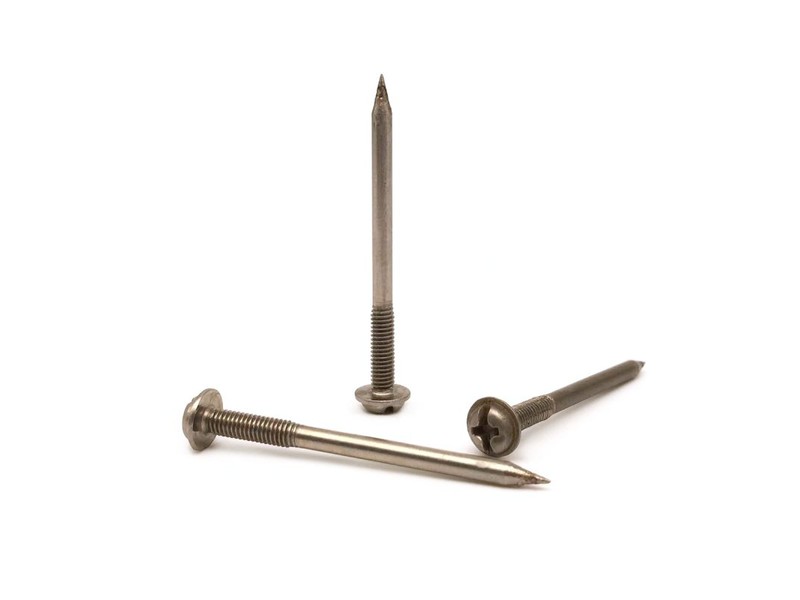
Type:Stainless washer head machine screw, integral collar, Phillips drive, full thread (Non-Standard)
Materials:Stainless Steel
Surface treatment:Plain: cleaned and passivated, no applied coating
Head Type:Pan washer head: low pan dome with a wide thin integral collar formed from the same wire; the flat underside of the collar is the bearing face; no separate washer
Drive:Phillips cross recess, four tapered wings with a pointed centre; no slot
Thread:Machine thread, rolled 60 degrees, full length from the collar underside to the end; no plain shank
Point:Blunt end with a small chamfer; no taper, no drill point
Size:M1 M2 M3 M4 M5 M6 M7 M8 M9 M10 M14
Forming:Single-die cold heading, thread rolling, cleaning and passivation, sorting
Number:780
We manufacture stainless washer head screws with an integral collar, a Phillips recess and a full machine thread from the collar underside, cleaned and passivated with no coating. Collar diameter and thickness, recess, thread and length are taken from your drawing.
Watch the factory video·Email sst@szsst88.com
ISO 9001:2015 · Manufacturing since 1998 · 8,678+ customers · 89 countries and regions
Made to order – there is no stock catalogue. Each part is produced to your drawing, and production starts after drawing review and first-article approval.
Stainless washer head screws are machine screws with an integral collar under the head, made in a stainless alloy so the fixing survives wash-down and weather as well as spreading load. The recorded item on this page has a pan washer head with a wide thin collar, a Phillips recess, a full machine thread from the collar underside and a blunt chamfered end, quoted from M1 to M14 with Number 780.
Integral collar. The collar is formed from the same wire as the head, and its flat underside is the bearing face. It gives the screw the bearing area of a washer without a separate part, and because it is formed it cannot rotate or fall off.
Stainless body. The alloy provides the corrosion protection, so there is no coating to chip at the collar edge and no plated layer to change the thread. On a visible joint the collar face is the part that is seen, and stainless keeps that face clean.
Phillips recess. A cross recess that centres the bit and cams out before the head is destroyed. On stainless it is worth knowing that the recess gives up before the thread does, so the bit has to fit.
Full machine thread. The thread runs from the collar underside to the end, with no plain shank, so the whole length below the head engages a tapped hole or a nut.
Blunt end. A machine screw end, not a point: it goes into a threaded hole and the chamfer lets the first thread enter cleanly.
The pan dome and the collar are upset in one heading stroke, and the Phillips recess is formed in the same stroke, so the recess stays concentric with the shank and the collar. A recess that is off centre on a washer head pushes the head sideways as the bit turns, and a thin collar tilts before it gives.
The collar is thin and wide by design. Thin lets it follow the surface it bears on and spread the load; wide puts the bearing area out where the panel needs it. The trade is stiffness: a thin collar can dish under heavy torque, so stainless washer head screws of this form are driven to a stated torque and the collar is checked after driving.
The thread is rolled from the collar underside to the end. Rolling work-hardens the stainless flank, which is what makes the thread hold up in repeated assembly, and it leaves a surface that galls less than a cut thread against another stainless part.
Passivation is the finish. It removes the free iron left by heading and rolling so the passive layer can rebuild across the collar face and the recess, and it changes no dimensions — which matters because the collar face is the bearing surface and the recess is the drive.
Nothing is plated afterwards. That is a deliberate choice on stainless: a coating would sit on the collar and in the recess without adding protection the alloy already has, and would change the fit of the driver.
The family is quoted from M1 to M14, with M1, M2, M3, M4, M5, M6, M7, M8, M9, M10 and M14 in the recorded range. Custom lengths up to 2,000 mm are subject to DFM review after drawing submission; stainless washer head screws run from the small instrument sizes to equipment sizes, with the collar growing with the thread.
| Item | How it is defined | What we control |
|---|---|---|
| Thread | Metric machine thread, rolled, full length | Gauged per batch |
| Head dome | Low pan dome above the collar | Checked on the projector |
| Collar diameter | Wide and thin, integral with the head | Measured on the first article |
| Collar thickness | Thin enough to follow the surface | Checked on the section |
| Recess | Phillips cross | Driven with the production bit |
| End | Blunt with a small chamfer | Checked on the first article |
| Length | From the collar underside to the end | Measured on the shop plate |
Length is measured from the collar underside, because that is the face that bears. It is not the same as measuring from the dome: on a counterbore, the collar thickness is the difference between the screw seating and the screw bottoming, and on a shallow counterbore that fraction decides the joint.
The collar diameter is the dimension to agree when the panel is thin or soft. A wider collar spreads load and covers an oversized hole; a narrower one fits into tighter spacing. On stainless washer head screws the collar is also the visible face, so its diameter is an appearance decision as well as a mechanical one.
Three things define this part, and each one has a limit that is worth stating before a drawing is issued.
| Feature | What it gives | What it costs |
|---|---|---|
| Integral collar | Bearing area without a loose washer | Cannot be changed; a dished collar scraps the screw |
| Stainless body | No coating to chip; wash-down and outdoor | Work-hardens; galls against stainless |
| Phillips recess | Standard bit, cams out before damage | Recess is the weakest point on a soft-alloy head |
| Full thread | Engagement over the whole length | No plain shank to centre the screw |
| Passivated finish | Free iron removed, no dimensional change | No added barrier beyond the alloy |
The collar is the reason to choose this head. On thin sheet a plain pan head bears on a narrow ring and the sheet dishes around it; the collar spreads the load and the sheet stays flat. On a stainless panel that difference is visible at once, because a dished panel catches the light.
Galling is the stainless price. Two clean stainless threads can seize under load, and a Phillips recess in a soft stainless head will round before the thread fails. A dry film on the thread, a different alloy pairing or a lower torque with more engagement are the answers, and they belong on the drawing rather than on the assembly line.
The collar is not a substitute for a hardened washer where the load is high. It spreads load and it cannot be forgotten, but it is thin and it is the same material as the screw; a joint that needs a hardened washer under a high preload still needs one.
The recorded finish is plain stainless, cleaned and passivated, with no coating. Nothing is added to the thread or the recess, and the collar face is the alloy as formed and cleaned.
| Option | What it does | Effect on collar and recess | Typical use |
|---|---|---|---|
| Cleaned and passivated | Removes free iron after forming | No dimensional change | General and wet service |
| Satin bead blast | Even matte face across the collar | Edges softened slightly | Visible panels that should not glare |
| Bright passivated | Cleaner, brighter surface | No dimensional change | Instruments and appliances |
| Electropolished | Levels micro peaks, strengthens the passive layer | Very slight material removal | Hygienic and chemical service |
| Dry film on the thread | Reduces galling in stainless joints | Film checked in the recess | Joints opened often |
The collar face is where the finish is judged, because it is the largest flat surface on the screw. A satin bead blast evens it out and stops it glaring under a light; a bright passivated finish keeps it mirror-like. Both are cosmetic, and both leave the dimensions alone, which is why they are safe to add late.
A dry film is the exception that changes something. It sits on the thread, reduces galling, and can also reach the recess, so where it is specified the recess is checked with the production bit after the film and not before.
Three assemblies where a wide bearing face and a stainless body are both needed:
| Where it sits | The screw fixes a panel or a fitting where the collar spreads the load on a thin stainless skin and the joint is washed down between runs. |
| When it goes wrong | A plated screw sheds coating into a wash area, and a narrow head dishes the skin and traps residue around the fixing. |
| Why it happens | The equipment is stainless, it is cleaned daily, and the fixing is visible. |
| What we control | Grade and passivation recorded, collar flatness checked before and after driving. |
| Where it sits | The screw closes a cover or fixes a bracket on equipment that stands outside or is hosed down, with the collar protecting the panel from the head. |
| When it goes wrong | A plain head deforms the sheet around the hole, and a plated washer rusts at the edge and stains the panel. |
| Why it happens | The enclosure is wet, the panel is thin, and the joint is serviced. |
| What we control | Grade 304 or 316 agreed, collar checked, and a dry film specified where the joint is stainless to stainless. |
| Where it sits | The screw holds a bezel, a plate or a component where the head is seen and a narrow head would leave a mark on the face. |
| When it goes wrong | A cross recess in a soft stainless head rounds early, and a plain head concentrates load into a ring. |
| Why it happens | The panel is thin, the face is visible, and the fixings are in rows. |
| What we control | Collar diameter matched to the spacing, recess driven with the production bit. |
Four reasons that matter on a stainless washer head, each tied to what the drawing has to prove:
|
Collar and grade reviewed together
The collar diameter and thickness, the recess size and the alloy grade are reviewed as one set, so a collar that would dish or a recess that would round is raised first. Basis: Collar and grade reviewed as one set. |
Head, collar and thread in one route
The pan dome, the collar and the recess are formed in one stroke, and the thread is rolled from the collar underside to a blunt chamfered end. Basis: One route from wire to passivated screw. |
|
Collar and recess checked on the part
The collar is checked for flatness before and after driving, and the recess is driven with the production bit on the first article. Basis: First article driven with the production bit. |
First article to repeat production
The first article records the drawing revision, wire heat, die set and thread roll, and repeat orders are checked against that record. Basis: First article signed off before the batch is released. |
Shi Shi Tong forms these stainless washer head screws on a single-die header that upsets the pan dome, the integral collar and the Phillips recess in one stroke, then rolls the machine thread from the collar underside to a blunt chamfered end. The parts are cleaned and passivated. The first part of every run is measured on the collar, driven into a sample joint and checked for flatness afterwards, before the batch continues.


|

|
Stainless makes the collar harder to form. It work-hardens in the heading stroke, so the die is cut for the grade and the collar thickness is set at the die rather than adjusted afterwards. A collar that comes out uneven shows in service as a head that leans when it is tightened, and by then the batch is plated and passivated.
What decides whether stainless washer head screws pass is the collar, the head, the recess, the thread and the surface. The inspection agreement covers those, and the criteria come from the drawing.

Collar and dome on the projector |

Thread gauged per batch |

Hardness testing of the wire |

Salt-spray testing where the service requires it |
The collar is checked for flatness before and after the first article is driven at the joint torque. A collar that is flat on the bench and dished after driving has told you the torque is above what that collar thickness will take, and the answer is a thicker collar or a lower torque.
The recess is checked by driving, not by looking. On a soft stainless head the damage starts as a polish mark on the wing edges before the head strips, and that mark is what the inspection looks for on the first article.
Every shipment of stainless washer head screws is traceable to the wire it was made from. The grade and heat number are recorded on the material certificate supplied with the parts, and the inspection records follow the criteria agreed on the drawing.

ISO 9001:2015 |

RoHS test report |

Registered trademark |

Patent: security screw and driver |
With each batch we supply the material certificate, the inspection record for the criteria on the drawing and, where it is listed, the third-party report for the material. The documents carry the drawing revision and the batch number, so the paperwork can be matched to the parts.
More than 8,678 customers in 89 countries and regions have ordered from Shi Shi Tong; 87% of orders come from repeat customers and 56% through referrals. Most projects follow the same route: drawing review, first-article approval, then batches checked against that sample. On a washer head the first article is driven at the joint torque and the collar re-checked afterwards, because the bearing face is what the part is for. Buyers visit during the process to review samples and to see how the heads are formed.
|
8,678+
customers served
|
87%
of orders from repeat customers
|
56%
of orders through referrals
|
89
countries and regions shipped to
|
Buyers and quality engineers visit for sample review, process discussion and supplier audits; the visit is arranged around production so the header and the passivation line can be seen on the day the parts run.

Customer group visit – sample review |

Customer group visit – process discussion |

Customer group visit – factory tour |

Customer visit – project kick-off |

Danish customer – drawing review |

Industry exhibition – meeting customers |
A machine screw with a wide thin collar formed into the head, in a stainless alloy. The collar underside is the bearing face, so no separate washer is needed.
For spreading load, yes. For high preload on a hardened surface, a separate hardened washer is still better, because the collar is thin and made of the same alloy as the screw.
The alloy protects the part, and a coating would sit on the collar and in the recess without adding protection. Passivation removes free iron without changing any dimension.
From the collar underside to the end. The collar adds thickness, so a counterbore has to allow for it.
They can, especially stainless into stainless. A dry film on the thread, a different alloy pairing, or a lower torque with more engagement are the usual answers.
Thread size and pitch, head and collar diameter, collar thickness, recess size, length and datum, stainless grade, and the joint torque.
How a stainless washer head screw project runs from drawing to repeat delivery:
|
1
Send the drawing or sample
|
→ |
2
Collar and grade review
|
→ |
3
First article driven and collar re-checked
|
→ |
4
Batch production and repeat orders
|
Each step is confirmed with you before the next one starts; the drawing revision from the first article is what repeat orders are checked against.
For a quotation, send the drawing with the thread size and pitch, head and collar diameter, collar thickness, recess size, length and datum, stainless grade and the joint torque.
|
Thread and pitch
|
Head and collar
|
Collar thickness
|
|
Recess size
|
Length and datum
|
Grade and torque
|
Sending a drawing? The form below does not take attachments. Email the PDF, DXF or STEP file to sst@szsst88.com with the part name and quantity in the subject line – the drawing is reviewed and a quotation follows.

 +86 13143444311
 sst@szsst88.com