Tel:
+86 13143444311
Email:sst@szsst88.com
Fax:+0086-755-27322278
Address:Building 9, First Industrial Zone, Tantou Industrial City, Songgang Street, Baoan District, Shenzhen 518105, Guangdong, China
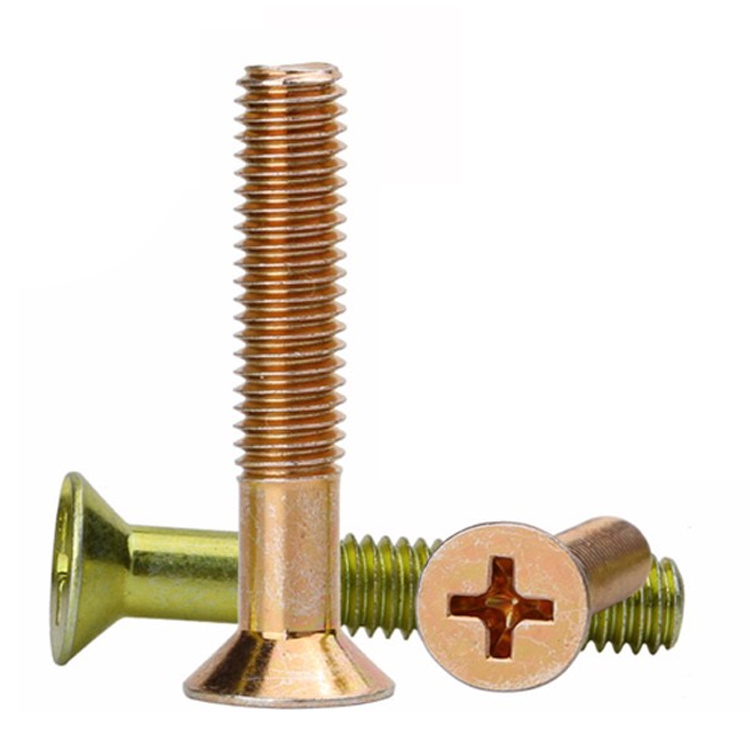
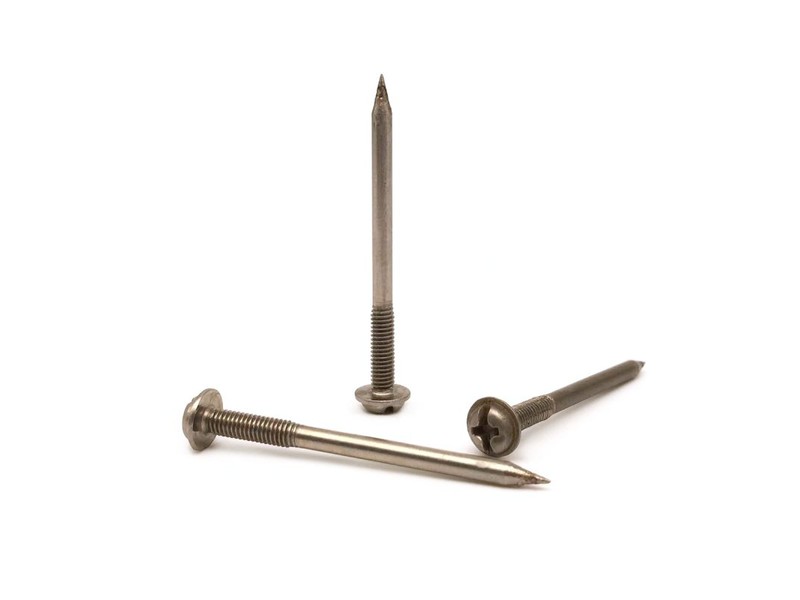
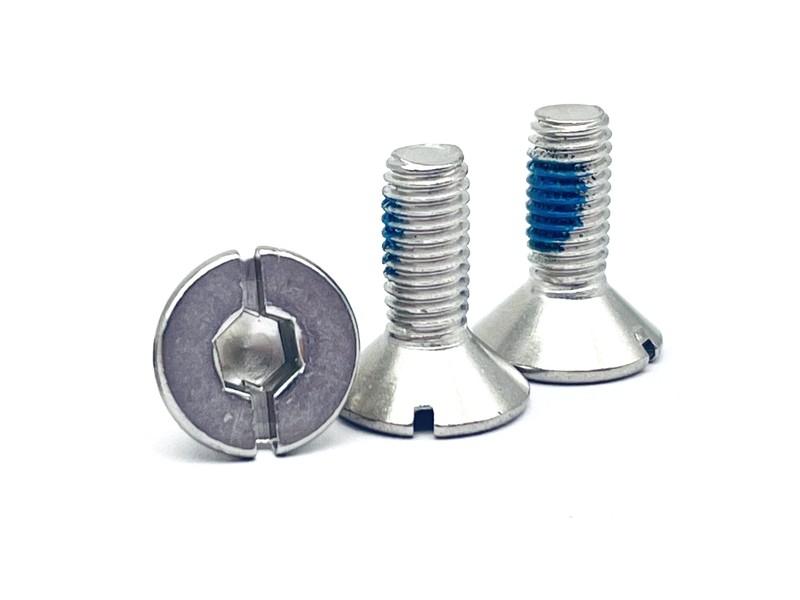
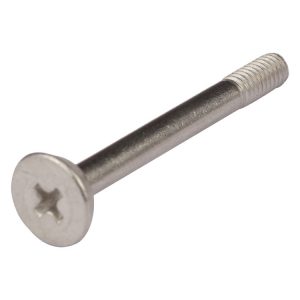
Type:Phillips flat head machine screw with a 90 degree countersunk cone, a Phillips cross recess and a partially threaded machine screw shank (Non-Standard)
Materials:Stainless Steel
Surface treatment:Vacuum coating (PVD), gold tone; a thin line of sight film over the cone, the recess walls and the thread, colour matched to a master sample
Head Type:Countersunk flat head, 90 degree cone underside as the bearing face, flat top face with a slight crown, head diameter about 2 times the thread diameter, head height about 0.5 times the head diameter; no washer, no flange, no collar
Drive:Phillips cross recess, four tapered wings with a pointed centre; no straight slot, no hexagon socket, no Torx
Thread:Machine thread, 60 degree form, rolled, constant diameter, uniform pitch, partially threaded: plain cylindrical shank under the head, then the thread starts and runs to the point, threaded length about half to two thirds of the shank
Point:Flat blunt end with a small chamfer; no gimlet taper, no drill point, no cutting slot
Size:M1 M2 M3 M4 M5 M6 M7 M8 M9 M10 M14
Forming:Single die cold heading, thread rolling, vacuum deposition (PVD) coating, sorting
Number:237-1
We manufacture phillips flat head machine screws with a 90-degree countersunk head, a partial machine thread on a plain shank and a gold-tone PVD finish over stainless steel. Cone angle, thread split, length and the colour sample are taken from your drawing.
Watch the factory video·Email sst@szsst88.com
ISO 9001:2015 · Manufacturing since 1998 · 8,678+ customers · 89 countries and regions
Made to order – there is no stock catalogue. Each part is produced to your drawing, and production starts after drawing review and first-article approval.
A phillips flat head machine screw is a machine screw with a 90-degree countersunk head, a cross recess and a threaded shank for a tapped hole or a nut. The recorded item on this page is stainless steel with a gold-tone PVD vacuum coating, a plain shank under the head and a partial thread, quoted from M1 to M14 with Number 237-1.
Flat head, 90 degrees. A cone on the underside that seats in a countersink and a flat top face with a slight crown. The head diameter is about twice the thread and its height about half the diameter, so it finishes flush rather than sitting on the surface.
Partial thread. A plain cylindrical shank under the head, then the thread starts and runs to the point over roughly half to two thirds of the shank. The plain section acts as a shoulder; the thread does the clamping.
Phillips recess. Four tapered wings and a pointed centre, sized for the standard cross bit — and, on a coated head, the recess is also where the coating’s evenness is judged, because it is the only place the film is seen in shadow.
Stainless body. The alloy protects the part, so the coating is there for colour and wear rather than for corrosion. That distinction matters: a gold PVD over stainless is a cosmetic film on a body that is already corrosion resistant.
Gold-tone PVD. A vacuum deposited film, thin enough to leave the thread and the recess at their formed dimensions and hard enough to resist the abrasion a screw sees in assembly. Its colour is matched to a master sample, and that match is the specification.
The cone and the Phillips recess are formed in one heading stroke, so the recess stays concentric with the shank and square to the cone. On a countersunk head that squareness decides whether the screw seats evenly or bites one side of the countersink first — and with a coloured coating, a mis-seated head shows as a crescent of gold where the rest of the cone is buried.
The plain shank under the head is turned or formed to nominal diameter and left unthreaded. The thread is rolled on the section below it, so the thread start is a defined position rather than wherever the roll happened to run. On a phillips flat head machine screw that position is a joint dimension: too early and the thread binds in the clearance hole.
The end is flat with a small chamfer. There is no point, because the screw goes into a threaded hole; the chamfer is what lets the first thread enter without catching on the lead-in.
The PVD film is applied after rolling, in a vacuum chamber, by condensing a vapour onto the parts as they are rotated. That process coats the surfaces it can see: the cone, the crown, the recess walls and the thread crests. Deep recesses and the spaces between close threads get less, which is why the recess can read a shade darker than the head face.
Because the film is thin — microns rather than tens of microns — the thread is gauged after coating and usually passes without correction. What it does change is colour, and colour is checked against the master sample rather than against a specification number.
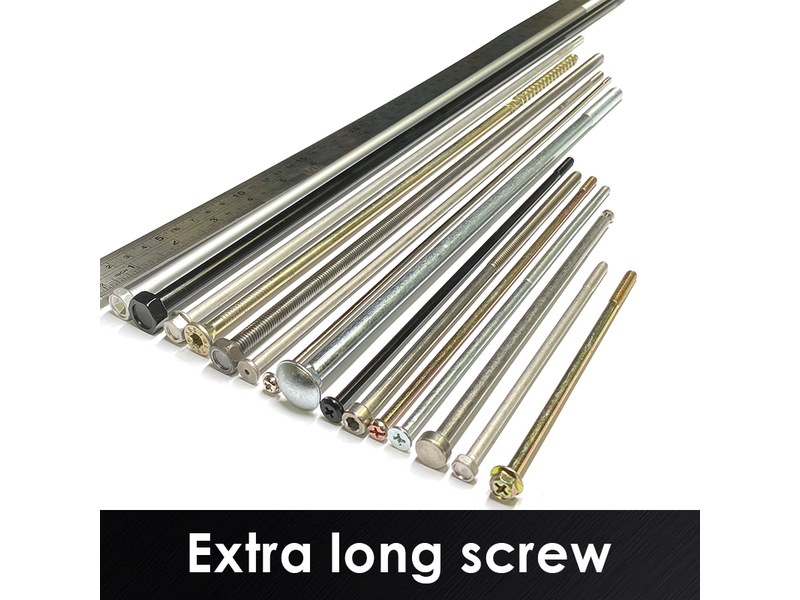
The family is quoted from M1 to M14, with M1, M2, M3, M4, M5, M6, M7, M8, M9, M10 and M14 in the recorded range. Custom lengths up to 2,000 mm are subject to DFM review after drawing submission; on a phillips flat head machine screw the overall length, the plain shank and the thread length are three numbers that all belong on the drawing.
| Item | How it is defined | What we control |
|---|---|---|
| Cone angle | 90 degrees, to match the countersink | Checked on the projector |
| Head diameter and height | About 2× thread and 0.5× head diameter | Measured on the first article |
| Recess | Phillips cross | Driven with the production bit |
| Plain shank | Nominal diameter, unthreaded | Measured with a micrometer |
| Thread start | Position where the thread begins | Measured from under the head |
| Thread length | About half to two thirds of the shank | Gauged per batch |
| Length | Overall, top of head to end | Measured on the shop plate |
Length on a flat head is measured overall, from the top of the head to the end, because the head sits below the surface. The working length is that figure minus the countersink depth, which is roughly the head height — and on the partial thread the working length is further divided between the plain shank and the thread.
The thread split is the number that decides the joint. A thread that starts at the back of the countersink clamps the top layer; one that starts lower down lets the top layer slide on the plain shank. Both are useful, in different joints, and the drawing has to say which.
A gold-tone screw is a finish decision, and the finish has to be specified with the same care as the thread. PVD is not plating: it is a vacuum deposited film, and that changes what it can and cannot do.
| Feature | What it gives | What it costs |
|---|---|---|
| PVD gold | Hard coloured film, thin enough for the thread | Colour sensitive; must be matched to a master |
| Stainless body | Corrosion resistance without a coating | Galls against stainless threads |
| Countersunk head | Flush finish, nothing to catch | Cone must match the countersink |
| Partial thread | Shoulder plus clamp in one screw | Thread start must be quoted |
| Blunt end | Stops at the thread end in a tapped hole | Cannot start in an unthreaded hole |
The colour is the specification. PVD gold is matched to a master sample, and a batch that drifts greener or browner is a reject even if every dimension is right. The film thickness affects the shade as well, which is why the process is controlled by deposition time and checked against the retained sample rather than by a gauge.
The film is hard and thin, which suits a screw that is assembled with a tool and then sits still. It is also brittle: flexing does not crack it, but a damaged edge or a scratched head cannot be touched up the way a plated part can, because there is no brush-on gold that matches. On a phillips flat head machine screw used on a visible face, that is worth knowing before a batch is fitted.
The recorded finish is gold-tone PVD over stainless, matched to a master sample. It is a decorative film that also happens to be hard and wear resistant, which is why it is used on fixings that are seen and handled rather than buried in a machine.
| Option | What it does | Effect on thread and recess | Typical use |
|---|---|---|---|
| Gold PVD on stainless | Hard coloured film, thin | No dimension change; recess checked | Visible decorative fixings |
| Black PVD on stainless | Hard dark film | No dimension change; tone checked | Dark equipment and instruments |
| Bright nickel | Hard plated film, silver | A few microns; recess re-checked | General visible hardware |
| Passivated stainless | No film; alloy protects | No change | Wet and hygienic service |
| Zinc plated steel | Sacrificial coating | A few microns; thread gauged after | Indoor structural joints |
PVD is chosen for two reasons: colour and hardness. On stainless the colour is the whole point — a gold or black screw with the corrosion resistance of stainless and the wear resistance of a hard film is a combination no plating gives. The limit is that the colour is a thin film on a surface, so it cannot be repaired and it does not tolerate the same abuse as a bulk alloy.
Where the joint is washed or outdoors, PVD on stainless is still the right choice if the colour matters, because the substrate is doing the corrosion work. Where the joint is a structural steel one, a PVD film is not a corrosion barrier and a zinc or Dacromet finish is what the drawing should call for.
Three assemblies where a flush head and a coloured finish are both wanted:
| Where it sits | The screw closes a housing or fixes a faceplate where the head finishes flush and the gold tone matches a trim or a connector. |
| When it goes wrong | A proud head breaks the line of a panel, and a batch that drifts in tone reads as mismatched hardware. |
| Why it happens | The face is visible, the fixing is flush, and the colour is part of the product. |
| What we control | Tone matched to the master sample, cone seated in a countersink sample, thread gauged after coating. |
| Where it sits | The screw holds a hinge plate, a handle or a trim where the fixing sits below the surface and the colour has to match the metalwork. |
| When it goes wrong | A silver screw among gold fittings reads as a substitution, and a scratched PVD head cannot be touched up. |
| Why it happens | The fitting is seen and handled, the head is flush, and the tone is specified. |
| What we control | Colour against the sample, recess checked with the bit after coating. |
| Where it sits | The screw fixes a panel, a sign or a display frame where the fixing is flush and the surface finish is part of the design. |
| When it goes wrong | A head that stands proud catches on cloth and light, and a tone mismatch is visible across a whole wall. |
| Why it happens | The face is large and visible, the fixings repeat in rows, and the finish is the product. |
| What we control | Samples approved as colour, then batches checked against that sample. |
Four reasons that matter on a coated flush screw, each tied to what the drawing has to prove:
|
Colour and geometry reviewed together
The countersink angle, the head proportions and the PVD tone are reviewed as one set against the joint and the master sample, so a batch that will not seat or will not match is raised first. Basis: Colour and geometry reviewed as one set. |
Head, shank and thread in one route
The cone and the recess are formed in one stroke, the plain shank is left unthreaded, and the thread is rolled before the PVD film is deposited. Basis: One route from wire to coated screw. |
|
Seat and recess checked after coating
The head is seated in a countersink sample and the recess driven with the production bit, after coating rather than before. Basis: First article checked after coating. |
First article to repeat production
The first article fixes the drawing revision, wire heat, die set, thread roll and the colour sample; repeat orders are compared against all of them. Basis: First article, including the colour sample, signed off. |
Shi Shi Tong forms these phillips flat head machine screws on a single-die header that upsets the 90-degree cone and the Phillips recess in one stroke, leaves the under-head shank plain and rolls the machine thread to a flat chamfered end. The PVD film is deposited in a vacuum chamber afterwards, and the parts are sorted against the colour sample. The first part of every run is seated in a countersink sample and matched to the master before the batch continues.


|

|
The PVD step is the one that decides whether a batch ships. The chamber coats what it can see, so the loading of the jig, the rotation and the deposition time all change the tone — and tone is the specification. That is why the approval is made against a retained master sample under the same light, not against a colour code.
What decides whether phillips flat head machine screws pass is the cone, the head, the recess, the shank, the thread and the colour. The inspection agreement covers those, and the criteria come from the drawing.

Cone angle on the projector |

Thread gauged after coating |

Hardness testing of the wire |

Salt-spray testing where the service requires it |
The colour is checked against the master sample in the same light, and the check includes the recess as well as the head face. A recess that reads darker than the crown is normal for PVD; a recess that reads a different hue is not, and it usually means the film is too thick or the jig was loaded badly.
The seat is checked by driving the first article into a countersink sample. On a coated part that test also shows wear at the cone, which is the fastest way to see whether the film is hard enough for the joint.
Every shipment of phillips flat head machine screws is traceable to the wire it was made from and to the coating run. The grade and heat number are recorded on the material certificate supplied with the parts, the coating run is recorded with the colour sample reference, and the inspection records follow the criteria agreed on the drawing.

ISO 9001:2015 |

RoHS test report |

Registered trademark |

Patent: security screw and driver |
With each batch we supply the material certificate, the inspection record for the criteria on the drawing and, where it is listed, the third-party report for the material or the coating. The documents carry the drawing revision and the batch number, so the paperwork can be matched to the parts.
More than 8,678 customers in 89 countries and regions have ordered from Shi Shi Tong; 87% of orders come from repeat customers and 56% through referrals. Most projects follow the same route: drawing review, first-article approval, then batches checked against that sample. On a coated screw the first article is approved as a colour sample as well as a part, and that sample is what every batch is then compared with. Buyers visit during the process to review samples and to see how the heads are formed.
|
8,678+
customers served
|
87%
of orders from repeat customers
|
56%
of orders through referrals
|
89
countries and regions shipped to
|
Buyers and quality engineers visit for sample review, process discussion and supplier audits; the visit is arranged around production so the header and the coating line can be seen on the day the parts run.

Customer group visit – sample review |

Customer group visit – process discussion |

Customer group visit – factory tour |

Customer visit – project kick-off |

Danish customer – drawing review |

Industry exhibition – meeting customers |
A vacuum deposited film. It is thin, hard and coloured, and on a stainless screw it is there for the tone and the wear resistance rather than for corrosion.
The film only coats what the vapour can see. A recess in shadow gets less, so it reads a shade darker. That is normal for PVD.
It is matched to a master sample and inspected in the same light. Stainless fixation of the tone is a sample approval, not a code.
Overall, from the top of the head to the end, because the head sits below the surface. The working length is that minus the countersink depth.
The plain shank acts as a shoulder through a clearance hole and the thread clamps at the far end. The thread start is a joint dimension and belongs on the drawing.
Thread size and pitch, head diameter and height, countersink angle, recess, shank length, thread start and length, overall length, alloy and coating sample.
How a phillips flat head machine screw project runs from drawing to repeat delivery:
|
1
Send the drawing and the colour sample
|
→ |
2
Cone and thread split review
|
→ |
3
First article seated and matched in tone
|
→ |
4
Batch production and repeat orders
|
Each step is confirmed with you before the next one starts; the drawing revision from the first article is what repeat orders are checked against.
For a quotation, send the drawing with the thread size and pitch, head diameter and height, countersink angle, recess, shank length, thread start and length, overall length, alloy and the coating sample to match.
|
Thread and pitch
|
Head diameter and height
|
Countersink angle
|
|
Shank length
|
Thread start
|
Alloy and colour sample
|
Sending a drawing? The form below does not take attachments. Email the PDF, DXF or STEP file to sst@szsst88.com with the part name and quantity in the subject line – the drawing is reviewed and a quotation follows.

 +86 13143444311
 sst@szsst88.com