
Tel:
+86 13143444311
Email:sst@szsst88.com
Fax:+0086-755-27322278
Address:Building 9, First Industrial Zone, Tantou Industrial City, Songgang Street, Baoan District, Shenzhen 518105, Guangdong, China
Type:Long brass machine screw
Materials:Brass
Surface treatment:Plain
Head Type:Pan Head
Size:M1 M2 M3 M4 M5 M6 M7 M8 M9 M10
Drive:Phillips cross recess
Thread:Machine thread, right hand
Forming:Split-die heading that supports the shank while the pan head is upset and the Phillips recess is formed; thread rolled at the far end
Number:SST966
We manufacture long brass machine screws with a pan head and a Phillips recess in plain brass, quoted from M1 to M10 and in long lengths, split-die headed and thread rolled. Head diameter, plain shank length, thread start and brass alloy are taken from your drawing.
Watch the factory video·Email sst@szsst88.com
ISO 9001:2015 · Manufacturing since 1998 · 8,678+ customers · 89 countries and regions
Made to order – there is no stock catalogue. Each part is produced to your drawing, and production starts after drawing review and first-article approval.
A long brass machine screw is a machine-threaded screw made from brass rather than steel, with a shank long enough to pass through a deep stack before the thread engages. The recorded item on this page is a pan head screw with a Phillips recess in plain brass, quoted from M1 to M10 and in long lengths.
Brass body. The alloy is copper and zinc, and it brings three properties that steel does not: it conducts, it is non-magnetic, and it machines and rolls easily. Those are the reasons a long brass machine screw is chosen at all.
Pan head. A low dome with a flat bearing face, wider than a socket head and flatter than a round head, so it presses on the panel without a sharp edge and leaves a clean profile on a visible part.
Long shank. The length is the point of the part: it passes through a terminal block, a spacer stack or a lamp body before the thread engages at the far end. Brass is softer than stainless, so the shank is produced on a supported die and handled so it does not take a set.
Plain finish. No plating and no lacquer as standard. The brass shows its own colour and keeps its conductivity at every surface, including the thread and the recess, which is what a terminal or an earth connection needs.
Together these decide the joint: the head bears on the panel, the long shank reaches through the stack, the thread engages the far end, and the brass body carries current or avoids magnetic interference. That is why a long brass machine screw is specified by alloy, head, thread and length together.
The body of this long brass machine screw is brass wire, with the alloy and temper fixed on the drawing and the heat number kept with the batch record. The alloy matters because brass covers a wide range: a free-cutting grade rolls and machines cleanly, while a grade with more copper is softer and bends where a harder one would drive.
The pan head is upset in a split die that supports the long shank while the head is formed. Brass upsets easily, which is an advantage on a long part, but it also means the heading step has to be set so the head does not overfill the die and flash at the edge.
The Phillips recess is formed in the same operation. In brass the recess is where torque shows first: the cross is softer than the same recess in steel, so its depth and the condition of the die are what decide whether the head survives repeated driving.
The machine thread is rolled at the far end. Rolling brass is clean and produces a smooth flank, and the plain shank between the head and the thread is measured from the bearing face so the length that passes through the stack is the same on every part.
The finish is plain, with no coating. Plain brass tarnishes to a darker tone over time, which is acceptable on decorative work and irrelevant inside a terminal block; where a bright surface has to stay bright, that is a separate specification agreed on the drawing rather than a default.
Long brass machine screws of this type are quoted from M1 to M10 and in long lengths; the recorded configuration is a pan head with a Phillips recess in plain brass. Custom lengths up to 2,000 mm are subject to DFM review after drawing submission, because brass is softer than steel and the heading, the thread roll and the packing all change with the length.
| Item | How it is defined | What we control |
|---|---|---|
| Head diameter and height | The pan head that bears on the panel | Checked on the projector on the first article |
| Recess depth | Phillips engagement in a brass head | Checked against the accepted sample |
| Plain shank diameter | The section that passes through the stack | Measured against the clearance hole on the drawing |
| Thread size and pitch | Machine thread at the far end | Gauged per batch |
| Total length | From the bearing face to the tip | Datum stated on the drawing; measured on the shop plate |
| Alloy and temper | The brass the part is made from | Confirmed against the material certificate |
Each size is quoted against the stack it passes through. The plain shank length, the clearance holes and the thread engagement are reviewed together, because a long screw that runs out of plain shank grips the stack instead of clamping it, and one with too little thread left in the tapped part works loose.
Length is measured from the bearing face rather than from the top of the head, and the plain shank from the same datum. Both are stated on the drawing, and the alloy is named on it as well, because two brass grades that look identical behave differently under the driver.
The pan head is the practical choice for a brass screw that will be seen and driven by hand. It is a low dome with a flat bearing face, so it spreads the clamp load on a thin panel and presents a clean profile without the sharp edge of a countersunk cone or the height of a cap head.
| Parameter | Why it matters on this part | What we control |
|---|---|---|
| Head diameter | Clamp load spread on a thin panel | Set from the panel on the drawing |
| Head height | Low profile on visible work | Measured from the bearing face on the projector |
| Recess depth | Phillips engagement in soft brass | Checked against the sample; cam-out reviewed |
| Thread start | Plain shank clears the stack | Set on the drawing; measured on the first article |
| Alloy temper | How the shank behaves under torque | Fixed on the drawing and confirmed on the certificate |
The Phillips recess is cut into a soft head, so the driver matters as much as the recess. A worn bit or a bit of the wrong size rounds the cross in brass sooner than it would in steel, which is why the recess is checked with the driver the customer uses and not only with a gauge.
The thread is rolled, not cut. Rolling keeps the grain continuous and leaves a smooth flank that engages a brass or plastic nut without galling, which matters when the mating part is also brass. The thread start is fixed relative to the bearing face so the plain length through the stack is repeatable.
Brass is softer than stainless, so a long shank takes its shape from handling as well as from the die. The parts are headed in a supported die, kept in trays between operations and packed straight, so the shank does not curve between the machine and the assembly.
This long brass machine screw is supplied plain, with no plating and no lacquer. That keeps the conductivity intact on every surface, including the thread and the recess, and it means there is no coating to chip at the edge of the head.
| Finish | How it protects | Effect on thread and recess | Typical use |
|---|---|---|---|
| Plain brass | None; the alloy is the surface | No build-up; conductivity intact | Terminals, earth points, indoor decorative work |
| Nickel plated | Barrier layer over the brass | Thin film; thread re-checked | Visible parts where a silver tone is wanted |
| Tin plated | Barrier layer, solderable | Thin film; thread re-checked | Electrical contacts and soldered joints |
| Clear lacquer | Organic film over polished brass | Film fills the recess; driver re-checked | Polished decorative brass kept bright |
| Antique / oxidised | Chemical darkening of the surface | No dimensional change | Reproduction hardware and trim |
Plain brass is not a finish for salt water. In a marine or chloride-rich environment brass can dezincify, losing zinc from the surface until it turns weak and pink; where that environment is real, the drawing should call for a different alloy or a coating rather than plain brass.
Packing keeps the shanks straight and the heads unmarked. Long brass parts are packed in tubes or trays with the shanks supported, and the label carries the batch, the alloy and the material heat.
Three assemblies where brass is chosen for what the metal does, not for how it looks:
Battery modules and power assemblies
|
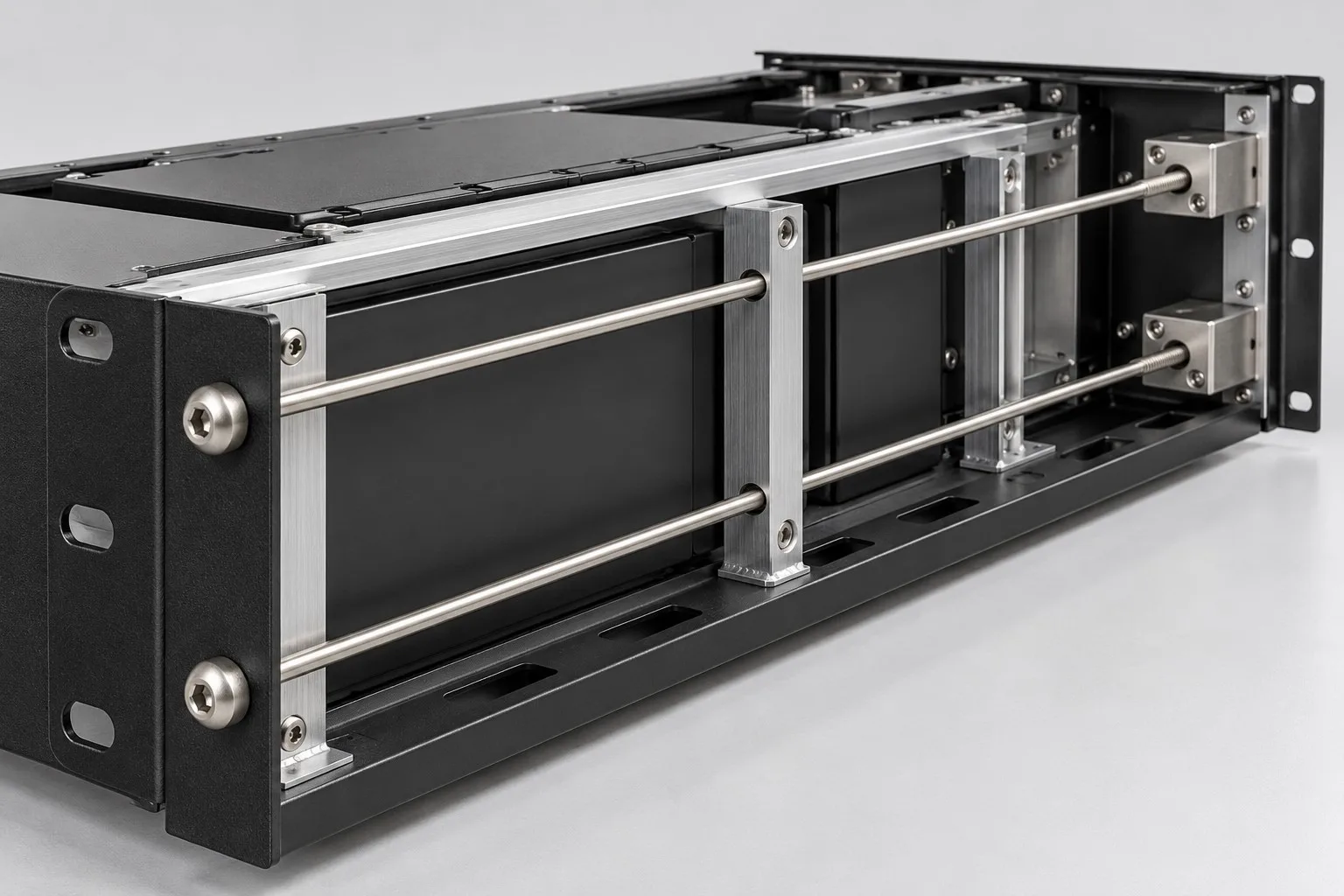
Through-screws in a battery module stack |
Audio and instrument equipment
|
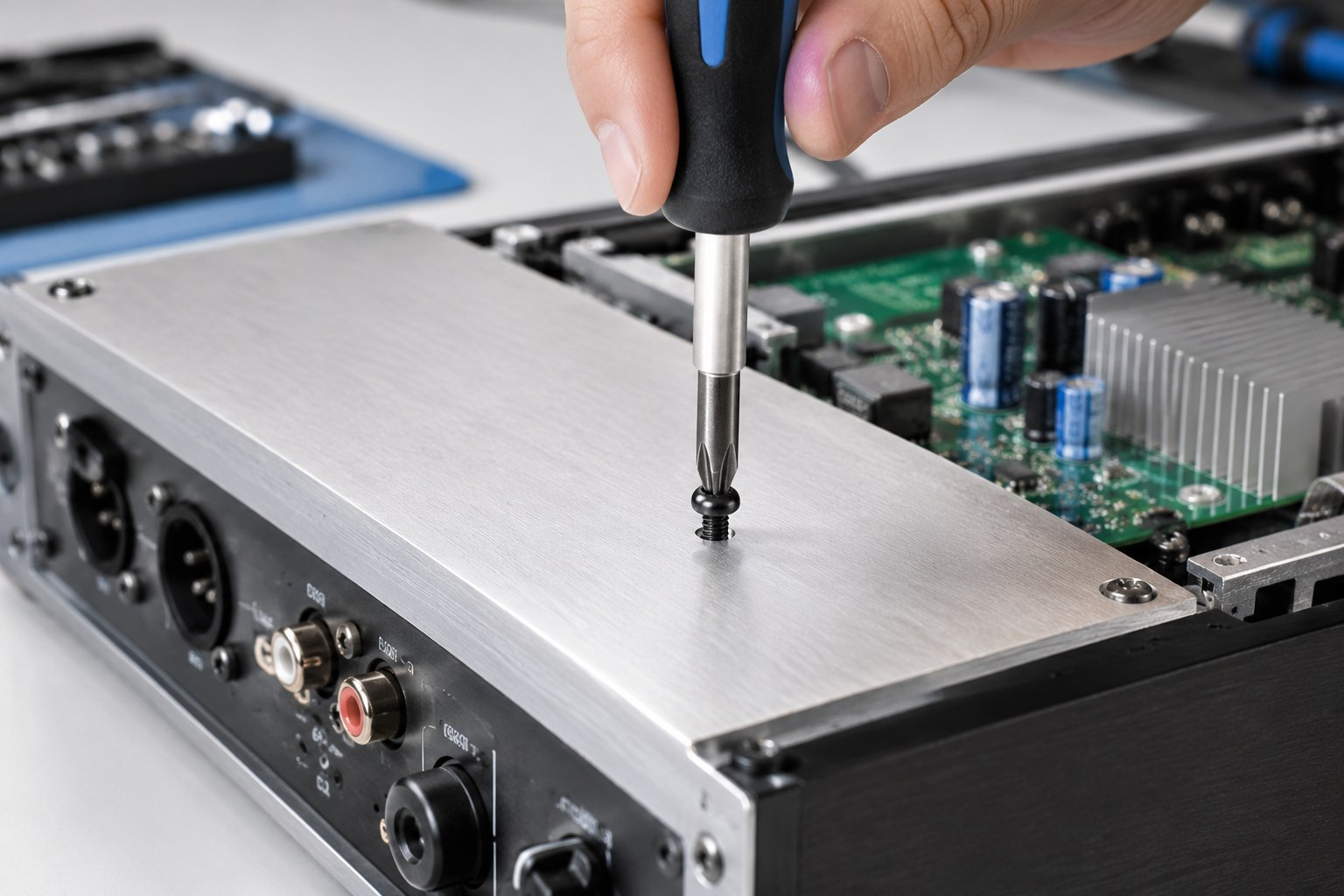
Brass screws in an audio amplifier chassis |
| Where it sits | The screw holds a lamp body, a shade carrier or a decorative plate where the brass is part of the finished appearance. |
| When it goes wrong | A plated screw that chips at the recess shows a bright ring on the fitting, and a soft head that strips cannot be re-driven. |
| Why it happens | The parts are visible, the fittings are assembled by hand, and the joint may be opened for relamping. |
| What we control | Recess checked with the driver, head profile checked on the first article, and the alloy fixed so the colour matches the rest of the fitting. |
Four reasons that matter on a long screw in a soft alloy, each tied to what the drawing has to prove:
|
Alloy and stack reviewed together
The brass grade, the plain shank length and the thread start are reviewed before the die is cut, so a screw that would strip or bend is raised first. Basis: Alloy, stack and thread reviewed before tooling. |
Headed and threaded in one route
The pan head and the Phillips recess are formed in a split die that supports the long shank, and the thread is rolled at the far end. Basis: One route from wire to finished brass screw. |
|
Recess and thread checked on the part
The recess is driven with the matching bit and the thread is gauged, on the first article, in the soft alloy the part is actually made from. Basis: Recess and thread checked on the first article. |
First article to repeat production
The first article fixes the drawing revision, alloy heat, die set and thread roll; repeat orders are compared against that record. Basis: First article signed off before the batch is released. |
Shi Shi Tong forms these long brass machine screws on a split-die header: the die closes around the wire and supports the shank while the pan head is upset, the Phillips recess is formed, and the thread is rolled at the far end. The first part of every run is measured on the head, the shank and the thread, and driven with the matching bit, before the batch continues.


|

|
Between runs the die insert is changed to the drawing head and recess, and the thread rolls to the size; the first part goes to the projector and the gauges before the run continues. Brass forms easily, so the setting is checked on the first part rather than adjusted on the fly, and long parts are packed straight so the shank does not take a set.
What decides whether a long brass machine screw passes is not only the thread: it is the head diameter and height, the recess in a soft alloy, the plain shank and the thread class at the far end. The inspection agreement covers those, and the criteria come from the drawing and the accepted sample.

Head and shank on the projector |

Thread gauging against GO/NO-GO gauges |

Hardness testing where the drawing requires it |

Salt-spray testing where a finish is specified |
Each batch is recorded against the drawing revision: head and recess from the first article, the thread gauged per batch, and the alloy confirmed against the material certificate. If a bit or the recess check fails, the parts back to the last good setting are held and re-checked.
Where a third-party report is required for the material or a finish, it is listed on the drawing so the paperwork ships with the parts, and the batch number on the label matches the record used for inspection.
Every shipment of long brass machine screws is traceable to the wire it was made from. The alloy, heat number and standard are recorded on the material certificate supplied with the parts, and the inspection records follow the criteria agreed on the drawing.

ISO 9001:2015 |

RoHS test report |

Registered trademark |

Patent: security screw and driver |
With each batch we supply the material certificate, the inspection record for the criteria on the drawing and, where it is listed, the third-party report for the material or the finish. The documents carry the drawing revision and the batch number, so the paperwork can be matched to the parts.
More than 8,678 customers in 89 countries and regions have ordered from Shi Shi Tong; 87% of orders come from repeat customers and 56% through referrals. Most projects follow the same route: drawing review, first-article approval, then batches checked against that sample. On brass parts the first article is driven with the customer’s own bit, so the recess is signed off in the alloy and at the torque the joint will see. Buyers visit during the process to review samples and to see how brass parts are headed and packed.
|
8,678+
customers served
|
87%
of orders from repeat customers
|
56%
of orders through referrals
|
89
countries and regions shipped to
|
Buyers and quality engineers visit for sample review, process discussion and supplier audits; the visit is arranged around production so the header and the thread line can be seen on the day the parts run.

Customer group visit – sample review |

Customer group visit – process discussion |

Customer group visit – factory tour |

Customer visit – project kick-off |

Danish customer – drawing review |

Industry exhibition – meeting customers |
It is a machine-threaded screw made from brass with a shank long enough to pass through a deep stack before the thread engages. This one has a pan head and a Phillips recess, in plain brass, quoted from M1 to M10 in long lengths.
Brass conducts, is non-magnetic and is easy to roll and drive. It is chosen where the joint carries current, where a magnetic fastener would disturb a signal, or where the metal itself is the visible finish.
Plain brass is not the right choice for salt water: in chlorides brass can dezincify, losing zinc until the surface turns weak and pink. For that environment the drawing should call for a different alloy or a coating.
Because brass is softer. The recess is checked with the driver that will be used and at the torque the joint needs, and a worn or undersized bit should be replaced rather than forced.
Parts of this type are quoted from M1 to M10 in long lengths. Custom lengths up to 2,000 mm are subject to DFM review after drawing submission.
Head diameter and height, recess type and size, plain shank length and diameter, thread size, pitch and length, total length and datum, brass alloy and temper, finish, and the stack the screw passes through.
How a long brass machine screw project runs from drawing to repeat delivery:
|
1
Send the drawing or sample
|
→ |
2
Alloy, stack and thread review
|
→ |
3
First article approval
|
→ |
4
Batch production and repeat orders
|
Each step is confirmed with you before the next one starts; the drawing revision from the first article is what repeat orders are checked against.
For a quotation, send the drawing with the head diameter and height, recess type and size, plain shank length and diameter, thread size, pitch and length, total length and datum, brass alloy and temper, finish, and the stack the screw passes through.
|
Head diameter and height
|
Recess type and size
|
Plain shank and thread start
|
|
Thread size, pitch and length
|
Brass alloy and temper
|
Stack and engagement
|
Sending a drawing? The form below does not take attachments. Email the PDF, DXF or STEP file to sst@szsst88.com with the part name and quantity in the subject line – the drawing is reviewed and a quotation follows.

 +86 13143444311
 sst@szsst88.com














