Tel:
+86 13143444311
Email:sst@szsst88.com
Fax:+0086-755-27322278
Address:Building 9, First Industrial Zone, Tantou Industrial City, Songgang Street, Baoan District, Shenzhen 518105, Guangdong, China
Materials:Titanium
Surface treatment:Anodized
Head Type:Pan Head
Groove Type:Phillips
Thread Type:Machine Thread
Forming:Headed or turned; cross cut; anodised
Point:Plain, chamfered
Size:M1 M2 M3 M4 M5 M6 M7 M8 M9 M10
Number:356
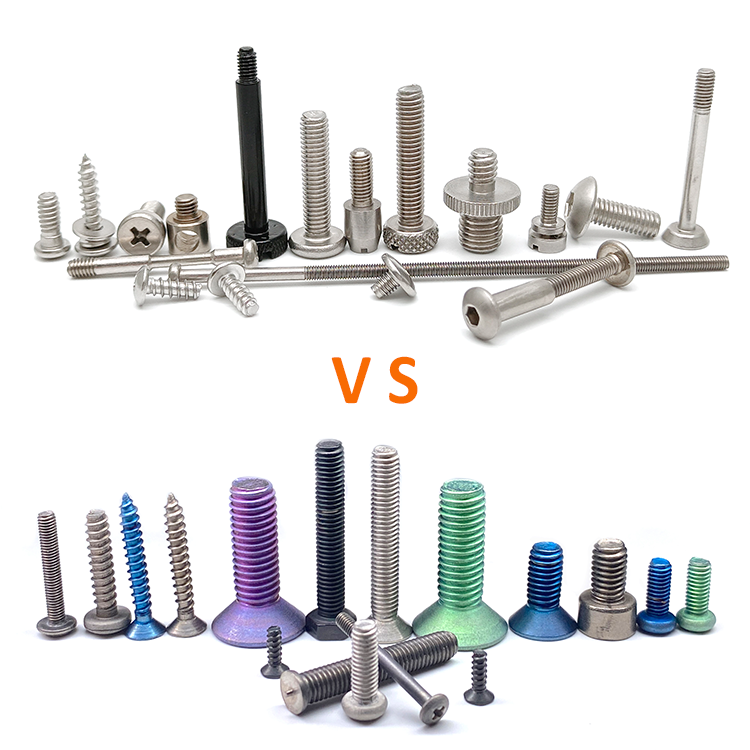
We make anodized titanium screws in titanium with a pan head and a Phillips cross, coloured to the film thickness on the drawing. The oxide that carries the colour is a dielectric, so an anodised screw insulates the joint it clamps — which matters wherever the fastener was part of the bonding path.
Watch the factory video·Email sst@szsst88.com
ISO 9001:2015 · Manufacturing since 1998 · 8,678+ customers · 89 countries and regions
Made to order – there is no stock catalogue. Each part is produced to your drawing, and production starts after drawing review and first-article approval.
Anodized titanium screws are titanium machine screws whose surface oxide has been grown electrolytically to a chosen thickness, which colours the metal. This part is a pan head Phillips screw from M1 to M10, anodised, and is quoted with the head and length made to the drawing.
Titanium body. Light, rust free and non-magnetic, with a lower elastic modulus than steel.
Anodised surface. An oxide grown into the metal, coloured by its thickness rather than by a pigment.
Pan head, Phillips cross. A standard head and recess, driven with the bit the line already uses.
Machine thread. A fine thread for a tapped hole or a nut, with a plain chamfered point.
These anodized titanium screws are used on instruments, eyewear, marine hardware and consumer products where a coloured fixing has to resist corrosion without a coating that can flake, and where the colour has to come from the metal rather than from paint.
Titanium anodising grows an oxide on the surface, and that oxide is a dielectric. On an anodized titanium screw the whole surface — head, thread, point — ends up insulated from anything it touches, including the plate it clamps and the nut it threads into. For most joints that is irrelevant. For a joint that relies on the fastener to carry current, it is a break in the circuit.
That matters more often than it sounds. Enclosures often use their screws as a bonding path between a coated panel and a chassis, because it is free: the screw touches both, the paint is displaced at the thread, and the connection is made. Replace that screw with an anodised titanium one and the joint is now insulated at both the head and the thread, and the enclosure’s bonding depends entirely on whatever else touches.
On anodized titanium screws the thickness that makes the colour also sets the standoff voltage. A deep colour is a thicker film and a higher breakdown voltage, so the electrical effect and the appearance move together: the more decorative the finish, the more completely it isolates.
There are three practical answers. Mask the thread and the bearing face so the joint has bare metal where it touches; use a plain titanium screw where bonding is required and colour somewhere else; or leave the screw anodised and add an explicit bonding strap. All three work; what does not work is assuming an anodised screw behaves like a plated one, because a plated screw is metal to metal at every contact.
On anodized titanium screws the same insulation applies to static and to stray currents. A plastic-bodied product with anodised titanium hardware has no path to earth through its fasteners at all, which is usually what the design intends, and should be stated on the drawing rather than discovered in test.
For the mechanical joint, none of this changes anything: the film is a few tens of nanometres to a few microns, it does not move the thread dimensions, and the screw clamps the same. The difference is electrical, and it is decided at the drawing stage.
Anodized titanium screws are quoted by thread size and pitch, length, head diameter and height, recess, grade, and the anodising thickness and colour. Custom lengths up to 2,000 mm, subject to DFM review after drawing submission. The quotation carries the grade, the head, the recess, the thread and the anodising.
| Item | How it is defined | What we control |
|---|---|---|
| Grade | Commercially pure or alloy | Alloy and mechanical properties |
| Head | Pan head | Diameter, height and bearing ring |
| Recess | Phillips | Depth and width |
| Thread | Machine thread | Size, pitch and class |
| Length | Under the head | Length and thread run |
| Anodising | Film thickness and colour | Colour, and electrical insulation |
Where the joint needs electrical continuity, the drawing should say so, and name the area to be masked. A note like that is the difference between a part that bonds and a part that insulates, on a screw that looks the same either way.
The film thickness is written with the colour, because the two are one setting. It also sets the standoff voltage, which matters on equipment that is tested for isolation.
The recess is checked after anodising. The film grows inside the cross as well, and a cross cut to the drawing takes the bit with slightly less clearance once the colour is on.
Four properties decide this part, and each carries a cost:
| Property | What it gives | What it costs |
|---|---|---|
| Titanium body | Light, rust free, non-magnetic | Lower modulus, and galling risk |
| Anodised colour | Colour in the metal, nothing to flake | The film insulates the joint |
| Pan head | A flat bearing ring and a full cross | Stands above the surface |
| Machine thread | A defined clamp in a tapped hole | Needs a nut or an insert |
The value of anodized titanium screws is a coloured fixing that will not corrode and will not lose its finish at the edges, on a product where the hardware is part of the appearance rather than hidden inside it.
The cost is that the same film that gives the colour also isolates the joint, so any bonding requirement has to be dealt with on the drawing rather than after an equipment test fails.
The recorded finish is anodised titanium. It is a grown oxide, so it adds no measurable thickness to the head or the thread; what it does add is a dielectric layer over every surface, which is the property to think about whenever the screw is part of an electrical path.
| Option | How it protects | Electrical behaviour | Typical use |
|---|---|---|---|
| Anodised | Grown oxide, coloured | Insulates; film is a dielectric | Coloured, isolated joints |
| Plain | Natural oxide | Conductive through contact | Bonded equipment |
| Anodised with masked thread | Coloured head, bare thread | Continuity at the thread only | Colour plus bonding |
| Gold plated | Thin metal layer | Conductive, and low contact resistance | RF and instrument hardware |
| Anodised with bonding strap | Colour plus a separate path | Continuity by design | Enclosures with anodised hardware |
Masking is the usual compromise: the head keeps its colour, the thread and the bearing face are left bare, and the joint bonds through the masked areas. It costs an extra operation and it is the only way to have both.
Gold plating is the other answer where contact resistance has to stay low over time, and it is why instrument and RF hardware is often gold rather than coloured.
Three products where colour and material both matter:
| Where it sits | The screw closes a panel on equipment that is also tested for electrical isolation. |
| When it goes wrong | The housing fails a bonding check, or a coloured screw is found to be the only path. |
| Why it happens | The anodised film insulates every contact point. |
| What we control | Masking and continuity specified; sample metered across the joint. |
| Where it sits | The screw is a visible detail on a product finished in a matching colour. |
| When it goes wrong | The colour does not match between the two sides, or the head marks the frame. |
| Why it happens | Two anodising lots were mixed, and the recess is tight after the film. |
| What we control | Colour compared as a lot; recess checked with the bit after the finish. |
| Where it sits | The screw closes a fitting that sees salt water and must not rust or seize. |
| When it goes wrong | The thread galls, or the joint is found to have no continuity where it should. |
| Why it happens | Titanium on stainless without a lubricant, and an anodised part used where bonding was needed. |
| What we control | Mating material, lubricant and finish agreed; sample exposed and metered. |
Four points that decide whether an anodised screw is right for the joint as well as for the look:
|
Colour and masking written down
The drawing states the colour, and the areas to be left bare where the joint has to bond. Basis: Electrical intent on the drawing. |
Machined, then anodised
The head and recess are finished before the film, and the recess is checked with the bit afterwards. Basis: Bit fits the coloured part. |
|
Driven and checked
The first article is driven and checked for colour against the sample and for continuity where required. Basis: Both proved on the sample. |
Same shot, same shade
Anodising lots are recorded with the drawing revision, so a repeat batch matches the assembly. Basis: Same shade across lots. |
An anodised part is bought for its appearance and can fail on a property nobody looked at. These four points put the electrical requirement next to the colour, where both can be checked.
These screws are headed or turned in titanium, with the pan head formed, the Phillips cross cut, the thread rolled or cut, and the parts anodised to the colour and thickness on the drawing. The first piece of every run is measured on head, recess, thread and length, and checked against the colour sample.


|

|
Anodising is controlled by voltage and time, and both the colour and the film thickness come from that setting. The same control sets how completely the part is insulated, which is why the anodising record is worth keeping even on a purely decorative job.
Where the joint needs continuity, the masking is done before the part goes into the bath: the thread and the bearing face are covered so no oxide grows there. Masking is a manual step, and it is the reason a masked part costs more than a fully coloured one.
Nothing is applied after the bath. The parts are packed as they come out, and the recess is checked with the bit on the finished parts rather than before the colour, because the film is inside the cross as well as on the face.
What decides whether a batch of anodized titanium screws passes is the recess that takes the bit, the colour against the sample and the film that produces both the colour and the insulation. The inspection agreement covers all three.

Head and recess on the projector |

Thread checked with gauges |

Material checked |

Salt-spray testing where required |
The recess is measured for depth and width and driven with the bit on the finished part. On a coloured screw this is the check that catches a film that grew too far into the cross.
The colour is compared with the reference sample under the same light, lot against lot. Mixed shades in one delivery come from separate anodising charges, and on a visible product that is the first defect a customer reports.
Where the drawing asks for continuity, the sample is checked with a meter across the joint, at the masked areas. That test is the only way to prove that a masked part actually bonds, and it is worth writing into the drawing rather than leaving it to the assembly.
Every batch of anodized titanium screws is traceable to the bar and to the anodising lot. The material certificate states the grade, the heat number, the chemistry and the mechanical properties; the anodising record carries the film thickness, the colour and the lot.

ISO 9001:2015 |

RoHS test report |

Registered trademark |

Patent: security screw and driver |
With each shipment we supply the material certificate, the inspection record for the head, recess and thread, and the anodising record. The records carry the batch number, so a repeat order can be compared with the first on the film thickness that sets both the colour and the electrical behaviour.
More than 8,678 customers in 89 countries and regions have ordered from Shi Shi Tong; 87% of orders come from repeat customers and 56% through referrals. Most projects follow the same route: drawing review, first-article approval, then batches checked against that sample. On a coloured finish the first article is also the colour reference, held against the lots that follow. Buyers visit during the process to review samples.
|
8,678+
customers served
|
87%
of orders from repeat customers
|
56%
of orders through referrals
|
89
countries and regions shipped to
|
Buyers and quality engineers visit for sample review, process discussion and supplier audits; the visit is arranged around production so the machining cell and the anodising line can be seen on the day the parts run.

Customer group visit – sample review |

Customer group visit – process discussion |

Customer group visit – factory tour |

Customer visit – project kick-off |

Danish customer – drawing review |

Industry exhibition – meeting customers |
No. The oxide grows into the metal, so the thread keeps its dimensions and the fit is unchanged.
No. The anodised film is a dielectric, so an anodised titanium screw insulates the joint at the head and the thread.
Mask the thread and bearing face, use a plain screw, or add a separate bonding strap. State it on the drawing.
The colour is set by the film thickness, which depends on the bath. Lots are the unit, so a sample is held as the reference.
All of them, in the sense that the film is part of the metal. Abrasion at a hard edge is what changes the appearance.
Grade, thread and length, head and recess, the colour and film thickness, and any area to be masked.
How an anodised titanium screw project runs from drawing to repeat delivery:
|
1
Send the drawing and the colour sample
|
→ |
2
Grade, colour and masking agreed
|
→ |
3
First article driven and colour-checked
|
→ |
4
Batch production and repeat orders
|
Each step is confirmed with you before the next one starts; the drawing revision used for the first article is what repeat orders are checked against.
For a quotation, send the drawing with the grade, thread and length, head and recess, the colour and film thickness, and the areas to be left bare if the joint has to bond.
|
Grade
|
Thread
|
Head
|
|
Recess
|
Colour
|
Masking
|
Sending a drawing? The form below does not take attachments. Email the PDF, DXF or STEP file to sst@szsst88.com with the part name and quantity in the subject line – the drawing is reviewed and a quotation follows.

 +86 13143444311
 sst@szsst88.com