Tel:
+86 13143444311
Email:sst@szsst88.com
Fax:+0086-755-27322278
Address:Building 9, First Industrial Zone, Tantou Industrial City, Songgang Street, Baoan District, Shenzhen 518105, Guangdong, China
Type:M4 Titanium Screws
Materials:Titanium
Surface treatment:Anodized
Head Type:Pan head
Drive:Phillips cross recess
Thread:Machine thread
Point:Plain, chamfered
Forming:Single Die Heading
Size:M1 M2 M3 M4 M5 M6 M7 M8 M9 M10
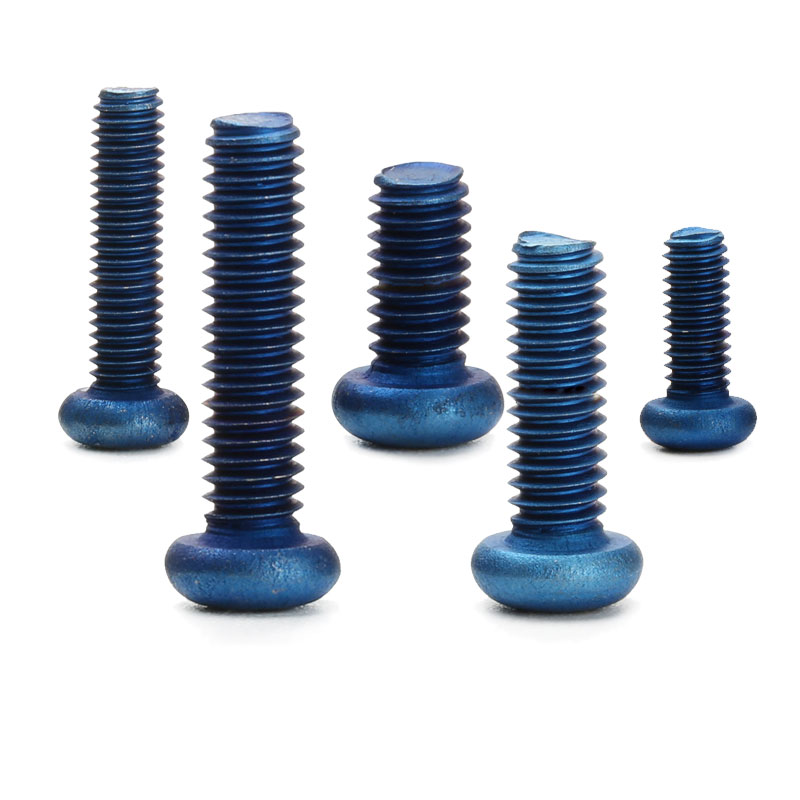
We make M4 titanium screws in the metric pan head form with a cross recess and an anodised finish, quoting the whole range from M1 to M10 with lengths made to the drawing. The anodising colour is agreed against a retained sample, and the first article is compared with yours under the same light.
Watch the factory video·Email sst@szsst88.com
ISO 9001:2015 · Manufacturing since 1998 · 8,678+ customers · 89 countries and regions
Made to order – there is no stock catalogue. Each part is produced to your drawing, and production starts after drawing review and first-article approval.
M4 titanium screws are machine screws of a common metric size made in titanium, with a pan head and a cross recess. The part recorded here is anodised, quoted across the M1 to M10 range with the M4 sizes in the same envelope and lengths made to the drawing.
Titanium body. Roughly half the weight of steel, corrosion resistant without a coating, and non-magnetic.
Pan head. A rounded head with a wide bearing face, suited to panels where the clamp has to be spread.
Cross recess. Four tapered arms driven by a matching bit, in a metal that galls if the drive is poor.
Anodised finish. A grown oxide layer that colours and hardens the surface without adding a film that can flake.
They are used on sports equipment, drones and model hardware, marine fittings, bicycles and motorcycle accessories, and any joint where weight, corrosion and appearance are all being specified at once.
Anodising turns the surface of the titanium into an oxide rather than covering it with a deposit. The oxide grows out of the metal, so there is no boundary between coating and substrate, nothing to lift at an edge, and nothing that can flake off into an assembly. On a fastener that matters more than it does on a decorative panel, because the head and the recess are handled and driven.
The colour of anodised M4 titanium screws comes from the thickness of that oxide, not from a pigment sitting on top. Light reflecting from the oxide surface interferes with light reflecting from the metal below, and different thicknesses produce different colours. That is why an anodised titanium part cannot be colour-matched by mixing a paint: the colour is a dimension.
The practical result is good for geometry and awkward for colour. Because the oxide is only micrometres thick and grows from the surface, the recess keeps its depth and the bit still seats to the floor. But because the colour depends on the process, two batches anodised in different runs can sit a shade apart, and on a visible panel that is the thing the customer notices first.
Anodising also changes the friction of the thread. Titanium galls against itself and against many metals when it is clean and dry, and an anodised surface is harder and slightly more abrasive than bare titanium. On M4 titanium screws that shows up as a thread that seizes on the third or fourth assembly rather than the first, which is why the assembly procedure is agreed with the drawing.
What the material buys is weight and corrosion together. An M4 titanium screw does the same clamping job at about half the mass of a steel one, does not rust in salt air, and does not disturb a magnetic sensor sitting next to it. Those three properties are the reason the price is accepted.
The recorded range is M1 to M10, with the M4 sizes quoted in the same envelope and lengths made to the drawing. Custom lengths up to 2,000 mm are subject to the drawing submission and DFM review. The quotation for M4 titanium screws carries the alloy, the head diameter and height, the PH size and recess depth, the anodising colour and thickness, the thread pitch and the overall length.
| Item | How it is defined | What we control |
|---|---|---|
| Alloy | Titanium grade per the drawing | Grade stated on the certificate |
| Head | Pan head, on the surface | Diameter, height and bearing face |
| Recess | Phillips, PH size for M4 | Depth and floor thickness |
| Finish | Anodised, colour and thickness | Colour against a retained sample |
| Thread | M4 machine thread | Pitch, length and start position |
| Length | Overall, head included | Length tolerance and thread start |
The anodising colour has to be specified as a reference rather than a name. Colours from the interference effect sit in bands, and “blue” covers a range that a customer will not accept as one colour on a visible assembly.
The recess is the part of an anodised screw that matters most in assembly. Because the oxide grows rather than deposits, the recess keeps its geometry, and that is a real advantage over plating; the check after anodising is therefore about surface condition rather than about fit.
Length is measured over the head. On a joint where the screw passes through a panel into an insert, the usable thread length is the overall length minus the panel thickness, and that engagement is what the anodised thread has to hold.
Four properties decide M4 titanium screws, and each one carries a cost:
| Property | What it gives | What it costs |
|---|---|---|
| Titanium body | About half the weight of steel | Higher unit cost; lower stiffness |
| Anodised finish | Colour without a film | Colour varies between anodising runs |
| Pan head | Wide bearing face | Stands above the surface |
| Cross recess | Standard bit, self-centring | Cam-out risk on a galling metal |
The value of M4 titanium screws is a fixing that disappears from the weight budget, survives salt water and looks like the product it holds. On a bicycle, a drone airframe or a marine fitting, all three of those matter at once.
The cost is in the process rather than the part: the anodising has to be matched across runs, and the assembly has to be controlled because titanium does not forgive a dry thread.
The trade is titanium weight and corrosion against a thread that galls if it is driven dry.
The recorded finish is anodised. On titanium it is the finish that does the most work: it colours the metal, hardens the surface and leaves the geometry as it was cut.
| Option | What it does | Effect on head and recess | Typical use |
|---|---|---|---|
| Anodised | Grown oxide, coloured | Micrometres thick; recess unchanged | Visible hardware |
| Plain, as formed | Native oxide only | No build; bright metal | Where colour is irrelevant |
| Polished | Mechanical smoothing | Edges softened; brighter | Decorative visible heads |
| Bead blasted | Uniform matte surface | Matte inside the recess | Equipment and enclosures |
| Dry film lubricant | Anti-galling layer | Thin, even film | Joints assembled more than once |
A dry film lubricant is not a finish for appearance; it is an assembly aid. On titanium joints that will be opened more than once, it is often specified alongside the anodising, because the harder anodised surface alone does not prevent galling.
Where the parts are visible and colour matters, the anodising batch is recorded against a retained sample. That is the only reliable way to keep a run of M4 titanium screws looking like one set.
Three settings where weight and corrosion are specified together:
| Where it sits | The screw holds a component where every gram counts and the fixing is exposed to weather and cleaning. |
| When it goes wrong | A steel fixing is substituted and the part gains weight or rusts at the head. |
| Why it happens | The assembly is handled, wet, and often opened for maintenance. |
| What we control | Alloy confirmed; anodising colour matched; first article assembled twice. |
| Where it sits | The screw closes a frame where mass affects flight time and magnetic parts disturb sensors. |
| When it goes wrong | A magnetic steel screw interferes with a compass, or the head loosens under vibration. |
| Why it happens | The frame is light, the joint is small, and the fixing is repeated. |
| What we control | Non-magnetic grade confirmed; torque and thread locking agreed. |
| Where it sits | The screw fixes hardware where salt water would attack a steel part within a season. |
| When it goes wrong | A coated screw breaks down at the recess and corrosion starts where the bit bears. |
| Why it happens | The joint is immersed or splashed, and the fixing is visible. |
| What we control | Salt-spray sample checked; first article fitted on the fixture. |
Four reasons that matter on a light part with a grown finish, each tied to something the drawing or the first article has to prove:
|
Colour specified by reference
The anodising colour is agreed against a retained sample rather than a name, because the colour comes from an interference effect and a name covers a range. Basis: Colour by reference, not name. |
Headed, recessed, threaded, anodised
The pan head and cross are formed in one stroke, the thread rolled, and the batch anodised after forming so the recess keeps its geometry. Basis: One route, geometry preserved. |
|
Recess and head measured after anodising
The recess and head are measured after the finish, not before, because that is the part the customer drives and sees. Basis: Measured after anodising. |
Same colour, same friction
The anodising lot and the assembly procedure are recorded with the drawing revision, so a repeat order of M4 titanium screws looks and drives the same. Basis: Colour and friction held. |
These screws are headed on single-die machines that form the pan head in one stroke, cut with the cross recess, thread rolled on the titanium, and anodised as a batch. The first part of every run is measured on head diameter and height, recess size and depth, thread and length, and the anodised colour is checked against the retained sample.


|

|
Titanium resists flow, so the head of an M4 titanium screw is formed with higher pressure than steel and the tooling wears faster. The recess is cut after the head is formed and is the operation that decides how the part drives: a slightly dull punch leaves lobe or arm corners that look right and hold a bit badly.
Thread rolling uses clean rolls and a blank diameter that displaces rather than squeezes. Titanium work-hardens quickly, and a squeezed thread has a hard, brittle crest that galls on the first assembly, which is exactly what the anodising is there to help with rather than to hide.
Anodising is the last step and the one that decides the appearance of the batch. The parts are cleaned, anodised in a controlled bath, rinsed and sealed, and the colour is compared with the retained sample under the same light before packing.
What decides whether M4 titanium screws pass is the colour, the recess, the thread and the surface. The inspection agreement covers those, and the criteria come from the drawing and the retained sample.

Head and recess after anodising |

Thread and start checked |

Hardness against the titanium spec |

Salt-spray testing of the anodised surface |
Colour is checked against the retained sample under the same light, because the interference colour shifts with viewing angle and a spot check in different conditions proves nothing. Head diameter, height and recess depth are measured after anodising on a sample from each lot.
The drive is proved with the production bit at the agreed torque, then the recess is inspected under magnification. Titanium does not shear cleanly at the corners, so the check looks at the shape of the drive rather than at a single dimension.
A sample from every batch is assembled into the customer part and opened twice, which is where galling appears. On an anodised titanium joint that second cycle is the one that matters.
Every batch is traceable to the titanium bar or wire it was made from. The grade and heat number appear on the material certificate supplied with the parts, and the anodising lot is recorded against the colour sample.

ISO 9001:2015 |

RoHS test report |

Registered trademark |

Patent: security screw and driver |
With each shipment we supply the material certificate, the inspection record for the dimensions on the drawing, and the anodising record with the colour sample reference. The documents carry the drawing revision and the batch number, so a repeat order of M4 titanium screws matches the original colour and friction.
More than 8,678 customers in 89 countries and regions have ordered from Shi Shi Tong; 87% of orders come from repeat customers and 56% through referrals. Most projects follow the same route: drawing review, first-article approval, then batches checked against that sample. On anodised parts the first article is compared with the customer sample under a known light, because colour is the first thing judged. Buyers visit during the process to review samples.
|
8,678+
customers served
|
87%
of orders from repeat customers
|
56%
of orders through referrals
|
89
countries and regions shipped to
|
Buyers and quality engineers visit for sample review, process discussion and supplier audits; the visit is arranged around production so the headers and the anodising line can be seen on the day the parts run.

Customer group visit – sample review |

Customer group visit – process discussion |

Customer group visit – factory tour |

Customer visit – project kick-off |

Danish customer – drawing review |

Industry exhibition – meeting customers |
No. It grows out of the metal rather than sitting on it, so there is no film edge to lift. It can wear through in time but it does not flake.
The colour comes from the oxide thickness, not from a pigment. Small process differences shift the shade, which is why a retained sample is used.
Only by micrometres, so the bit still seats to the floor. That is an advantage over plating on a part this small.
Titanium galls when dry surfaces rub under load. The assembly procedure, a lubricant, or both are agreed with the drawing.
Titanium has a lower stiffness than steel, so the same size behaves differently. The joint is designed around the material, not only the diameter.
The titanium grade, head diameter and height, PH size and recess depth, anodising colour and thread specification.
How a titanium screw project runs from drawing to repeat delivery:
|
1
Send the drawing and the colour sample
|
→ |
2
Grade and anodising agreed
|
→ |
3
First article compared with your sample
|
→ |
4
Batch production and repeat orders
|
Each step is confirmed with you before the next one starts; the drawing revision from the first article is what repeat orders are checked against.
For a quotation, send the drawing with the titanium grade, head diameter and height, PH size, anodising colour and thread specification.
|
Titanium grade
|
Head diameter
|
PH size
|
|
Anodising colour
|
Thread pitch
|
Length
|
Sending a drawing? The form below does not take attachments. Email the PDF, DXF or STEP file to sst@szsst88.com with the part name and quantity in the subject line – the drawing is reviewed and a quotation follows.

 +86 13143444311
 sst@szsst88.com