Tel:
+86 13143444311
Email:sst@szsst88.com
Fax:+0086-755-27322278
Address:Building 9, First Industrial Zone, Tantou Industrial City, Songgang Street, Baoan District, Shenzhen 518105, Guangdong, China
Type:Screw Rivets Suppliers, Screw Companies
Materials:Stainless Steel
Surface treatment:Plain
Head Type:Round Head
Drive:None; hammer driven
Thread:U-drive spiral
Point:Chamfered, non-cutting
Forming:Single Die Heading
Size:M1 M2 M3 M4 M5 M6 M7 M8 M9 M10
Number:888
We make screw rivets in plain A2 stainless with a round head and a U-drive spiral, driven with a hammer and quoted from M1 to M10. Head, shank, spiral pitch, length and the hole size come from your drawing, and the first article is driven into your own panel.
Watch the factory video·Email sst@szsst88.com
ISO 9001:2015 · Manufacturing since 1998 · 8,678+ customers · 89 countries and regions
Made to order – there is no stock catalogue. Each part is produced to your drawing, and production starts after drawing review and first-article approval.
Screw rivets are fasteners driven in with a hammer rather than turned with a tool: a round head, a shank with a coarse U-drive spiral, and no recess of any kind. These are plain A2 stainless, quoted from M1 to M10 with Number 888, and they are used where the joint can only be reached from one side.
Round head. A domed head that sits on the surface and is often the visible face of the fixing.
No recess. There is no slot and no socket, because the part is not turned; it is struck.
U-drive spiral. A coarse, hardened thread with a wide pitch that cuts and compresses its way into the hole under impact.
Plain stainless. A2 grade, passivated and uncoated, so the head and the spiral are as made.
Blind fixing. The fastener works from the front face only, with nothing needed behind the panel.
Screw rivets are used in nameplates, badges, hinges, sheet panels, cabinet hardware and any assembly where the back of the panel is closed or inaccessible. They replace a screw and a nut, or a rivet and a setting tool, with one part and one hammer.
A drive screw works by interference, the same way a nail does, with one difference: the spiral flutes form a thread as they go in. The hole is drilled to a diameter slightly smaller than the spiral, and the impact forces the flutes to cut and compress the material into that undersize bore. The part is held by the deformed material in the hole, not by a nut behind it.
That is why screw rivets have no recess. A driven fastener never has to be turned, so the head can be a plain dome with no material removed from it, which is both cheaper and stronger than a headed screw of the same diameter. The head is what takes the hammer blow, so a solid dome is the right shape for the process.
For screw rivets the hole size is the whole specification. A hole that is too small splits a brittle panel or will not take the shank at all; a hole that is too large lets the spiral cut its way without gripping, and the fastener can be pulled out by hand afterwards. On stainless parts in stainless sheet the tolerance is tighter than on plastic, because both materials resist deformation.
Removal of screw rivets is destructive by design. A screw rivet is not meant to come out; taking one out usually means drilling the head off or levering it, which damages the panel around the hole. That is acceptable for a nameplate that is fitted once and unacceptable for a cover that is opened for service, and that single fact decides where the part belongs.
Stainless makes screw rivets a corrosion-resistant choice, but it also makes the driving harder. The head is harder than most hammer faces and the spiral does not deform as easily as a soft steel one, so the panel has to be supported behind the hole and the hammer blow has to be square. A blow that is off square tips the fastener and leaves the head sitting at an angle on a visible panel.
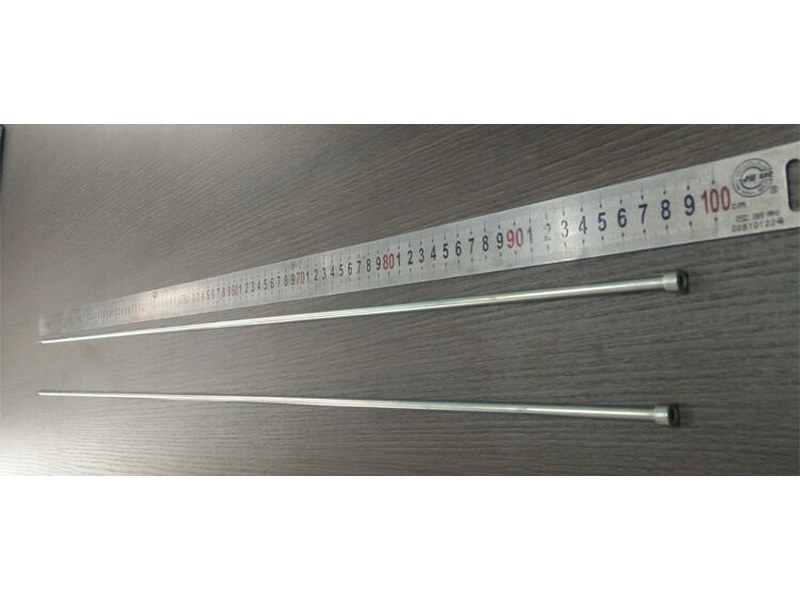
The recorded range is M1 to M10, with lengths made to the drawing. Custom lengths up to 2,000 mm are subject to DFM review after drawing submission. For screw rivets the quotation carries head diameter and height, shank diameter, spiral pitch, length under the head and the hole size the part is designed for.
| Item | How it is defined | What we control |
|---|---|---|
| Head | Round, domed | Diameter, height and rim condition |
| Shank | Plain diameter to the spiral | Diameter and length under the head |
| Spiral | U-drive thread | Pitch, flute depth and point form |
| Length | Under the head | Length tolerance and point length |
| Material | A2 stainless | Grade and heat number on the certificate |
| Finish | Passivated, plain | Surface condition and head polish |
On screw rivets the hole size belongs on the drawing with the shank diameter, because the two together decide whether the part grips. A supplier who is given only the screw cannot choose the hole, and a customer who drills by eye will not reproduce the joint from batch to batch.
Length on screw rivets is measured under the head and has to be quoted with the panel thickness. A drive screw should pass through the panel and grip in the full thickness; one that is too long bottoms out and stands off, and one that is too short grips only at the surface layer.
Four features define screw rivets, and each one has a consequence:
| Feature | What it gives | What it costs |
|---|---|---|
| Blind fixing | Works from the front face only | Cannot be adjusted once driven |
| [‘Round head’] | Solid, visible, no recess to wear | Must be struck square; no re-driving |
| U-drive spiral | Grip formed in the hole | Hole tolerance is the whole joint |
| No recess | Cheaper head, stronger dome | Cannot be removed without damage |
| Plain stainless | Corrosion resistant in exposed joints | Harder to drive; needs support behind |
The blind fixing is the reason screw rivets exist. Where the back of a panel is a sealed cavity, a foam core or the inside of a cabinet, a screw and nut cannot be assembled at all, and a screw rivet can be driven from the front in one operation.
The destruction on removal is the price. A nameplate, a badge, a hinge leaf, a fixed trim: all of them are fitted once. A part that has to come apart again is a screw, and trying to use a drive screw there is a decision that will be paid for at the first service visit.
The recorded finish is passivation on A2 stainless with no coating. On a drive screw that matters because the head is struck: a coating would be marked by the hammer and would flake at the edge of the mark, leaving a bright ring around a dent. A passivated head takes the blow and keeps its colour.
| Option | How it protects | Effect on head and spiral | Typical use |
|---|---|---|---|
| A2 stainless, passivated | Passive chromium oxide film | Head and spiral as formed | Nameplates and panels |
| A4 stainless, passivated | Passive film with molybdenum | Head and spiral as formed | Marine and washdown |
| Stainless, polished | Passive film, bright finish | Decorative head; spiral unchanged | Visible badges |
| Steel, zinc plated | Sacrificial zinc | Hammer marks show as bare spots | Indoor general work |
| Aluminium, plain | Natural oxide | Soft head; dents on impact | Light panels |
Where the head is decorative, a polished stainless head is the usual choice: it catches light like a fitting rather than like a fastener, and it does not show the hammer mark the way a satin finish does.
Where a plated steel drive screw is used, the hammer mark is where the corrosion starts, because the plating is broken exactly where the tool struck. That is a small detail until the joint is outdoors, where the mark becomes a rust spot in the middle of the panel.
Three assemblies where a blind driven fixing is the only practical answer:
| Where it sits | The fastener holds a plate onto a panel that is closed behind, where a screw and nut cannot be assembled. |
| When it goes wrong | The hole is oversized and the badge can be lifted off by hand. |
| Why it happens | The joint is blind, the plate is thin, and the fixing is permanent. |
| What we control | Hole size and shank checked; first article driven into a sample panel. |
| Where it sits | The fastener closes a fixed panel onto a frame where access behind it is blocked by insulation or equipment. |
| When it goes wrong | The fastener tips as it is driven and the head sits at an angle. |
| Why it happens | The panel is thin, the access is one-sided, and the fixing is never opened. |
| What we control | Head and spiral checked; first article driven with support behind the panel. |
| Where it sits | The fastener holds a hinge or a bracket where the inside of the enclosure is not accessible after assembly. |
| When it goes wrong | A short fastener grips only the surface and the hinge works loose. |
| Why it happens | The joint is blind, the sheet is thin, and the load is repeated. |
| What we control | Length against panel thickness checked; first article assembled and loaded. |
Four reasons that matter on a driven fastener, each tied to something the drawing has to prove:
|
Hole size agreed with the shank
Shank diameter, spiral pitch and the hole the part is designed for are agreed together, because the grip is made by interference rather than by a thread. Basis: Hole size agreed with the shank. |
Formed head, rolled spiral
The dome is formed in one stroke and the U-drive spiral is rolled and hardened before passivation. Basis: One route from wire to passivated part. |
|
Head and spiral measured
Head diameter and height are checked with the spiral pitch, because a tipped fastener starts with a head that is not square to the shank. Basis: Head and spiral measured. |
First article driven in your panel
The first article is driven into the customer panel with support behind it, because the joint is proven by the hole and the material. Basis: First article driven in the panel. |
Screw rivets are headed on single-die machines that form the round dome, then rolled with the U-drive spiral and pointed before passivation. The spiral is coarse and the flutes are deep, so the roll is the step that decides how the part grips; the first part of every run is measured on head, shank, spiral pitch and length.


|

|
A screw rivet is only as good as the squareness of its head to its shank. The head of a screw rivet takes the blow, so any runout between head face and axis tips the fastener on impact, and a tipped fastener grips with one side of the spiral and stands at an angle. That is measured on the first part of every run rather than watched for on the line.
Hardening the spiral is what allows the part to be driven into a harder panel. A soft spiral folds over instead of cutting, and the fastener either stops or spins in the hole. The heat treatment is controlled so that the head stays tough enough to take the hammer while the flutes stay hard enough to cut.
What decides whether screw rivets pass is the head, the spiral, the length and the material. The inspection agreement covers those, and the criteria come from the drawing.

Head and spiral on the projector |

Spiral and point checked |

Flute hardness checked |

Salt-spray testing of the grade |
Head diameter, height and squareness are measured on a projector, and the spiral is checked for pitch and flute depth. Hardness is checked on a sample of each batch, because a drive screw with a soft spiral looks correct and fails on the first blow.
A sample is driven into a panel of the customer’s material and thickness, and then pulled to destruction. That test gives the number that matters for a blind fixing: how hard the part is to pull out, measured in the material it will actually be used in.
Every batch is traceable to the wire it was made from and to the passivation batch that finished it. The grade and heat number appear on the material certificate supplied with the parts, and the inspection records follow the criteria agreed on the drawing.

ISO 9001:2015 |

RoHS test report |

Registered trademark |

Patent: security screw and driver |
With each shipment we supply the material certificate, the inspection record for the dimensions on the drawing and, where the grade is listed, the third-party report that covers it. The documents carry the drawing revision and the batch number, so a repeat order keeps the same spiral and the same length.
More than 8,678 customers in 89 countries and regions have ordered from Shi Shi Tong; 87% of orders come from repeat customers and 56% through referrals. Most projects follow the same route: drawing review, first-article approval, then batches checked against that sample. On screw rivets the first article is driven into the customer panel, because the grip of a drive screw is a property of the hole and the material. Buyers visit during the process to review samples.
|
8,678+
customers served
|
87%
of orders from repeat customers
|
56%
of orders through referrals
|
89
countries and regions shipped to
|
Buyers and quality engineers visit for sample review, process discussion and supplier audits; the visit is arranged around production so the headers and the passivation line can be seen on the day the parts run.

Customer group visit – sample review |

Customer group visit – process discussion |

Customer group visit – factory tour |

Customer visit – project kick-off |

Danish customer – drawing review |

Industry exhibition – meeting customers |
Driven with a hammer into a drilled hole of the specified size. The U-drive spiral cuts and compresses its way in; there is no turning.
Not without damage. Removal means drilling the head off, and the hole is usually damaged in the process. Use a screw where the joint is serviced.
Slightly smaller than the spiral. That difference is what creates the grip, so the hole belongs on the drawing with the fastener.
Yes, and plastic is a common use. In brittle plastics the hole has to be large enough not to split the panel.
The head takes the hammer blow and a solid dome is stronger for it. A recess would only remove material from the part being struck.
Head diameter and height, shank diameter, spiral pitch, length under the head and the hole size.
How a screw rivet project runs from drawing to repeat delivery:
|
1
Send the drawing and the panel
|
→ |
2
Hole size and shank agreed
|
→ |
3
First article driven in your panel
|
→ |
4
Batch production and repeat orders
|
Each step is confirmed with you before the next one starts; the drawing revision from the first article is what repeat orders are checked against.
For a quotation, send the drawing with the head diameter and height, shank diameter, spiral pitch, length under the head and the panel thickness and hole size.
|
Head size
|
Shank
|
Spiral pitch
|
|
Length
|
Panel thickness
|
Hole size
|
Sending a drawing? The form below does not take attachments. Email the PDF, DXF or STEP file to sst@szsst88.com with the part name and quantity in the subject line – the drawing is reviewed and a quotation follows.

 +86 13143444311
 sst@szsst88.com