Tel:
+86 13143444311
Email:sst@szsst88.com
Fax:+0086-755-27322278
Address:Building 9, First Industrial Zone, Tantou Industrial City, Songgang Street, Baoan District, Shenzhen 518105, Guangdong, China
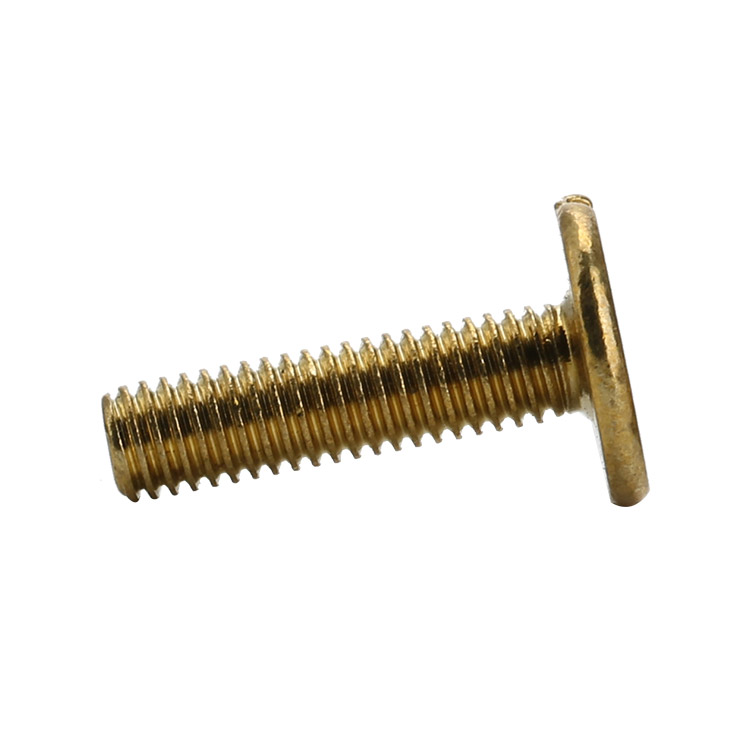
Type:Brass Slotted Screws, Brass Machine Screws Suppliers
Materials:Brass
Surface treatment:Plain
Head Type:Low profile head
Drive:Slotted (single slot)
Thread:Machine thread
Point:Plain
Forming:Single Die Heading
Size:M1 M2 M3 M4 M5 M6 M7 M8 M9 M10
We make brass slotted screws with a low head and a plain finish, quoting them from M1 to M10 with lengths made to the drawing. Slot width and depth are set against the blade that will drive them, and the first article is matched to your sample on tone and head height.
Watch the factory video·Email sst@szsst88.com
ISO 9001:2015 · Manufacturing since 1998 · 8,678+ customers · 89 countries and regions
Made to order – there is no stock catalogue. Each part is produced to your drawing, and production starts after drawing review and first-article approval.
Brass slotted screws are machine screws cut in brass with a single straight slot across the head, finished plain so the metal shows. The part recorded here is quoted from M1 to M10 with lengths made to the drawing.
Brass body. Copper with zinc, free-cutting, non-magnetic, and the finish is the alloy itself rather than a coating.
Single slot. One straight slot, sized as a width and a depth, driven with a flat blade.
Low head. A shallow head that keeps the fixing close to the panel and leaves the slot shallow too.
Plain finish. No plating, so the parts can be polished, aged or lacquered after assembly without stripping a coating first.
These are the screws that appear on electrical plates, lamp fittings, instrument covers, picture frames and restored cabinets, where the fixing is driven by hand with a screwdriver that is already in the toolbox and where the metal is meant to be seen.
A Phillips recess has four walls to drive against, so a bit that is slightly small still finds a corner and the recess pulls it into line. A slot has two walls and no centring effect at all: the blade either spans the slot or it does not, and if it is narrower than the slot, it bears on the two bottom edges and walks out on one side as soon as torque rises.
That single geometry sets everything else about brass slotted screws. Slot width, slot depth and blade thickness are one relationship, and a screw is only right for the driver that will meet it. Where a drawing gives a slot width but not a depth, the part can be made with a slot that is wide and shallow, which is the shape that tears first.
Low heads make the relation tighter. A low profile head has little material above the thread, so the slot is cut into a thinner section and the depth is limited by what is left under it. Cut too deep and the head is weak at the centre; cut too shallow and the blade bottoms out and stops driving before the head seats.
Brass adds the last variable. It is soft, so the slot walls yield before they shear: the blade edges mark the corners, the slot widens with each removal, and the driver that fitted on the first assembly becomes loose by the fifth. That is a material property, not a defect, and it is why brass slotted screws are chosen for joints that are closed once and opened rarely, and why the slot depth and blade thickness belong on the drawing together.
None of this needs a power tool. These are joints driven by hand at low torque, where feel and a blade that matches the slot matter more than the driver’s brand.
The recorded range is M1 to M10, with lengths made to the drawing. Custom lengths up to 2,000 mm are subject to the drawing submission and DFM review. Quotations for brass slotted screws carry the head diameter and height, the slot width and depth, the thread pitch and the overall length measured over the head.
| Item | How it is defined | What we control |
|---|---|---|
| Head | Low profile, flat top | Diameter and height |
| Slot | One straight slot | Width and depth together |
| Drive | Flat blade | Blade thickness proven in the slot |
| Thread | Machine thread in brass | Pitch, length and start position |
| Length | Overall, head included | Length tolerance and thread start |
| Finish | Plain brass | Surface condition; no coating to strip |
Slot width is usually quoted as a range rather than a single value, because the blade that will be used has a thickness with its own tolerance. What matters is that the two ranges overlap: a 0.8 mm slot with a 0.7 mm blade drives on the edges, while a 0.6 mm slot with a 0.8 mm blade will not enter.
Head height is the second constraint. A low head finishes close to the panel and looks right in a shallow recess, but the height is also the material available for the slot. Where a customer asks for a thinner head, the slot depth has to come down with it, and the blade thickness is chosen to match.
Length is measured over the head so the datum agrees with the countersink or recess the screw sits in. On a plain brass part the end of the shank is left chamfered and clean, because a burr on the point shows on the thread and marks the tapped hole.
Four properties decide a brass slotted screw, and each one carries a cost:
| Property | What it gives | What it costs |
|---|---|---|
| Single slot | Any flat blade can drive it | No centring; walks out under torque |
| Brass body | Non-magnetic, corrosion resistant indoors | Slot walls mark and widen with refits |
| Low head | Sits close to the panel | Less material for the slot |
| Plain finish | Can be polished, aged or lacquered | No coating to protect the surface |
The value is that the joint can be opened anywhere with a tool everyone has, and that the head is a small line of metal rather than a recess that fills with paint or dirt. On restoration work that is the whole point: the fixing has to look like it was always there.
The cost is tolerance. A recess forgives a slightly wrong bit; a slot does not, and in brass the evidence of a wrong blade is permanent. That is why the slot dimensions and the driver are specified together rather than separately on brass slotted screws.
The recorded finish is plain, meaning the alloy surface with no plating. For brass slotted screws that is a deliberate choice: the part can be polished bright, left to age to a deeper tone, or lacquered after assembly, and none of those steps has to deal with a coating that has to be removed first.
| Option | How it protects | Effect on slot and head | Typical use |
|---|---|---|---|
| Plain, as supplied | The alloy itself | Slot as cut; no build | Electrical plates, instruments |
| Polished | The alloy itself | Slot edges rounded slightly | Decorative and visible heads |
| Lacquered | Clear film over brass | Film can bridge the slot if heavy | Furniture and shopfitting |
| Antique / aged | Chemical darkening | Colour even in the slot | Restoration and period work |
| Nickel or chrome plated | Hard barrier deposit | Build measurable; slot re-gauged | Where a bright steel look is wanted |
Plain brass indoors holds its colour for a long time and does not stain what it touches the way a rusting steel screw will. In a damp room brass slotted screws darken rather than corrode, and the darkening is uniform enough that a row of heads stays consistent.
Where a lacquer is applied, the film is the risk: a heavy coat bridges the slot and the blade then cuts through it, leaving a ragged edge that reads as damage. Where the appearance matters, the screws are lacquered before assembly and the blade is used carefully, or the parts are left plain and polished on site.
Three settings where a single slot and plain brass are the requirement:
| Where it sits | The screw fixes a cover plate where the head is seen and the joint is opened by an electrician with a flat blade. |
| When it goes wrong | The slot widens after a few services and the plate no longer pulls down tight. |
| Why it happens | The plate is thin, the fixing is visible, and the joint is serviced. |
| What we control | Slot width and depth checked; blade thickness proved in the slot. |
| Where it sits | The screw holds a shade or a terminal cover where brass is the intended finish. |
| When it goes wrong | A plated screw is substituted and the colour reads as steel rather than brass. |
| Why it happens | The fitting is decorative, the joint is small, and the head is on show. |
| What we control | Alloy and surface condition confirmed; first article fitted in the fitting. |
| Where it sits | The screw replaces a period fixing where the slot and the brass tone have to match what was there. |
| When it goes wrong | A modern recess or a bright zinc finish breaks the look of the piece. |
| Why it happens | The work is visible, the joint is hand-driven, and the parts are few. |
| What we control | Head height and slot matched to the sample; first article compared side by side. |
Four reasons that matter on a hand-driven plain brass part, each tied to something the drawing has to prove:
|
Slot and blade specified together
The slot width and depth are agreed with the blade thickness that will drive them, because a slot that does not match its driver is a slot that will be marked on the first assembly. Basis: Slot and blade agreed together. |
Headed, slotted and left plain
The low head and single slot are formed and cut in one sequence, the thread rolled on the brass, and the parts left plain so no coating has to be stripped before polishing or lacquering. Basis: One route, no coating to remove. |
|
Slot width and depth measured
Slot width and depth are measured on the projector and the slot is proved with a blade of the agreed thickness, because on brass the first assembly leaves a permanent record. Basis: Slot gauged and proved with a blade. |
First article against your sample
On restoration work the first article is compared side by side with the fixing it replaces, because head height and tone are what the customer sees. Basis: First article matched to the sample. |
Brass slotted screws are headed on single-die machines that form the low head in one stroke, slotted with a saw or a punch, then thread rolled on the brass shank and left plain. The first part of every run is measured on head diameter and height, slot width and depth, thread and length.


|

|
Cutting the slot is the step that decides the part. A saw cuts a slot with parallel walls and a flat bottom; a punch shears the metal and leaves a slot with slightly rounded corners and a little displaced brass at the rim. On a low head the punch approach is faster but the displaced metal has to be dressed, or the rim stands proud and the head no longer sits flat.
The depth of the cut is the balance. Cut too shallow and the blade bottoms out before the head seats; cut too deep and the material left under the slot is thin enough that the head folds when the brass slotted screws are driven home. On brass the margin is narrow, which is why the depth is measured on the first article and again after any change to the tool.
Because the parts are left plain, the surface condition is part of the specification. Brass that has been handled with bare hands tarnishes unevenly, so the parts are kept dry and inspected for fingerprints and water marks before packing, and the finish is described on the drawing as plain rather than as bright or polished.
What decides whether brass slotted screws pass is the slot, the head, the thread and the surface. The inspection agreement covers those, and the criteria come from the drawing.

Slot width and depth on the projector |

Thread and start checked |

Core hardness checked |

Humidity exposure on plain brass |
Slot width is measured at the top and at the bottom of the cut, because a saw that is slightly worn cuts a taper that a single measurement misses. Depth is measured from the top of the head, not from the rim, so the value matches what a blade feels.
The head is checked for height and for the flatness of its top face. A punched slot leaves displaced brass at the rim, and a head that is not flat will not sit down on the panel even when the thread is correct.
A sample from every batch is driven into a brass test block with a blade of the agreed thickness and removed three times. That cycle shows a slot that is too narrow, a blade that bottoms out, or a slot that widens too quickly, and it is the check that matters on brass slotted screws, whose failure mode is wear rather than breakage.
Every batch is traceable to the brass rod it was made from. The alloy and heat number appear on the material certificate supplied with the parts, and the inspection records follow the criteria agreed on the drawing.

ISO 9001:2015 |

RoHS test report |

Registered trademark |

Patent: security screw and driver |
With each shipment we supply the material certificate, the inspection record for the dimensions on the drawing including the slot width and depth, and a retained sample from the first article. The documents carry the drawing revision and the batch number, so a repeat order keeps the same slot and the same tone.
More than 8,678 customers in 89 countries and regions have ordered from Shi Shi Tong; 87% of orders come from repeat customers and 56% through referrals. Most projects follow the same route: drawing review, first-article approval, then batches checked against that sample. On plain brass parts the first article is compared side by side with the customer sample, because tone and head height are judged by eye. Buyers visit during the process to review samples.
|
8,678+
customers served
|
87%
of orders from repeat customers
|
56%
of orders through referrals
|
89
countries and regions shipped to
|
Buyers and quality engineers visit for sample review, process discussion and supplier audits; the visit is arranged around production so the headers and the slotting station can be seen on the day the parts run.

Customer group visit – sample review |

Customer group visit – process discussion |

Customer group visit – factory tour |

Customer visit – project kick-off |

Danish customer – drawing review |

Industry exhibition – meeting customers |
A flat blade whose thickness spans most of the slot depth and whose width matches the slot length; a blade that is too thin bears on the edges and tears them.
Brass is soft and the slot has two walls with no centring, so the blade edges mark the corners at low torque and the slot widens with each removal.
They are usually hand-driven. A driver with a clutch can be used, but the blade still has to match the slot and the torque has to be low.
Indoors it darkens slowly and does not stain what it touches. In damp or salt air it tarnishes faster, and a different alloy is the answer rather than a coating.
Yes, and the lacquer is usually applied before assembly. A heavy coat bridges the slot and the blade then cuts through it.
Head diameter and height, slot width and depth, thread pitch and overall length, plus the blade thickness the parts will be driven with.
How a brass slotted screw project runs from drawing to repeat delivery:
|
1
Send the drawing and the blade thickness
|
→ |
2
Slot width and depth agreed
|
→ |
3
First article compared with your sample
|
→ |
4
Batch production and repeat orders
|
Each step is confirmed with you before the next one starts; the drawing revision from the first article is what repeat orders are checked against.
For a quotation, send the drawing with the head diameter and height, slot width and depth, thread pitch and overall length.
|
Head diameter
|
Head height
|
Slot width
|
|
Slot depth
|
Thread pitch
|
Length
|
Sending a drawing? The form below does not take attachments. Email the PDF, DXF or STEP file to sst@szsst88.com with the part name and quantity in the subject line – the drawing is reviewed and a quotation follows.

 +86 13143444311
 sst@szsst88.com