Tel:
+86 13143444311
Email:sst@szsst88.com
Fax:+0086-755-27322278
Address:Building 9, First Industrial Zone, Tantou Industrial City, Songgang Street, Baoan District, Shenzhen 518105, Guangdong, China
Type:Long Screws
Materials:Stainless Steel
Surface treatment:Plain
Head Type:Cup head (socket cap)
Drive:Hex socket (Allen)
Thread:Machine thread, part or full run
Point:Plain, chamfered
Forming:Cold heading; thread cut or rolled to the drawn run
Size:M1 M2 M3 M4 M5 M6 M7 M8 M9 M10
We make long screws in stainless steel with a cup head socket, quoting the length and the thread run to the stack they have to cross. At forty diameters long the shank absorbs torque before the far thread turns, so a long screw clamps by the driving sequence, not by the torque figure alone.
Watch the factory video·Email sst@szsst88.com
ISO 9001:2015 · Manufacturing since 1998 · 8,678+ customers · 89 countries and regions
Made to order – there is no stock catalogue. Each part is produced to your drawing, and production starts after drawing review and first-article approval.
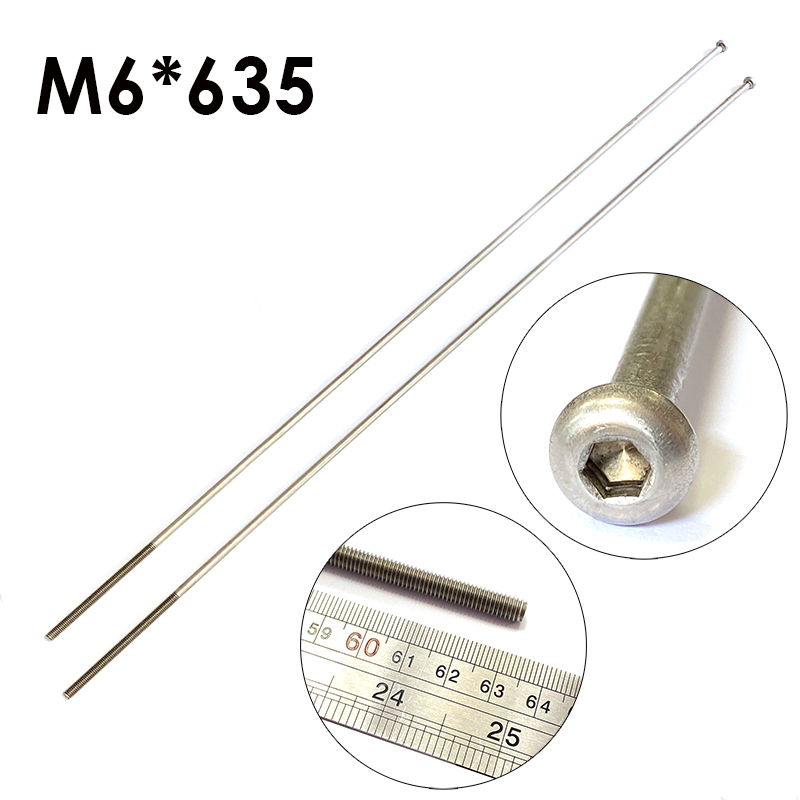
Long screws are machine screws whose length is many times their diameter, used where a joint has to pass through a thick stack or stand off from a surface. This part is a stainless steel M5 by 220 cup head socket screw, supplied plain, and is quoted with the length and thread run made to the drawing.
High length-to-diameter ratio. Around 44 to 1 on an M5 by 220, which changes how the part behaves under load.
Cup head socket. A cylindrical head with a hex socket, for a joint that is tightened from one side.
Stainless steel. No coating to chip, and no rust in ordinary service.
Thread at the far end. The clamp happens at the end of a long elastic shaft rather than close to the head.
They are used in stand-offs, through-bolted panels, long clamps, battery modules and equipment frames, wherever the distance between two faces is too large for a standard screw and a nut cannot reach the far side.
When a driver turns the head of a long screw, the thread at the far end does not turn at the same instant. The shank between them has to be twisted first, and a shank that is forty diameters long stores a noticeable amount of rotation before the far thread starts to move. The torque wrench reads what was applied at the socket; the thread reads what survived the trip.
That is the difference between a long screw and a short one, and it explains a failure that looks impossible. A joint is tightened to its stated torque, the wrench clicks, and the parts are still loose: the torque went into twisting the shank and into friction along a long length of thread, and very little of it became clamp load at the joint face.
The remedy is procedural rather than dimensional. Long screws are drawn up in stages, so the shank untwists and the thread catches up between passes; a lubricant on the thread reduces the friction that eats the torque on the way; and where the joint allows, the clamp is placed on a short engaged length rather than at the far end of a long thread.
The thread run matters here as well. A half-threaded long screw has a plain shank that carries the load in shear and a thread that only clamps at the end; a fully threaded long screw spreads friction over the whole length, which is exactly where the applied torque disappears. The two look similar in a drawing and behave differently in a joint.
Stainless adds friction of its own. A plain stainless thread on a stainless nut galls under load, and the run-down torque climbs as the length grows. On a long screw that is felt as a joint that gets progressively harder to turn, long before the clamp is reached.
None of this is measured on the screw. A long screw can pass every dimension and still fail to clamp, because the property that decides the joint is how it is driven, and that is decided on the drawing as much as on the bench.
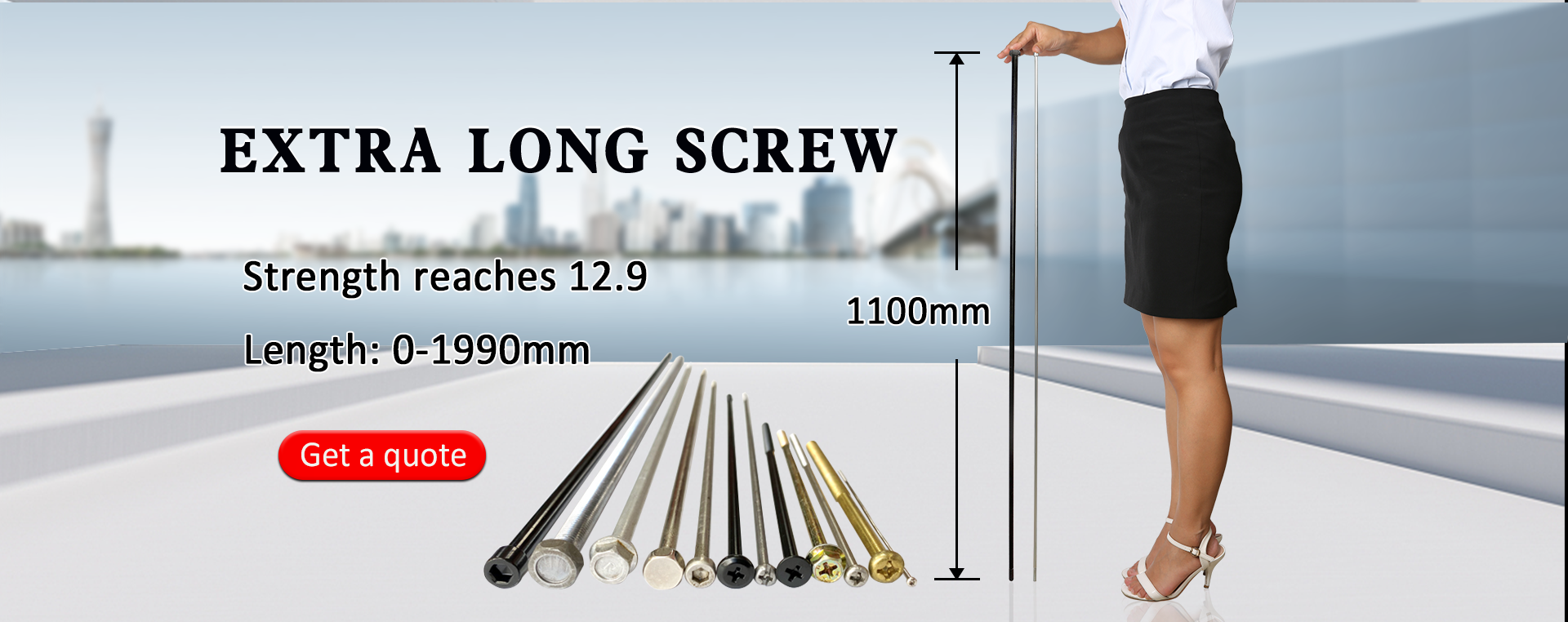
Long screws are quoted by thread size and pitch, overall length, thread length, head diameter and height, socket size and finish. Custom lengths up to 2,000 mm, subject to DFM review after drawing submission. The quotation carries the grade, the head, the thread run, the length and the finish.
| Item | How it is defined | What we control |
|---|---|---|
| Body | Stainless steel | Grade and mechanical properties |
| Head | Cup head, hex socket | Diameter, height and socket depth |
| Thread run | Full or part thread | Threaded length and start position |
| Length | Under the head | Overall length and tolerance |
| Point | Plain, chamfered | Chamfer and burr |
| Finish | Plain stainless | Surface condition and passivation |
The threaded length is written as a dimension and not as a description, because on a long screw the difference between a half-threaded and a fully threaded part is the difference between a clamp at the end and friction over the whole. The position of the first full thread is what the customer’s nut actually sees.
Length is measured under the head, and the tolerance is agreed rather than taken from a standard. On a stand-off the length sets the gap between two faces, so it is a functional dimension rather than a nominal one.
The head is the same cup head used on short socket screws, but it works harder here. The socket takes the whole driving torque of a long elastic shaft, so a worn key or a shallow socket shows up as a rounded hex on a screw that is otherwise perfect.
Four properties decide this part, and each carries a cost:
| Property | What it gives | What it costs |
|---|---|---|
| Long shank | A joint across a deep stack | Applied torque is lost twisting the shaft |
| Cup head socket | High torque from one side | A shallow socket rounds under long drives |
| Part thread | Shear in the shank, clamp at the end | Runs out of thread on a thick stack |
| Plain stainless | No coating, no rust | Galls against stainless under load |
The value is a joint that reaches across a distance a standard screw cannot, tightened from one face, with no nut access on the far side.
The cost is that the same screw is far more sensitive to how it is driven: the torque figure that works on a short screw does not produce the same clamp on a long one, and the assembly step has to be written into the drawing rather than left to the bench.
The recorded finish is plain stainless: the natural passive oxide, with no coating to add thickness to the thread. On a long screw that is the right choice, because a plated thread over a metre of length would change the fit along the run and add friction where friction is already the problem.
| Option | How it protects | Effect on driving | Typical use |
|---|---|---|---|
| Plain stainless | Natural passive oxide | High friction; galling risk | Indoor and marine joints |
| Passivated | Cleaned, thickened oxide | Same, cleaner surface | Food and medical equipment |
| Dry film lubricant | Low-friction film | Lower torque loss along the run | Long joints that are serviced |
| Zinc plated steel | Sacrificial layer | Smoother run-down | Indoor structural use |
| Black oxide | Conversion layer | Dry feel; some lubricity | Tooling and fixtures |
A dry film lubricant is the treatment that addresses the real problem on a long joint: it lowers the friction along the thread run so more of the applied torque reaches the far end as clamp load.
Where the joint is indoor and not serviced, plain stainless is enough, provided the driving is done in stages and the thread is not expected to carry a high preload at the end of a 200 mm shaft.
Three assemblies that need a fixing across a long distance:
| Where it sits | The screw holds two faces apart at a fixed distance, with the clamp at one end only. |
| When it goes wrong | The faces are not parallel, or the gap closes when the screw is tightened. |
| Why it happens | The length is a functional dimension and it was taken from a nominal rather than from the assembly. |
| What we control | Length and tolerance agreed from the stack; first article assembled and measured. |
| Where it sits | The screw passes through a module frame into a nut at the far end of a deep stack. |
| When it goes wrong | The joint reads tight on the wrench but the module is still free to move. |
| Why it happens | The torque is lost twisting the shaft and in friction along the long thread run. |
| What we control | Driving sequence and lubricant specified; sample driven in stages and checked. |
| Where it sits | The screw draws a frame together across a span where no nut can reach from behind. |
| When it goes wrong | The thread rounds at the socket, or the screw runs out of thread before the clamp. |
| Why it happens | The socket is shallow and the thread run is shorter than the span. |
| What we control | Thread run and socket depth specified; sample driven at the joint torque. |
Four points that decide whether a long screw actually clamps the joint it was drawn for:
|
Thread run written as a dimension
The drawing states where the thread starts and ends, because on a long screw that position decides where the clamp happens. Basis: Run tied to the stack. |
Headed then rolled to length
The head is formed and the thread rolled on the finished blank, so the run starts where the drawing says it does. Basis: Thread where it was drawn. |
|
Driven in stages
The first article is driven in stages into the customer stack, with the clamp checked after each pass. Basis: Clamp proved, not assumed. |
Same grade every lot
Grade and thread run are recorded with the drawing revision, so a repeat lot needs the same driving sequence. Basis: Same behaviour across lots. |
A long screw is the part in the range that is most often blamed for a joint that was never tightened, because the torque wrench said otherwise. These four points make the clamp a measured result rather than an assumption.
Long screws are cold headed from wire for the head, joined to a shaft where the length requires it, and then threaded. On stainless parts the thread is usually cut or rolled on the finished shaft, and the part is passivated before packing. The first piece of every run is measured on head, socket, thread run and length, and fitted into a sample stack.


|

|
The thread run is set at the threading step, and on a long part that setting is what the customer’s nut will find at the far end. A run that starts a few millimetres late is invisible in a pile and decisive in a joint.
The socket is formed with the head and is the same feature as on a short socket screw, but it is asked to do more. A long shaft transmits the driver’s torque as a twist rather than as a turn, and the socket sees the full value of that torque at the point where the key bears.
Stainless parts are passivated after threading to remove free iron from the cut surfaces. It adds nothing measurable, which matters on a thread that has to run freely along its whole length.
What decides whether a batch of long screws passes is the thread run, the socket and the length. The inspection agreement covers those, and the criteria come from the drawing.

Head and socket on the projector |

Thread and run position checked |

Material checked |

Salt-spray testing of the finish |
The thread run is measured from the point, not from the head, so the position of the first full thread is known at both ends of the tolerance. That is the dimension that decides whether a nut engages at the depth the customer expects.
The socket is measured for across-flats and depth and driven with the key at the joint torque. On a long screw the drive is the highest-stress moment in the part, and a socket that is a little shallow will round on a production driver rather than on a test bench.
Length is checked over the whole part, and the sample is fitted into a stack to confirm that the thread reaches where the drawing says. A long screw that is dimensionally correct can still leave a nut turning on nothing if the run started late.
Every batch of long screws is traceable to the wire and the bar it was made from. The material certificate states the grade, the heat number, the chemistry and the mechanical properties, and the inspection record carries the head, socket, thread run and length against the drawing revision.

ISO 9001:2015 |

RoHS test report |

Registered trademark |

Patent: security screw and driver |
With each shipment we supply the material certificate and the inspection record for the head, socket, thread run and length. The records carry the batch number, so a repeat order of long screws can be compared with the first on the dimension that decides the joint: where the thread begins.
More than 8,678 customers in 89 countries and regions have ordered from Shi Shi Tong; 87% of orders come from repeat customers and 56% through referrals. Most projects follow the same route: drawing review, first-article approval, then batches checked against that sample. On long screws the first article is driven into the customer’s stack in stages, because the clamp is a result of the driving sequence as much as of the part. Buyers visit during the process to review samples.
|
8,678+
customers served
|
87%
of orders from repeat customers
|
56%
of orders through referrals
|
89
countries and regions shipped to
|
Buyers and quality engineers visit for sample review, process discussion and supplier audits; the visit is arranged around production so the heading cells and the threading can be seen on the day the parts run.

Customer group visit – sample review |

Customer group visit – process discussion |

Customer group visit – factory tour |

Customer visit – project kick-off |

Danish customer – drawing review |

Industry exhibition – meeting customers |
The torque is being used to twist the shank and to overcome friction along the thread, so little of it reaches the joint.
In stages, letting the shank untwist between passes, with a lubricant on the thread where the drawing allows one.
No. Friction acts along the whole thread run, so more of the applied torque is lost on the way to the far end.
Thread size and pitch, overall length, thread run and its start position, head and socket, and the driving method.
It can. Plain stainless galls under load, and the run-down torque climbs with length.
Yes, up to the limit on the drawing, with the thread run set to the joint.
How a long screw project runs from drawing to repeat delivery:
|
1
Send the drawing and the stack height
|
→ |
2
Thread run and length agreed
|
→ |
3
First article driven in stages
|
→ |
4
Batch production and repeat orders
|
Each step is confirmed with you before the next one starts; the drawing revision used for the first article is what repeat orders are checked against.
For a quotation, send the drawing with the grade, thread size and pitch, overall length, thread run and its start position, head and socket size, and the finish.
|
Grade
|
Thread
|
Length
|
|
Thread run
|
Head
|
Finish
|
Sending a drawing? The form below does not take attachments. Email the PDF, DXF or STEP file to sst@szsst88.com with the part name and quantity in the subject line – the drawing is reviewed and a quotation follows.

 +86 13143444311
 sst@szsst88.com