Tel:
+86 13143444311
Email:sst@szsst88.com
Fax:+0086-755-27322278
Address:Building 9, First Industrial Zone, Tantou Industrial City, Songgang Street, Baoan District, Shenzhen 518105, Guangdong, China
Type:Book Screw
Materials:Steel
Surface treatment:Eco Black Zinc Plated
Head Type:Flat head
Drive:Smooth head as drawn
Thread:Internal thread in the barrel, external on the post
Grip range:Stated as a minimum and maximum thickness
Forming:Barrel and post turned or headed with a flat head; internal thread cut in the barrel, external thread on the post
Size:M1 M2 M3 M4 M5 M6 M7 M8 M9 M10
We make book screws as a matched pair: a threaded barrel and a post, flat heads on both, in carbon steel with an eco black zinc finish. The pair is sold by grip range rather than by length, because the thread inside the barrel only engages a fixed number of turns at a given material thickness.
Watch the factory video·Email sst@szsst88.com
ISO 9001:2015 · Manufacturing since 1998 · 8,678+ customers · 89 countries and regions
Made to order – there is no stock catalogue. Each part is produced to your drawing, and production starts after drawing review and first-article approval.
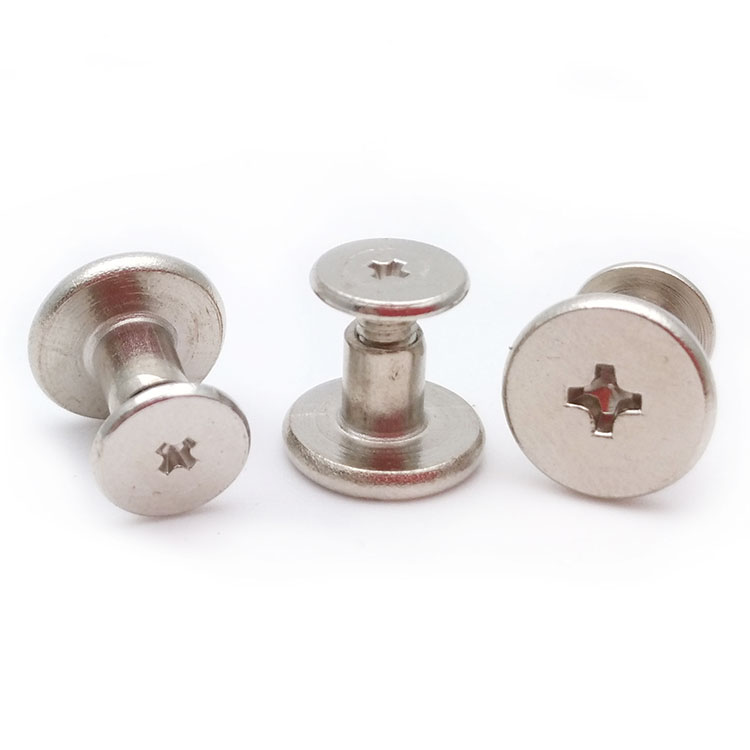
A book screw is a two-piece post: a female barrel with an internal thread and a flat head, and a male post with a threaded shank and a matching head. The two draw together through the material and clamp it between their heads. This part is carbon steel with a flat head, finished in eco black zinc and quoted from M1 upward with the grip range made to the drawing.
Two pieces. A barrel and a post, so the fastener can be undone and refitted without access behind the sheet.
Flat heads. Wide, low discs that sit against the outer faces of the material and hold it between them.
Internal thread. In the barrel, which is what sets how many turns the male can engage.
Black zinc. A thin, uniform dark finish, cheap enough for a part bought in volume.
Book screws are used wherever sheets have to be bound together and reopened: albums, sample books, swatch decks, leather goods, menus and display boards. The pair acts as a post rather than a clamp, which suits soft materials that would be crushed by a nut.
A book screw is sold by its grip range, not by its length. The barrel has a fixed internal thread, the post has a fixed length of thread, and the pair can only clamp a stack that falls between two limits. Below the lower limit the post bottoms in the barrel and the two heads never load the material; above the upper limit the thread engages too few turns and the joint works loose under handling.
That is why two parts of the same nominal size can behave completely differently on two projects. A book screw that holds a 4 mm album cover may be useless on a 12 mm sample book, even though both are called M4, because the thread engagement inside the barrel is fixed and the post runs out of turns.
The heads do the clamping, and they are wide for a reason. Binding materials are usually soft: leather, board, coated paper, plastic sheet. A wide flat head spreads the load so the material is not marked and the hole is not enlarged when the pair is tightened by hand.
Because the heads are smooth, the joint is drawn up by friction between the fingers or by the driver feature on the head as drawn. There is no torque specification in the usual sense: what matters is that the two heads meet the material evenly, which is why the pair is tightened until it stops rather than to a value.
On any book screw the thread inside the barrel is the part that wears. Every time the joint is opened, the male thread runs through the female thread again, and a black zinc finish offers no lubricity. On a book that is reopened often, the thread is what limits the life of the part, not the heads.
One more consequence: the two heads can be rotated independently before the joint is drawn up, so the pair can be aligned to the material rather than to the hole. That freedom is why the part suits bound edges that are not perfectly parallel, and why the drawing states heads rather than a single orientation.
Book screws are quoted by barrel diameter and length, post diameter and length, thread size and pitch, head diameter, grip range and finish. Custom lengths up to 2,000 mm, subject to DFM review after drawing submission. The quotation carries the material, the barrel, the post, the heads and the plating.
| Item | How it is defined | What we control |
|---|---|---|
| Barrel | Diameter and internal thread | Thread depth and internal fit |
| Post | Diameter and thread length | Thread length and run-out |
| Grip range | Material thickness the pair clamps | Set by the barrel and post lengths |
| Head | Diameter and thickness | Bearing area and flatness |
| Thread | Size and pitch | Engagement over the grip range |
| Finish | Eco black zinc | Thickness, colour and coverage |
The grip range is written as two numbers, the minimum and the maximum material thickness the pair can hold. Writing a single figure leaves the tolerance out, and the tolerance is where binding thicknesses usually vary.
On a book screw the head diameter is chosen with the material. On leather and coated board a larger head is the difference between a clean fixing and a torn hole, and on a thin plastic sheet the same head will dish if it is too thin.
The internal thread depth is the number that decides the upper end of the grip range on a book screw. It is not visible on the assembled part, and it is the first dimension to check when a pair that worked at one thickness fails at another.
Four properties decide this part, and each carries a cost:
| Property | What it gives | What it costs |
|---|---|---|
| Two pieces | A joint that opens without access behind | Two parts to stock and to lose |
| Fixed grip range | A clean clamp on a known thickness | Wrong for any other stack |
| Wide flat heads | A soft material is held, not crushed | The heads are visible on both faces |
| Black zinc | Uniform dark finish at low cost | The colour wears at the head edge |
The value is a bound edge that can be reopened. Nothing else in the fastener range does that without a tool on both sides, and on a photo album or a swatch deck being able to add a page is the point.
The cost is a fixed working range. A book screw is not adjustable, and when the material runs thicker than planned the pair has to be changed rather than shimmed.
The recorded finish is eco black zinc: a thin electroplated zinc layer with a black dye. It gives the pair a uniform dark colour at low cost and protects the steel by sacrificing itself at a scratch, which matters on binding parts that are handled.
| Option | How it protects | Effect on the thread | Typical use |
|---|---|---|---|
| Eco black zinc | Sacrificial zinc plus dye | Thin; internal thread clearing checked | Albums and sample books |
| Black oxide | Conversion layer, no sacrifice | Nearest to zero build | Dry indoor bindings |
| Black nickel | Hard barrier layer | Builds slightly; engagement checked | Premium leather goods |
| Anodised aluminium | Grown oxide | No build; lighter part | Lightweight swatches |
| Brass | No coating needed | No build | Decorative bindings |
Black zinc is the default because the film is thin enough to leave the internal thread clean. On a barrel the thread is a closed feature, and a heavier coating that builds inside it can make the post stiff on the first turn.
Where the binding is a premium product, black nickel or brass is chosen for the surface rather than for the protection, and the internal thread is then checked with the post that goes with it.
Three bindings where a two-piece post is the right answer:
| Where it sits | The pair binds covers and pages that have to be added to or reordered after delivery. |
| When it goes wrong | The pages slide, or the post loosens and the binding opens at the edge. |
| Why it happens | The grip range is wrong for the assembled thickness, and the thread engages too few turns. |
| What we control | Grip range matched to the book; first article assembled and reopened. |
| Where it sits | The pair holds a stack of cards that is fanned and handled constantly. |
| When it goes wrong | The head wears into the card, or the pair works loose in the hand. |
| Why it happens | The head is small for the card thickness, and the thread has no locking element. |
| What we control | Head diameter and grip range agreed; sample fanned and cycled. |
| Where it sits | The pair joins two leather panels where no access is possible from behind. |
| When it goes wrong | The leather tears at the hole, or the head marks the surface. |
| Why it happens | The bearing area is small for soft leather, and the barrel is short for the panel. |
| What we control | Head diameter and grip range specified; sample assembled and pulled. |
Four points that decide whether a two-piece post holds the stack it was bought for:
|
Grip range written as two numbers
The drawing gives the minimum and maximum thickness the pair holds, because a single length hides the tolerance that matters. Basis: Range, not a length. |
Barrel and post made as a pair
The internal and external threads are cut to work together, so the post turns freely to the end of its engagement. Basis: Pair proved together. |
|
Assembled on real material
The first article is assembled through the customer material and reopened, and the heads are checked for marking. Basis: Joint proved on the material. |
Same engagement every lot
Barrel depth, post thread length and plating thickness are recorded with the drawing revision, so a repeat pair engages the same. Basis: Same engagement across lots. |
A book screw is a simple part that fails in a way that is hard to see: it holds at the sample thickness and slips at the production thickness. These four points make that difference measurable before the batch is run.
Book screws are made as two separate parts: the barrel is turned or headed with a flat head and an internal thread cut into it, and the post is turned or headed with a flat head and an external thread. Both are then zinc plated and dyed black, and the pair is checked together before packing.


|

|
The internal thread is the slower of the two to make, because it has to be cut inside a small bore and the depth is limited by the tap or the tool. That depth is what sets the upper end of the grip range, so it is set from the customer’s thickest assembly rather than from the nominal size.
The two parts are plated in the same lot where possible. A barrel and a post from different lots can differ slightly in colour, and on a binding that is seen from both faces that shows as a mismatched pair.
Before packing, a sample pair is assembled to the two ends of the grip range and turned by hand. A pair that binds at the thin end or runs out of thread at the thick end is rejected, because neither fault shows in a dimensional check of the parts on their own.
What decides whether a batch of book screws passes is the grip range the pair actually holds, the thread that engages inside the barrel and the heads that clamp the material. The inspection agreement covers all three.

Head and barrel on the projector |

Internal and external threads gauged |

Material checked |

Salt-spray testing of the coating |
For each lot of book screws the grip range is checked by assembling the pair over spacers at the minimum and maximum thickness. The barrel depth and the post thread length are measured first, but the assembled test is what proves the range, because the two tolerances combine.
The internal thread is gauged with a plug gauge and then run with the mating post. A barrel that passes its gauge can still be stiff with its own post if the two were plated in different lots and the films differ.
The heads are measured for diameter and thickness and checked for flatness on the bearing face. On soft material a head that is not flat marks the surface in a ring, and that is the defect customers see first.
Every batch of book screws is traceable to the wire, the heading lot and the plating lot. The material certificate states the grade, the heat number and the mechanical properties; the plating record carries the coating thickness and the lot, and the inspection record carries the barrel, post and grip range data.

ISO 9001:2015 |

RoHS test report |

Registered trademark |

Patent: security screw and driver |
With each shipment we supply the material certificate, the inspection record for the barrel, post and heads, and the assembled grip range result. The records carry the batch number, so a repeat order of book screws can be compared with the first on the number that decides the binding: the thickness the pair will hold.
More than 8,678 customers in 89 countries and regions have ordered from Shi Shi Tong; 87% of orders come from repeat customers and 56% through referrals. Most projects follow the same route: drawing review, first-article approval, then batches checked against that sample. On a two-piece post the first article is assembled through the customer’s own material, because the grip range is a property of the pair and the book together. Buyers visit during the process to review samples.
|
8,678+
customers served
|
87%
of orders from repeat customers
|
56%
of orders through referrals
|
89
countries and regions shipped to
|
Buyers and quality engineers visit for sample review, process discussion and supplier audits; the visit is arranged around production so the heading cells and the plating line can be seen on the day the parts run.

Customer group visit – sample review |

Customer group visit – process discussion |

Customer group visit – factory tour |

Customer visit – project kick-off |

Danish customer – drawing review |

Industry exhibition – meeting customers |
A two-piece post: a threaded barrel and a post that screws into it, clamping the material between two flat heads.
The thickness range the pair can hold. Below it the post bottoms in the barrel; above it the thread engages too few turns.
The material is thicker than the pair was made for, so the post runs out of thread before the heads load the stack.
Only within its grip range. A pair sized for a 4 mm cover will not hold a 12 mm sample book.
A head that is too small for the material will. A larger head spreads the load and avoids the ring mark.
Barrel diameter and length, post length, thread size, head diameter and the minimum and maximum grip.
How a book screw project runs from drawing to repeat delivery:
|
1
Send the drawing and the material stack
|
→ |
2
Grip range and head size agreed
|
→ |
3
First article assembled and reopened
|
→ |
4
Batch production and repeat orders
|
Each step is confirmed with you before the next one starts; the drawing revision used for the first article is what repeat orders are checked against.
For a quotation, send the drawing with the barrel and post dimensions, thread and pitch, head size, the material thickness range and the finish.
|
Barrel
|
Post
|
Thread
|
|
Head
|
Grip range
|
Finish
|
Sending a drawing? The form below does not take attachments. Email the PDF, DXF or STEP file to sst@szsst88.com with the part name and quantity in the subject line – the drawing is reviewed and a quotation follows.

 +86 13143444311
 sst@szsst88.com