
 +86 13143444311
 sst@szsst88.com






Titanium screws in CVD equipment must be selected for the actual fastening location. A cooler external bracket, a shielded internal support and a directly exposed process component can have very different requirements. TA2 or Grade 2 on a drawing does not establish resistance to every process gas, sufficient hot strength or an acceptable electrical connection.
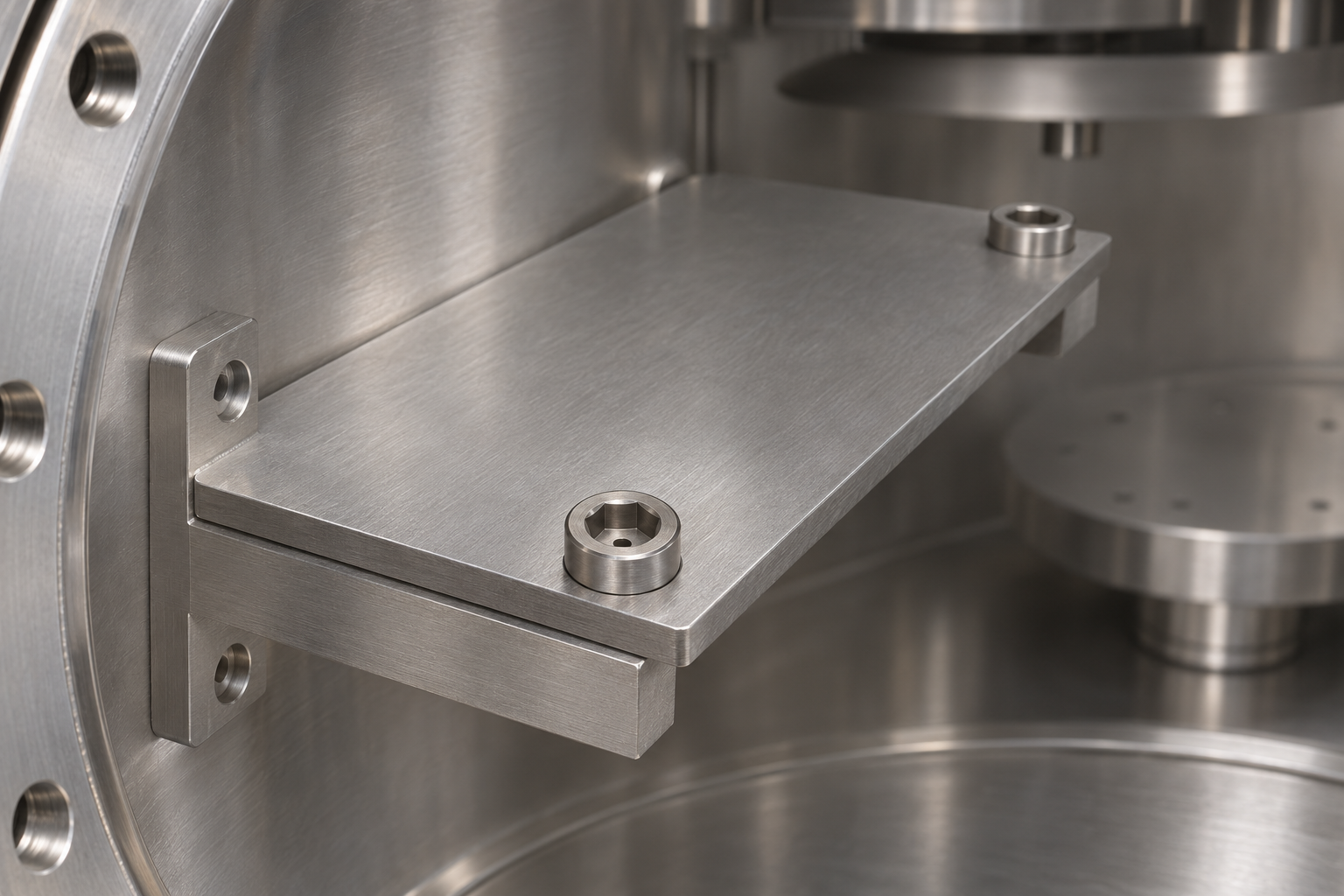
Map the screw location before selecting titanium
This is a guide to fasteners used in CVD and PECVD equipment, rather than to CVD coatings applied to screws. Begin with an assembly section identifying the vacuum boundary, process-facing surfaces, shields, heaters, cooling paths and receiving thread. Mark the candidate fastener position on that section.
| Location | Questions that control selection | Required evidence |
|---|---|---|
| External auxiliary bracket | What load, ambient exposure and heat transfer reach the screw? | Local service temperature, bracket load and mating material |
| Shielded internal fixture | Does the shield reduce direct exposure, and can gas still reach the joint? | Assembly section and exposure assessment for the enclosed interfaces |
| Directly exposed internal component | Which gases, reactive species and thermal conditions contact the screw? | Equipment-owner material approval for the actual process conditions |
| Electrical or RF connection | Must the interface conduct, isolate or maintain a defined contact resistance? | Electrical acceptance requirement and joint design, separate from mechanical fit |
A shield can change exposure without making the region chemically isolated. Similarly, being outside the main process zone does not establish room-temperature service. Follow the physical connections and the operating sequence rather than assigning one condition to the entire machine.
Use local screw temperature, not one recipe number
PECVD uses plasma energy to support film formation at lower substrate temperatures than many furnace-driven processes; this is explained by Plasma-Therm’s PECVD process overview. That distinction does not provide a universal temperature rating for a titanium fastener.
The substrate, showerhead and wall may have separately controlled temperatures. ASM’s PECVD equipment description explicitly distinguishes these parameters. The screw temperature depends on its contact paths, radiation exposure, time at temperature and operating transitions.
For a design review, provide the minimum and maximum local temperature, dwell time, heating and cooling sequence, and intended service life. Use appropriate elevated-temperature strength or relaxation data for the specified product condition. A room-temperature tensile value and the metal’s melting point are not service-temperature approval criteria.
Review the actual chemical exposure
‘Corrosion resistant’ is incomplete without an environment. TIMET’s titanium corrosion guide distinguishes favorable moist-chlorine service from rapid attack possible in dry chlorine. Its data also make clear that chemical form and conditions matter; resistance to an aqueous chloride solution cannot be transferred automatically to a dry reactive process.
Identify the chemicals that contact the screw, their physical state, temperature, pressure, exposure duration and whether plasma changes the species reaching the surface. Include startup and shutdown exposure. A bulk-liquid corrosion chart is not a validation of a plasma-facing fastener.
If the equipment documentation specifies a different alloy, retain that requirement unless the equipment owner approves a reviewed change. Do not select a titanium replacement merely because it performs well in seawater or because another titanium component exists elsewhere in the tool.
Interpret Grade 2 material data correctly
The Alleima Grade 2 datasheet provides the following reference values. It is a seamless tube-and-pipe datasheet, and its mechanical values relate to ASTM B338. These figures explain material behavior; they are not a specification for a finished TA2 screw.
| Published reference | Value | What it means for a screw review |
|---|---|---|
| Density | 4.51 g/cm³ | Supports mass estimates for a known geometry |
| Tensile elastic modulus | 103 GPa | Stiffness differs from steel; use the appropriate value in the joint model |
| Minimum tensile strength, ASTM B338 Grade 2 tubing | 345 MPa | Product-form-specific reference, not a finished-fastener rating |
| Minimum yield strength, same tubing specification | 275 MPa | Do not substitute this for certified screw properties or hot-strength data |
Keep specified minimums separate from typical values. A typical value in a supplier brochure does not raise the guaranteed minimum for a purchased batch. Confirm the material standard, starting product form and finished mechanical requirements before calculating an allowable load.
Section change matters even when the alloy stays the same. For a selected circular section of 4.0 mm diameter, drilling a 1.0 mm axial bore removes (1.0/4.0)² = 6.25% of its gross area. At the same axial force, nominal stress in that section rises by 1/(1 − 0.0625) − 1 ≈ 6.7%.
This is a uniform-section comparison. It excludes thread-root concentration, the drive recess, bore offset and installation torsion, so it is not a load rating.
Review preload and electrical function separately
A screw can satisfy the dimensional drawing and still be unsuitable for the joint. Check required clamp load, receiving-thread strength, bearing area, the material’s specified condition and the temperature range. Reusing a torque value from a stainless screw can produce a different result because friction and available strength may differ.
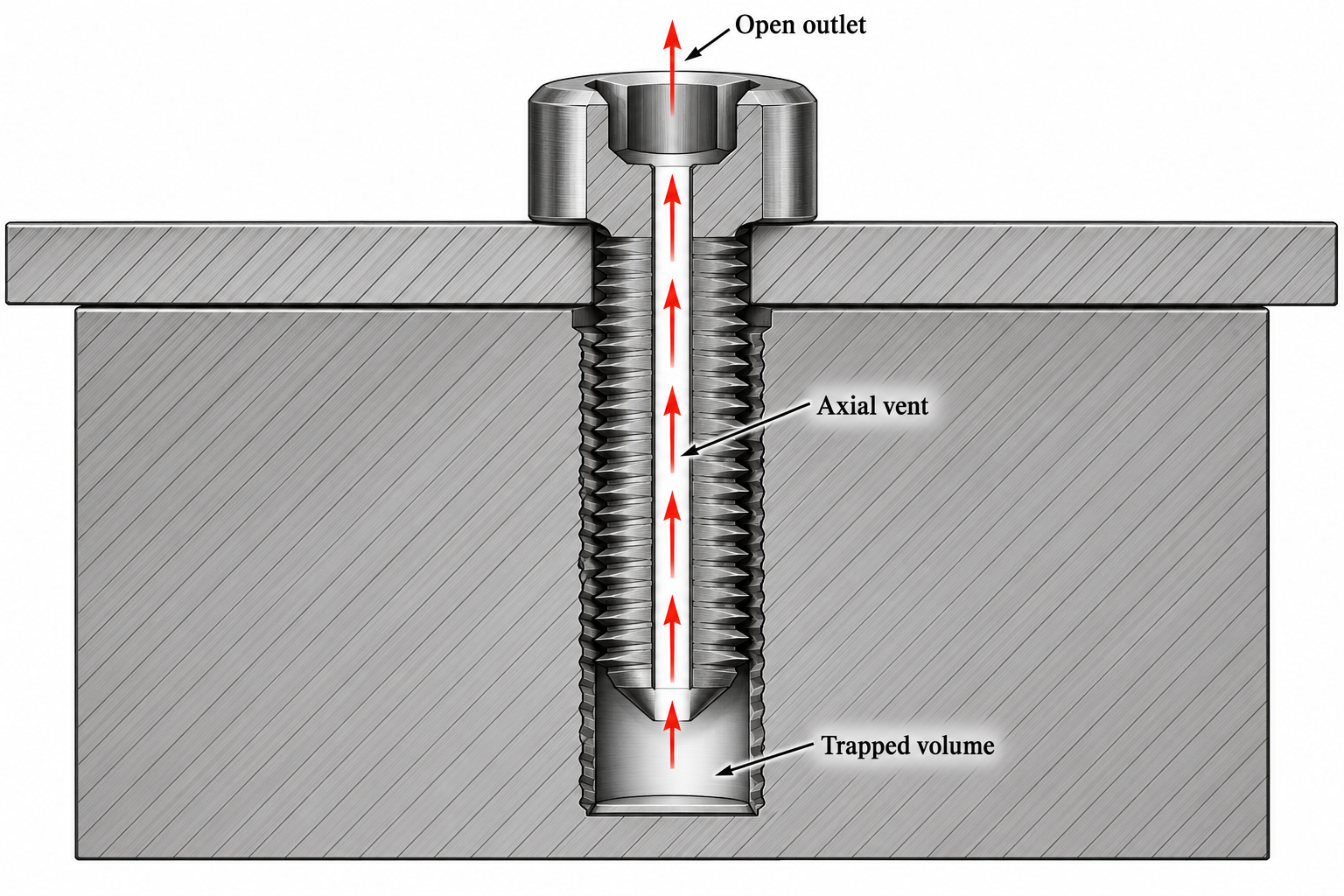
For a vented design, include the bore-to-recess intersection and the smallest remaining wall in the mechanical review. A large head does not compensate for a weak section below the socket. If the joint also carries current or forms an RF path, define that function explicitly; mechanical tightening alone does not certify electrical performance.
Define the procurement and drawing requirements
For custom titanium fasteners, the request should identify the purchasing standard and grade, supply condition, finished dimensions, relevant mechanical requirements and inspection documentation. TA2 and Grade 2 are not interchangeable purchase instructions without comparing the applicable specifications.
Add the installation location and service envelope as review inputs. State whether the supplier is manufacturing to an approved material selection or is being asked to propose an alternative for evaluation. Require a controlled approval before changing material, heat treatment, vent geometry or surface condition.
A practical release package combines the approved screw drawing, mating-part section, material evidence, inspection plan and equipment-owner approval of process compatibility. The drawing review can establish a manufacturable fastener; it cannot replace validation of an unknown CVD chemistry.
Technical FAQ
Are titanium screws suitable for every PECVD chamber?
No. Suitability depends on the local temperature, chemical and plasma exposure, mechanical load and any electrical function. The equipment location and approved service conditions must be reviewed.
Can the substrate temperature be used as the screw temperature?
Not automatically. Contact paths and exposure differ between the substrate, chamber wall, showerhead and support fasteners. Use a justified local temperature envelope.
Does a Grade 2 datasheet define the strength of a TA2 screw?
No. Check the purchasing standard, product form and finished condition. Tubing data can help explain material behavior but does not certify a screw manufactured to a different specification.
Does an axial vent hole change the mechanical review?
Yes. It removes material and may reduce the remaining wall near the thread root or drive recess. Include the final bore geometry when checking the loaded section.
What should be sent for a CVD-equipment screw review?
Send the screw and mating-part drawings, approved material requirements, fastener location, temperature and exposure envelope, joint-load requirements, quantity and inspection criteria.
Review the screw and the mating assembly together
Send your screw drawing, a section through the mating hole, material specification, quantity and critical acceptance requirements. Shi Shi Tong reviews the geometry, manufacturing route and inspection requirements before confirming a custom screw proposal.
Copy this email address and attach your drawings in your email service:sst@szsst88.comOpen Email App →
If your email app does not open, copy this address into your email service.