
Tel:
+86 13143444311
Email:sst@szsst88.com
Fax:+0086-755-27322278
Address:Building 9, First Industrial Zone, Tantou Industrial City, Songgang Street, Baoan District, Shenzhen 518105, Guangdong, China
Nylon patch vs liquid threadlocker is a choice between different locking mechanisms and assembly processes. A mechanical nylon patch creates resistance as it is compressed in the mating thread. An anaerobic liquid threadlocker develops its cured properties under the specified conditions after assembly. Neither should be selected solely by colour, and neither replaces correct thread engagement and joint design.
| Issue | Mechanical nylon patch | Anaerobic liquid threadlocker |
|---|---|---|
| Installation behaviour | Adds prevailing resistance during thread movement | Changes the interface before curing; develops adhesive resistance after cure |
| Process control | Patch material, position, length and mating fit | Product, quantity, application location, substrate and cure conditions |
| Production timing | No post-installation chemical cure for the mechanical patch | Allow the specified cure before required loading or testing |
| Reuse | Validate the permitted cycles and residual resistance | Follow product instructions for cleaning and reapplication |
| Inspection | Placement plus torque or functional checks | Application and cure control plus specified performance tests |
Not every preapplied coloured patch is nylon. Some preapplied systems are reactive adhesives. Identify the actual chemistry or supplier specification before assigning a no-cure process or a reuse claim. Similarly, the colour of a bottled product is not a universal strength classification across manufacturers.
ND Industries describes its ND Patch mechanical nylon process as ready for use without a cure period. Its processing notes normally leave one to three lead threads clear and describe a coating length of four to six threads. These are that supplier’s process references, not universal dimensions for every patched screw or a statement that SHISHITONG supplies that branded treatment.
Henkel’s LOCTITE 243 technical data sheet, April 2025 describes anaerobic curing between close-fitting metal surfaces. It shows cure performance varying with substrate, gap and temperature. Its laboratory conditions must remain attached to any quoted result; a test on M10 steel hardware cannot be transferred directly to a custom micro screw or a different mating surface.
Specify a treatment and acceptance requirement by product or approved process, including its service temperature and chemical environment. Avoid copying a supplier’s headline performance claim into a custom fastener quotation without the corresponding test conditions and approved sourcing.
A patched screw consumes torque while turning before its head seats. If a driver stops at a total torque limit, changing that resistance can change how much of the process is available for developing clamp load. A single residual-torque number does not reveal the clamp force.
| Stated torque-budget illustration | Case A | Case B |
|---|---|---|
| Total torque limit | 1.00 N·m | 1.00 N·m |
| Assumed running resistance near seating | 0.20 N·m | 0.35 N·m |
| Arithmetic remainder | 0.80 N·m | 0.65 N·m |
The remainder decreases by 18.75% between these cases. This arithmetic demonstrates sensitivity; it is not a calibrated preload calculation. Running resistance can vary with rotation, speed and seating, and the remaining torque still includes thread and bearing friction. Validate clamp or functional performance directly where required rather than subtracting one measured resistance value and assuming the result proves preload.
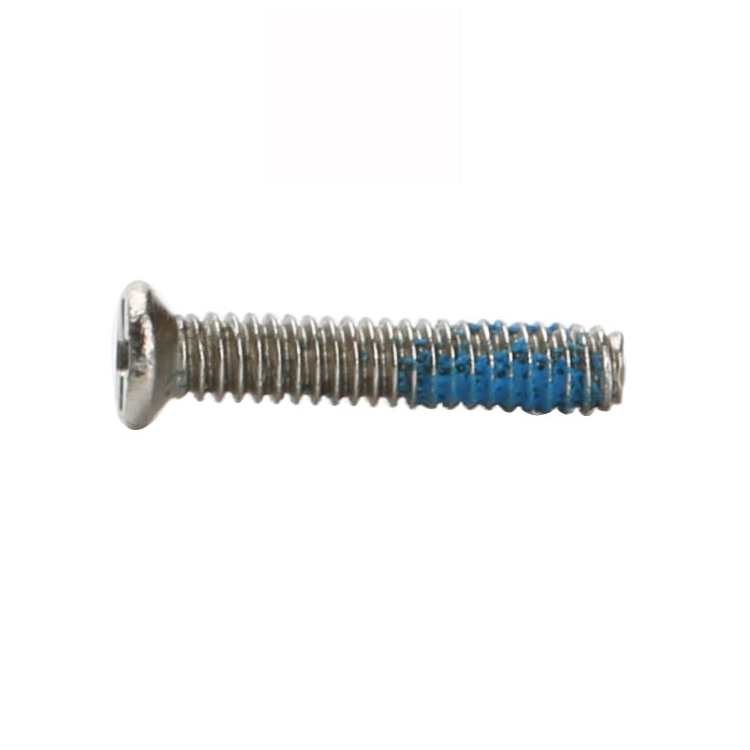
Compare patch location with the actual engaged thread length at both tolerance limits. A patch beyond the mating thread may add no useful locking action. A patch too close to the start can make alignment harder; a treatment near an internal stop or a vent may create another assembly problem. The installed geometry decides which threads participate.
For liquid application, define the amount and location using the selected product’s instructions. Excess material can migrate into adjacent features. In an enclosure or precision mechanism, contamination limits may govern the choice. If the screw also has an electrical-contact or sealing function, validate those requirements independently rather than assuming the locking treatment supports them.
Decide whether the joint is single-use or serviceable and specify the number of required installation and removal cycles. Measure the relevant running, breakaway or removal torque using the agreed method and conditions. These terms describe different measurements; they should not be combined into one unspecified “locking torque.”
| Stage | Record |
|---|---|
| Initial installation | Thread condition, treatment identity, rundown and seating result |
| After required cure or dwell | Time, temperature and specified functional result |
| Removal | Measurement method, speed and torque definition |
| Repeated use | Cycle count, treatment condition and remaining acceptance margin |
| Final inspection | Thread damage, contamination and replacement decision |
A treatment that passes an initial test can fail a later service requirement. Conversely, increased removal torque can hinder maintenance or damage a small drive. Use both minimum retention and maximum service-removal requirements where the application needs them.
It is a localized polymer treatment that produces mechanical resistance when compressed in the mating thread. Confirm that the specified patch is mechanical nylon rather than a reactive adhesive system.
Potential alternatives include a validated prevailing-torque feature or another suitable mechanical locking design. Selection depends on joint motion, service access, temperature and the required retention performance.
Some systems are designed for reuse, but the permitted cycle count and acceptance limits must come from the chosen process and application validation. Do not apply one supplier’s reuse claim to all patches.
Do not assume so. Friction, running resistance, cure timing and removal behaviour can all change. Revalidate the assembly process.
Not automatically. Sealing depends on coverage, geometry, fluid, pressure and the specified test. A threadlocking requirement alone does not establish leak-tightness.
Send the screw drawing, mating thread, engagement length, service temperature, required reuse cycles and tightening process. Identify any specified treatment brand or approved equivalent and the required acceptance tests.
sst@szsst88.com Attach your drawing in your email app.
2026.10.31
kalyn

 +86 13143444311
 sst@szsst88.com




